 格物
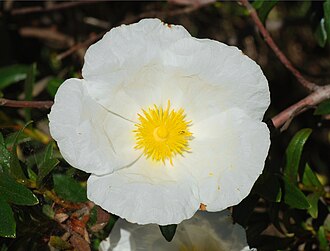
图:Alvesgaspar · CC BY-SA 3.0 · Wikimedia Commons
- 学名
- Cistus
- 分类等级
- 属
- 上级类群
- 半日花科
- 大类
- 被子植物
- 命名
- 卡尔·林奈,1753 年
- 数据库
- NCBI 分类 · GBIF
下级类群(7)
- 鼠尾草叶岩蔷薇 Cistus salviifolius 种
- Cistus albidus 种
- 岩蔷薇 Cistus ladanifer 种
- Cistus creticus 种
- 白岩蔷薇 Cistus monspeliensis 种
- Cistus laurifolius 种
- Cistus populifolius 种
百科正文
分类
该属可以分为两个演化支,其一为开紫色和粉色花的岩蔷薇(purple pink clade,PPC),另外一个是开白花的岩蔷薇(white or whitish pink clade,WWPC)。其分类如下:
除此之外,该属还包含有大量的栽培种。
以上内容摘自维基百科「岩蔷薇属」,按 CC BY-SA 4.0 使用,去掉了参考文献、外部链接等尾部小节,公式改写成了纯文本。全文、配图和出处见原文。
英文维基百科补充中文条目比较短,下面是英文条目「Cistus」的原文
Cistus (from the Greek kistos) is a genus of flowering plants in the rockrose family Cistaceae, containing about 34 species and a similar number of natural hybrids. They are perennial shrubs found on dry or rocky soils throughout the Mediterranean region, from Morocco, Spain, Italy, Greece, through to the Middle East, and also on the Canary Islands.
Cistus, with its many hybrids and cultivars, is commonly encountered as a garden flower.
The common name rock-rose or rockrose is applied to the species, a name also shared by the related genera Helianthemum and Tuberaria, all in the same family Cistaceae. The common name gum cistus is also applied to resin-bearing species, especially C. ladanifer.
Description
The leaves are evergreen, opposite, simple, usually slightly rough-surfaced, 2–8 cm long. In a few species (notably C. ladanifer), the leaves are coated with a highly aromatic resin called labdanum.
They have showy 5-petaled flowers ranging from white to purple and dark pink, in a few species with a conspicuous dark red spot at the base of each petal.
Taxonomy
Phylogeny
Cistus and Halimium form a cohesive and the most derived clade within Cistaceae. Plants of the World Online and World Flora Online treat Halimium as a synonym of Cistus. Molecular phylogenetic analyses conducted between 2005 and 2011 confirm that Cistus species divide into two well-defined clades, neither of which was fully resolved internally. The first clade consists of those with purple and pink flowers (the "purple pink clade" or PPC). The second clade consists of those with white flowers or, in the case of Cistus parviflorus, pale pink flowers (the "white or whitish pink clade" or WWPC). Although the flower colour of C. parviflorus is anomalous, it has very short styles, otherwise characteristic of WWPC species. A hybrid origin has been suggested. A simplified cladogram is shown below:
Within the purple pink clade (PPC), C. crispus is consistently the first diverging species. C. albidus, C. creticus and C. heterophyllus form a well supported clade. Seven species endemic to the Canary Islands form a polytomy, resolved differently in different analyses, in which subtaxa of some species do not always cluster together. Within the white and whitish pink clade (WWPC), there is weak support for a clade consisting of C. clusii and C. munbyi; the other species either formed part of a polytomy or resolved differently in different analyses. Halimium and Cistus were regularly shown to be paraphyletic with respect to one another.
Ecology
They are thermophilous plants, which require open, sunny places. This plant genus is peculiar in that it has developed a range of specific adaptations to resist summer drought and frequent disturbance events, such as fire and grazing. In addition, it can form both ectomycorrhizas and arbuscular mycorrhizas. More than 200 ectomycorrhiza-forming fungal species belonging to 40 genera have been reported so far to be associated with Cistus. As with many other Cistaceae, the species of Cistus have the ability to form mycorrhizal associations with truffles (Tuber) and are thus able to thrive on poor sandy soils or rocks. Cistus ladanifer has been found to have mycorrhizal associations with Boletus edulis, Boletus rhodoxanthus, and Laccaria laccata.
Cistus are the only host of Cytinus hypocistis, a small parasitic plant that lives on the roots and is noticeable only for a short period of time when in flower. The presence of the parasite does not seem to harm the host population.
Cistus species are used as food plants by the larvae of some Lepidoptera species including Coleophora confluella and Coleophora helianthemella, the latter recorded on Cistus monspeliensis.
Various Cistus species are known to emit volatile oils, rendering the plants flammable. Their emission of these essential oils is a genetic adaptation for the species intended to actually promote flammability and even cause spontaneous combustion. Cistus plants are therefore considered pyrophytes, or plants which rely upon fire as a part of their life cycle to encourage spread within their biome.
Cultivation
Cistuses are suitable for sunny gardens with a nearly frost-free Mediterranean climate. The hardiest of the species is C. laurifolius, which survived the hard frost at Royal Botanical Gardens at Kew in 1895 that eliminated all the cistuses save this and two white-flowered natural hybrids, C. × corbariensis, already grown by John Tradescant the Elder, and C. × loretii, a 19th-century introduction.
以上节选摘自英文维基百科「Cistus」,按 CC BY-SA 4.0 使用,去掉了参考文献、外部链接等尾部小节,公式改写成了纯文本。篇幅所限,较长的小节只摘了开头一部分,有的小节没有收;全文、配图和出处见原文。