 格物
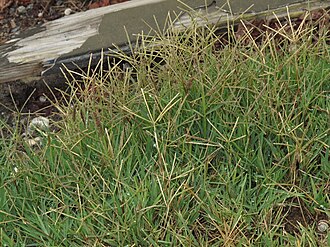
图:Robert Flogaus-Faust · CC BY 4.0 · Wikimedia Commons
- 学名
- Cynodon dactylon
- 分类等级
- 种
- 上级类群
- 狗牙根属
- 大类
- 被子植物
- 命名
- 克里斯蒂安·亨德里克·佩尔松,1805 年
- 中文别名
- 绊根草、爬根草、咸沙草、铁线草
- 用途
- 饲料、药用植物
- 数据库
- NCBI 分类 · GBIF
百科正文
形态
狗牙根秆常匍匐地面上,节着土易生根,初夏抽花穗时,秆始上伸,顶生3-6枚穗状花序排成指状,夏秋开花。
分布
百慕大草原产热带非洲,世界各地皆有普及分布于原野及平原地区。台湾亦有原生种恒春狗牙根。
用途
狗牙根为家畜的优良饲料,根状茎供药用,可清血。因其根状茎蔓延力强,常用以铺建草坪,或栽于堤岸上保土固堤。
以上内容摘自维基百科「狗牙根」,按 CC BY-SA 4.0 使用,去掉了参考文献、外部链接等尾部小节,公式改写成了纯文本。全文、配图和出处见原文。
英文维基百科补充中文条目比较短,下面是英文条目「Cynodon dactylon」的原文
Cynodon dactylon, commonly known as Bermuda grass or as couch grass in Australia and New Zealand, is a warm season grass found worldwide in warm and tropical climates. It is native to Europe, Africa, Australia, and much of Asia and has been introduced to the Americas.
Despite its common name, C. dactylon is not native to Bermuda but is an abundant invasive species there. In Bermuda, it has been known as crabgrass, also a name for Digitaria sanguinalis.
Interspecific hybrids occur naturally through cross-pollination, but cultivars are also developed by selecting individual plants with desirable traits from seeded or vegetatively propagated stands. These cultivars are typically triploids with three sets of chromosomes.
Description
The blades are grey-green in color and short, usually 2–15 cm (0.79–5.91 in) long with rough edges. The erect stems can grow 1–30 cm (0.39–11.81 in) tall. The stems are slightly flattened, often white or green, and occasionally tinged purple in colour.
The seed heads are produced in a cluster of two to six spikes together at the top of the stem, each spike 2–5 cm (0.79–1.97 in) long.
Cynodon dactylon has a deep root system. When grown in penetrable soil under drought conditions, its roots can grow to over 2 metres (6.6 ft) deep, though most of the root mass is less than 60 centimetres (24 in) under the surface. The grass creeps along the ground with its stolons and roots wherever a node touches the ground, forming a dense mat. C. dactylon reproduces through seeds, stolons, and rhizomes.
The grass starts actively growing at temperatures above 15 °C (59 °F) with ideal growth between 24 and 37 °C (75 and 99 °F); in winter or in the dry season, the grass becomes dormant and turns light brown.
Cultivation
Cynodon dactylon is widely cultivated in warm climates all over the world between about 30° S and 30° N latitude, and in regions that receive between 625 and 1,750 mm (24.6 and 68.9 in) of rainfall a year, or less, if irrigation is available. For example, in the United States, it is grown mostly in the southern half of the country.
Cultivars
Hundreds of cultivars have been created specifically for environmental tolerance and stakeholder requirements. New cultivars are released annually.
Uses
Religious
In Hinduism, it is considered important in the worship of Lord Ganesha. A unique festival called Durga Ashtami, dedicated to this grass, is celebrated on the eighth day of the Navratri festival.
It is known as arugampull in Tamil, garikēhullu in Kannada and karuka in Malayalam, and is part of the Dashapushpam (ten sacred flowers) in Kerala.
In Nepal, the grass is known as dubo. For Nepalese Hindus, it symbolizes long life and is essential for the Naga Panchami and Gaura festivals. In a Nepalese Hindu wedding, a garland made of this grass is worn by the bride and groom.
Folk medicine
In Mexico, the plant may have been used during the 20th century as a decoction intended to treat various illnesses.
Other
Bermuda grass is fast-growing and tough, making it a popular choice for sports fields because it will recover quickly when damaged. It is a highly desirable turfgrass in warm temperate climates, particularly in hot and dry regions where it will survive while other grass species cannot.
Ecology
Invasive species
Bermuda grass can be a highly aggressive invasive species, crowding out most other grasses and invading other habitats, and has become a hard-to-eradicate weed in some areas. It can be controlled somewhat with triclopyr, mesotrione, fluazifop-p-butyl, and glyphosate.
This weedy nature leads some gardeners to give it the name of devil grass. Bermuda grass is incredibly difficult to control in flower beds, and most herbicides do not work. However, Ornamec, Ornamec 170, Turflon ester (tricyclopyr), and Imazapyr have shown some effectiveness. All of these items are difficult to find in retail stores, as they are primarily marketed to professional landscapers.
Toxicity
The hybrid variety Tifton 85, like some other grasses (e.g. sorghum), produces cyanide under certain conditions, and has been implicated in several livestock deaths.
Density of Cynodon
Cynodon dactylon is an aggressive grass that can be difficult to remove once established, so it is best suited for areas where a permanent, fast-growing ground cover is wanted. It can also regrow if planted again in fertile soil.
以上节选摘自英文维基百科「Cynodon dactylon」,按 CC BY-SA 4.0 使用,去掉了参考文献、外部链接等尾部小节,公式改写成了纯文本。篇幅所限,较长的小节只摘了开头一部分,有的小节没有收;全文、配图和出处见原文。