 格物
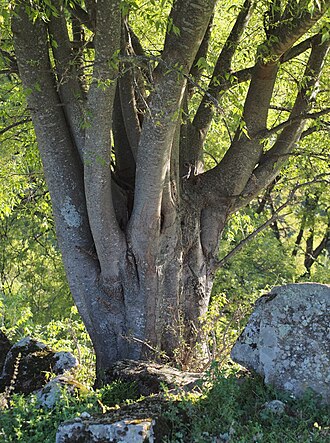
图:Luis Fernández García · CC BY-SA 4.0 · Wikimedia Commons
- 学名
- Celtis australis
- 分类等级
- 种
- 上级类群
- 朴属
- 大类
- 被子植物
- 命名
- 卡尔·林奈,1753 年
- 保护状况(IUCN)
- 无危物种
- 数据库
- NCBI 分类 · GBIF · IUCN 红色名录
百科正文
形态特征
树高可达25米(温带地区常见10米)。树皮光滑呈灰色,状似象皮。叶互生,窄长具锐齿,长5-15公分,叶面皱褶、叶背被绒毛,全年呈暗灰绿色,秋季转淡黄后凋落。花为两性的无花瓣风媒花,细小呈绿色,单生或簇生。果实为深紫色核果状小浆果,直径1公分,成短簇下垂,可食用,极受鸟类与野生动物喜爱。
历史
本种被认为是古典文献中记载的“忘忧树”,其果实被希罗多德、迪奥斯科里德斯与泰奥弗拉斯托斯描述为甘美怡人且有益健康。荷马史诗《奥德赛》第九卷描述的“食莲者”即与此树相关。
因寿命长且耐空气污染,常作为观赏树种。果实可鲜食或加工,叶与果具收敛、镇痛、健胃功效,煎剂用于治疗闭经、月经过多及腹痛,亦可用于止泻、痢疾与消化道溃疡。树皮可提取黄色染料。木材坚韧富弹性,广泛用于车削工艺;细长柔韧的枝条可制手杖。
栽培
适宜排水良好的轻质(沙质)至中等(壤质)土壤,耐贫瘠与干旱但不耐阴。虽适应地中海气候,亦可耐受寒冷气候(USDA抗寒分区7B)。12世纪农学家伊本·阿瓦姆于《农业之书》详述其栽培技术。
俗称
各地对本树的称呼包括:
贸易名称:nettle wood、brimji
著名植株
法国普罗旺斯Fox-Amphoux村教堂前有一株1550年种植的巨树,2013年测得树高18米,胸围5米。伊斯兰传统视朴树为圣树,其木材制护身符用于驱魔。耶路撒冷圣殿山上的朴树据称为全球最古老。丁尼生诗作《食莲人》描写其果实与致幻效果。
次级代谢物
叶含丰富黄酮类化合物C-糖苷。意大利北部幼叶酚类含量最高,五月中旬后显著下降,此趋势影响咖啡酸衍生物与黄酮类含量。
以上内容摘自维基百科「歐洲朴」,按 CC BY-SA 4.0 使用,去掉了参考文献、外部链接等尾部小节,公式改写成了纯文本。全文、配图和出处见原文。
英文维基百科补充中文条目比较短,下面是英文条目「Celtis australis」的原文
Celtis australis, the European nettle tree, European hackberry, Mediterranean hackberry, lote tree, southern nettle tree, or honeyberry, is a deciduous tree native to Southern Europe, North Africa, and Asia Minor.
Description
The tree can grow to 25 metres (82 ft) in height, though 10 m (33 ft) is more common in cooler climates. The bark is smooth and grey, almost elephantine.
The alternate leaves are narrow and sharp-toothed, rugose above and tomentose below, 5–15 centimetres (2–6 in) long and dark grey/green throughout the year, fading to a pale yellow before falling in autumn.
The apetalous wind-pollinated flowers are perfect (hermaphrodite, having both male and female organs), small and green, either singly or in small clusters.
The fruit is a small, dark-purple berry-like drupe, 1 cm wide, hanging in short clusters.
Distribution and habitat
The plant prefers light well-drained (sandy) and medium (loamy) soils, including those nutritionally poor; it can tolerate drought but not shade. The Mediterranean climate is especially suitable for the plant but it can tolerate colder climate (USDA Zone 7B). An article on Nettle tree cultivation is brought down in Ibn al-'Awwam's 12th-century agricultural work, Book on Agriculture.
Archaeological evidence which supports the opinion that the tree is native to the Levant; Celtis australis seeds were discovered at an Iron Age dig in Tel Rehov, Israel. Wooden shards from the tree were also discovered there, as well as at Tel Jezreel, another site in Israel. The tree still grows wild in many places in the country, and is one of the many trees used for public landscaping in Tel Aviv.
The species likes to stand with a mix of other kinds of trees, in wooded ravines, by streams. It thrives anywhere from sea level to 1,200 metres.
The tree was introduced to England in 1796.
Ecology
The drupes are extremely popular with birds and other wildlife. Its diminutive, green-tinted flowers also attract pollinators.
Uses
Trade names for the species include nettle wood and brimji. It is often planted as an ornamental as it is long-living and resistant to air pollution.
The fruit is sweet and edible raw or cooked. The leaves and fruit are astringent, lenitive, and stomachic. A decoction of both the leaves and fruit is used in the treatment of amenorrhoea, heavy menstrual and inter-menstrual bleeding, and colic. The decoction can also be used to astringe the mucous membranes in the treatment of diarrhea, dysentery, and peptic ulcers. A yellow dye is obtained from the bark.
The wood is very tough, pliable, durable, and widely used by turners; the flexible, thin shoots are used as walking sticks.
Secondary metabolites
The leaves of Celtis australis are a rich source of flavonoid C-glycosides. Young leaves of C. australis from Northern Italy were found to contain the highest amounts of phenolics per gram dry weight. Amounts rapidly decreased until mid-May and after this date the level of phenolics fluctuated but showed no discernible trend. This general trend of high amounts of phenolics in the early growing season and a fast decline affected both caffeic acid derivatives and flavonoids.
In culture
Celtis australis is supposed to have been the Lotus of the ancients, whose fruit Herodotus, Dioscorides, and Theophrastus describe as sweet, pleasant, and wholesome. Homer has Ulysses refer to the "Lotus-eaters" and the "lotus" in Odyssey, Book IX.
In Islamic tradition, hackberry trees are considered holy and amulets made from their wood are employed to exorcise demons. The hackberry trees on the Temple Mount in Jerusalem are said to be the oldest in the world.
A large specimen planted in 1550 stands before the church in the village perché of Fox-Amphoux in the Provence region of southern France. The tree was 18 m (59 ft) in height with a circumference at breast height of 5 m in 2013.
The fruit and its effects are described in Alfred Tennyson's poem The Lotos-Eaters.
以上内容摘自英文维基百科「Celtis australis」,按 CC BY-SA 4.0 使用,去掉了参考文献、外部链接等尾部小节,公式改写成了纯文本。全文、配图和出处见原文。