 格物
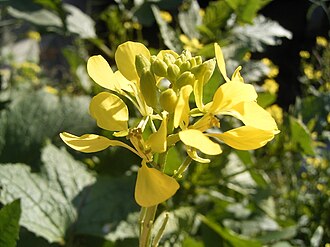
图:No machine-readable author provided. TeunSpaans assumed (bas… · CC BY 2.5 · Wikimedia Commons
- 学名
- Sinapis arvensis
- 分类等级
- 种
- 上级类群
- 白芥属
- 大类
- 被子植物
- 命名
- 卡尔·林奈,1753 年
- 数据库
- NCBI 分类 · GBIF
百科正文
形态特征
新疆白芥株高通常20-80公分,在理想条件下可超过1米。茎直立、分枝且具纵棱,基部被粗硬毛。叶柄长1-4公分,基生叶呈长圆形至羽裂状,长4-18公分,宽2-5公分;茎生叶较小,近无柄但不呈耳状抱茎。在英国花期5-9月。总状花序由黄色四瓣花组成,萼片开展。长角果长3-5公分,喙长1-2公分,具3-5脉。种子深红或褐色,直径1-1.5毫米。
植物化学
含芥子苷类化合物如白芥子苷。种子含赤霉素,可影响种子休眠。
分类
1753年由卡尔·林奈在《植物种志》第668页正式描述。
词源
旧属名Sinapis源自古希腊语"sinapi"(芥子),种加词"arvense"意为"田野生长的"。
分布
原产地中海盆地,现广布于北美、南美、澳大利亚等地。
生态
蜜蜂(如Andrena agilissima)和蝇类为其传粉者。在加利福尼亚州被列为高危入侵物种。
用途
- 嫩叶可作野菜
- 种子可制芥末
- 种子油曾用于机械润滑
- 爱尔兰大饥荒期间作为救荒食物
以上内容摘自维基百科「新疆白芥」,按 CC BY-SA 4.0 使用,去掉了参考文献、外部链接等尾部小节,公式改写成了纯文本。全文、配图和出处见原文。
英文维基百科补充中文条目比较短,下面是英文条目「Rhamphospermum arvense」的原文
Rhamphospermum arvense, (syns. Brassica arvensis and Sinapis arvensis) the charlock, sometimes also called field mustard, wild mustard, or charlock mustard, is an annual or winter annual plant in the family Brassicaceae. It is found in the fields of North Africa, Asia, Europe, and some other areas where it has been transported and naturalised. Pieris rapae, the small white butterfly, and Pieris napi, the green veined white butterfly, are significant consumers of charlock during their larval stages.
Description
Charlock reaches on average 20–100 cm (8–39 in) in height, but under optimal conditions can exceed one metre. The stems are erect, branched or unbranched, striated, with coarse spreading hairs especially near the base. The leaves are petiolate (stalked) with a 1–4 cm (0.4–1.6 in) petiole. The basal leaves are oblong, oval, lanceolate, lyrate, pinnatifid to dentate, 4–18 cm (1.6–7.1 in) long, 2–5 cm (0.8–2.0 in) wide. The cauline leaves are much reduced and are short petiolate to sessile but not auriculate-clasping. It blooms from May to September, or May to August, in the UK. The inflorescence is a raceme made up of yellow flowers having four petals 6–13 mm long, with spreading sepals just over half the length of the petals. The fruit is a silique 2.5–5 cm long with a beak 0.7–2 cm long that is flattened-quadrangular. The valves of the silique are glabrous or rarely bristly, three to five nerved. The seeds are dark red or brown, smooth 1-1.5 mm in diameter.
Taxonomy
It was formally described by the Swedish botanist Carl Linnaeus in his seminal publication 'Species Plantarum' on page 668 in 1753.
It is commonly known as charlock, or sometimes as charlock mustard, field mustard, or wild mustard.
Etymology
The former generic name Sinapis derives from the Greek word sinapi meaning 'mustard' and was the old name used by Theophrastus for any mustard. The specific epithet arvense is a Latin adjective meaning 'from/of the field'.
Distribution
A native of the Mediterranean basin, from temperate regions of North Africa, Europe and parts of Asia. It has also become naturalised throughout much of North America, South America, Australia, Japan and South Africa.
Range
It is found in North Africa, within Algeria, Egypt, Libya, Morocco and Tunisia. Within Asia, it is found in Arabian Peninsula (in Kuwait, Oman, Qatar, Saudi Arabia and the United Arab Emirates), Armenia, Azerbaijan, the Caucasus, China, Georgia, Iran, Iraq, Israel, Jordan, Kazakhstan, Kyrgyzstan, Lebanon, Siberia, Syria, Tajikistan, Turkmenistan and Uzbekistan. It is also found in tropical Pakistan. In eastern Europe, it is found within Belarus, Estonia, Latvia, Lithuania, Moldova and Ukraine. In middle Europe, it is in Austria, Belgium, the Czech Republic, Germany, Hungary, the Netherlands, Poland, Slovakia and Switzerland. In northern Europe, in Denmark, Finland, Ireland, Norway, Sweden and the United Kingdom.
Habitat
It grows in the plains and mountains, in pastures, fields, roadsides, waste places (such as railways, tips, and waste ground), and ruins, but mainly in cultivated places. It prefers calcareous soils in sunny places, at an altitude of 0–1,400 m (0–4,600 ft) above sea level.
Ecology
The flowers are pollinated by various bees like Andrena agilissima and flies (entomophily). Rhamphospermum arvense is the host plant of the caterpillars of some Lepidoptera, such as the small white, Pieris rapae. The seeds are toxic to most animals, except birds, and can cause gastrointestinal problems, especially if consumed in large quantities.
It is a highly invasive species in states such as California.
Uses
Charlock leaves are edible at the juvenile stage of the plant; they are usually boiled, such as in 18th century, in Dublin, where it was sold in the streets. During the Great Famine of Ireland, wild mustard was a common famine food, even though it often caused stomach upset. Once the seeds are ground, they produce a kind of mustard.
A type of oil can be extracted from the seed which has been used for lubricating machinery.
As ruminant feed
Grazing charlock at growing and flowering stages is harmless for cattle and sheep. Poisoning can occur in the same animals when fed with older seed-bearing plants. This can occur when wild mustard grows as a weed in green-fed rapeseed or cereals. Accidental consumption of charlock oil can also be the cause of reported intoxications.
以上节选摘自英文维基百科「Rhamphospermum arvense」,按 CC BY-SA 4.0 使用,去掉了参考文献、外部链接等尾部小节,公式改写成了纯文本。篇幅所限,较长的小节只摘了开头一部分,有的小节没有收;全文、配图和出处见原文。