 格物
- 学名
- Macadamia
- 分类等级
- 属
- 上级类群
- 山龙眼科
- 大类
- 被子植物
- 命名
- 费迪南德·冯穆勒,1858 年
- 数据库
- NCBI 分类 · GBIF
下级类群(2)
百科正文
澳大利亚坚果属(学名:Macadamia,又名澳大利亚坚果(仁)、澳大利亚坚果、澳大利亚核桃、昆士兰山龙眼、夏威夷火山豆、夏威夷豆),是山龙眼科植物的一属,共包括九个种。澳大利亚坚果广泛分布于澳大利亚东部(七个种)、新喀里多尼亚(New Caledonia,一个种M. neurophylla)及印度尼西亚苏拉威西岛(一个种M. hildebrandii)。
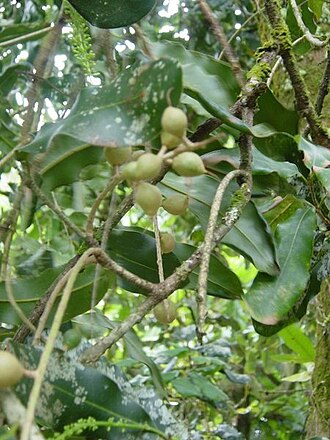
澳大利亚坚果是2-12米高的常绿乔木,叶片3-6轮排列,椭圆或倒卵形,6-30厘米长,2-13厘米阔,边缘有锯齿。花为细长的总状花序,单个花长10-15毫米,白色至分红或紫色,有四片被片。果实为坚硬的木质小球,有一个明显的顶点,内含1-2个种子,种子可供食用。台湾于1910年代引进林业试验场台北苗圃作为标本树栽植,1931年又从夏威夷引入种子和实生苗500株在嘉义林业试验支场栽种。1940年原岭南大学引种澳大利亚坚果于广州。另外澳大利亚坚果难以弄开,所以大部分厂商会附赠开罐器。
食用价值
澳大利亚坚果含油量高达70%以上,富含不饱和脂肪酸,还含有丰富的钙,磷,铁,维生素B1、B2和人体必需的8种氨基酸。同时由于热量过高,每日食用3~5颗即可,过量摄入可能会引起肥胖等问题。
以上内容摘自维基百科「澳洲坚果属」,按 CC BY-SA 4.0 使用,去掉了参考文献、外部链接等尾部小节,公式改写成了纯文本。全文、配图和出处见原文。
英文维基百科补充中文条目比较短,下面是英文条目「Macadamia」的原文
Macadamia is a genus of four species of trees in the flowering plant family Proteaceae. They are indigenous to Australia—specifically, northeastern New South Wales and central and southeastern Queensland. Two species of the genus are commercially important for their fruit, the macadamia nut (or simply macadamia). Global production in 2025 was 344,000 tonnes (379,000 short tons). Other names include Queensland nut, bush nut, maroochi nut or bauple nut. It was an important source of bushfood for the Aboriginal peoples.
The nut was first commercially produced on a wide scale in Hawaii, where Australian seeds were introduced in the 1880s, and which for more than a century was the world's largest producer. South Africa has been the world's largest producer of the macadamia since the 2010s.
The macadamia is the only widely grown food plant that is native to Australia.
Description
Macadamia is a genus of evergreen trees that grows 2–12 m (7–40 ft) tall.
The leaves are arranged in whorls of three to six, lanceolate to obovate or elliptic in shape, 60–300 mm (2+1⁄2–12 in) long and 30–130 mm (1+1⁄8–5+1⁄8 in) broad, with an entire or spiny-serrated margin. The flowers are produced in a long, slender, and simple raceme 50–300 mm (2–12 in) long, the individual flowers 10–15 mm (3⁄8–9⁄16 in) long, white to pink or purple, with four tepals.
Taxonomy
Species
Nuts from M. jansenii and M. ternifolia contain cyanogenic glycosides. The other two species are cultivated for the commercial production of macadamia nuts for human consumption.
Previously, more species with disjunct distributions were named as members of this genus Macadamia. Genetics and morphological studies published in 2008 show they have separated from the genus Macadamia, correlating less closely than thought from earlier morphological studies.
Cultivation
The macadamia tree is usually propagated by grafting. It does not begin to produce commercial quantities of seeds until it is 7–10 years old, but once established, it may continue bearing for over 100 years. Macadamias prefer fertile, well-drained soils, a rainfall of 1,000–2,000 mm (40–80 in), and temperatures not falling below 10 °C (50 °F) (although once established, they can withstand light frosts), with an optimum temperature of 25 °C (80 °F).
Production
In 2024, South Africa was the leading producer of macadamia nuts, with 87,000 tonnes, up from 77,000 tonnes in 2023 and 54,000 tonnes out of global production of 211,000 tonnes in 2018. Macadamia is commercially produced in many countries of East Africa, Southeast Asia, South America, Australia, and North America having Mediterranean, temperate or tropical climates.
Toxicity
Nuts from M. jansenii and M. ternifolia contain cyanogenic glycosides.
Allergen
Macadamia allergy is a type of food allergy to macadamia nuts which is relatively rare, affecting less than 5% of people with tree nut allergy in the United States. Macadamia allergy can cause mild to severe allergic reactions, such as oral allergy syndrome, urticaria, angioedema, vomiting, abdominal pain, asthma, and anaphylaxis.
Uses
Nutrition
Raw macadamia nuts are 1% water, 14% carbohydrates, 76% fat, and 8% protein (table). In a reference amount of 100 g (3.5 oz), macadamia nuts provide 740 kilocalories of food energy, and are a rich source (20% or more of the Daily Value, DV) of thiamine, iron, magnesium, and manganese, with other B vitamins and dietary minerals in moderate amounts (table).
Modern history
1828
Allan Cunningham was the first European to encounter the macadamia plant in Australia.
1857–1858
German-Australian botanist Ferdinand von Mueller named the genus Macadamia after his friend John Macadam, a noted scientist and secretary of the Philosophical Institute of Australia.
1858
'Bauple nuts' were discovered in Bauple, Queensland; they are now known as macadamia nuts.
以上节选摘自英文维基百科「Macadamia」,按 CC BY-SA 4.0 使用,去掉了参考文献、外部链接等尾部小节,公式改写成了纯文本。篇幅所限,较长的小节只摘了开头一部分,有的小节没有收;全文、配图和出处见原文。