 格物
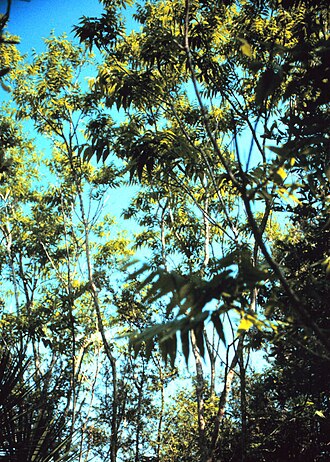
图:Public domain · Wikimedia Commons
- 学名
- Sapindus
- 分类等级
- 属
- 上级类群
- 无患子科
- 大类
- 被子植物
- 命名
- 卡尔·林奈,1753 年
- 数据库
- NCBI 分类 · GBIF
下级类群(3)
百科正文
学名Sapindus是saponis indicus的缩写,意思是“印度的肥皂”,因为它那厚肉质状的果皮含有皂素,只要用水搓揉便会产生泡沫,可用于清洗,是古代的主要清洁剂之一。目前已知约有13个物种,分布于亚洲、美洲和大洋洲。中国产于长江流域以南,沿岸岛屿等等地方。
种类与分布
川滇无患子 Sapindus delavayi,中国、印度
Sapindus drummondii(异名S. saponaria var. drummondii),Western Soapberry,美国南部、墨西哥
Sapindus emarginatus,南亚
Sapindus marginatus,Florida Soapberry,佛罗里达州、南卡罗来纳;一些作者认为此种包含在S. saponaria内
Sapindus oahuensis,Hawaii Soapberry或Ionomea,夏威夷(特有种)
- 毛瓣无患子 Sapindus rarak,东南亚
- 毛瓣无患子 Sapindus rarak var. rarak
- 石屏无患子 Sapindus rarak var. velutinus
无患子 Sapindus saponaria,印度、中南半岛、中国南部、日本、朝鲜半岛;美国南部、佛罗里达礁岛群、夏威夷、加勒比海、中美洲、乔治亚州亦有引进种植
绒毛无患子 Sapindus tomentosus,中国
三叶无患子 Sapindus trifoliatus,South India Soapnut或Three-leaf Soapberry,印度南部、巴基斯坦
以上内容摘自维基百科「无患子属」,按 CC BY-SA 4.0 使用,去掉了参考文献、外部链接等尾部小节,公式改写成了纯文本。全文、配图和出处见原文。
英文维基百科补充中文条目比较短,下面是英文条目「Sapindus」的原文
Sapindus is a genus of about thirteen species of shrubs and small trees in the maple and lychee family, Sapindaceae and tribe Sapindeae. It is native to warm temperate to tropical regions of the world. The genus includes both deciduous and evergreen species. Members of the genus are commonly known as soapberries or soapnuts because the pulp of the fruit is used to make soap and shampoo. The generic name is derived from the Latin words sapo, meaning "soap", and indicus, meaning "of India".
The leaves are alternate, 15–40 cm (5.9–15.7 in) long, pinnate (except in S. oahuensis, which has simple leaves), with 14–30 leaflets, the terminal leaflet often absent. The flowers form in large panicles, each flower small, creamy white. The fruit is a small leathery-skinned drupe 1–2 cm (0.4–0.8 in) in diameter, yellow ripening blackish, containing one seed. Fossils date back to the Cretaceous.
Ecology
Sapindus species are used as food plants by the larvae of some Lepidoptera (moths and butterflies) species including Endoclita malabaricus. Kernel extracts of soapnut disrupt the activity of enzymes of larvae and pupae and inhibit the growth of the mosquito Aedes aegypti, an important vector of viral diseases.
Uses
The drupes (soapnuts) contain saponins, which have surfactant properties, being used for washing by ancient Asian and American peoples. A number of other uses for Sapindus have also been reported such as making arrows from the wood and decorative objects from the seeds.
Folk medicine
Leaf and fruit extracts of Sapindus have historically been used in folk remedies to treat various conditions.
Dyeing process
Soapnut is used as a scouring agent for preparation of coloring fibers such as the yarn of Tussar silk and cotton.
Species
Formerly placed here
- Lepisanthes fruticosa (Roxb.) Leenh. (as S. fruticosus Roxb.)
- Lepisanthes senegalensis (Juss. ex Poir.) Leenh. (as S. senegalensis Juss. ex Poir.)
- Lepisanthes tetraphylla (Vahl) Radlk. (as S. tetraphylla Vahl)
- Talisia cerasina (Benth.) Radlk. (as S. cerasinus Benth.)
- Talisia esculenta (A.St.-Hil.) Radlk. (as S. esculenta A.St.-Hil.)
以上内容摘自英文维基百科「Sapindus」,按 CC BY-SA 4.0 使用,去掉了参考文献、外部链接等尾部小节,公式改写成了纯文本。全文、配图和出处见原文。