 格物
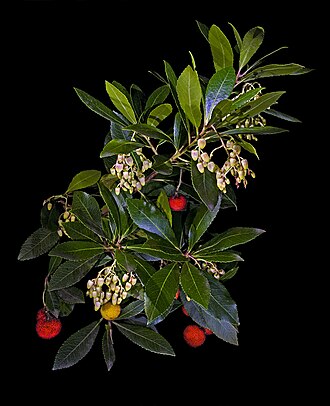
图:Didier Descouens · CC BY-SA 4.0 · Wikimedia Commons
- 学名
- Arbutus unedo
- 分类等级
- 种
- 上级类群
- 草莓树属
- 大类
- 被子植物
- 命名
- 卡尔·林奈,1753 年
- 保护状况(IUCN)
- 无危物种
- 数据库
- NCBI 分类 · GBIF · IUCN 红色名录
百科正文
形态
草莓树的高度在5—10米(16—33英尺)之间,最高可达15米(49英尺)。每十二个月结红色浆果,种子由吃浆果的鸟类传播。果实表皮粗糙,可以食用,但口感并不好。其种加词“unedo”来自古罗马作家老普林尼所说的“unum edo”,意思是“我吃过一个”但由于味道不好而再没有吃第二个。
以上内容摘自维基百科「草莓樹」,按 CC BY-SA 4.0 使用,去掉了参考文献、外部链接等尾部小节,公式改写成了纯文本。全文、配图和出处见原文。
英文维基百科补充中文条目比较短,下面是英文条目「Arbutus unedo」的原文
Arbutus unedo, commonly known as strawberry-tree, or strawberry tree, also called madroño in Spanish, is an evergreen shrub or small tree in the family Ericaceae, native to the Mediterranean Basin and Western Europe. The tree is well known for its fruit, the arbutus berry, which bears some resemblance to the strawberry, hence the common name strawberry-tree. However, it is not closely related to true strawberries of the genus Fragaria.
Its presence in Ireland also lends it the name Irish strawberry-tree, or cain, or cane apple, from the Irish name for the tree, caithne, or sometimes Killarney strawberry-tree. The strawberry-tree is the national tree of Italy because of its green leaves, its white flowers and its red berries, colours that recall the Italian flag. The flower is the national flower of Italy.
Taxonomy
Arbutus unedo was one of the many species described by Carl Linnaeus in Volume One of his landmark 1753 work Species Plantarum, giving it the name it still bears today.
It is monotypic, with no subspecies or varieties accepted. A red-flowered variant was named A. unedo var. rubra by William Aiton in 1785; it is not now considered botanically distinct.
A study published in 2001 which analysed ribosomal DNA from Arbutus and related genera found Arbutus to be paraphyletic, and A.
Description
Arbutus unedo grows to 4–7 m (13–23 ft) tall, rarely up to 13 m (45 ft), with a trunk diameter of up to 120 cm (47 in). It grows in hardiness zones 7–10.
The twigs are reddish-brown and abundantly leafy, and often have small hairs. The leaves are green and glossy on the upper side, dull on the underside, 5–10 cm (2–4 in) long and 1.5–4 cm (1–2 in) broad, laurel-like and usually with a serrated or serrulated margin, rarely entire.
Distribution
Arbutus unedo is widespread in the Mediterranean region, in Portugal, Spain, western and southeastern France; southward in Algeria, Morocco, Libya, and Tunisia, and eastward in Albania, Bulgaria, Croatia, Greece, Italy, Malta, Montenegro, Slovenia, Turkey, Israel, Palestine, Jordan, Lebanon, and Syria. It is naturalised in Great Britain and Ireland, being particularly common in western Ireland, where it is an archaeophyte that was formerly believed to be native.
Cultivation
Arbutus unedo is quite an easy plant to cultivate, and is adaptable to many climates. Once established it is fairly drought resistant, frost resistant, shade tolerant and salt tolerant.
Lower production of fruit mass has however been reported in case of summer droughts, and frosts in flowering time were seen to decrease the amount of fruit.
Uses
Culinary uses
Arbutus berries have a high content of sugars (40%), and antioxidant vitamins such as vitamin C, beta-carotene, niacin, tocopherols, and organic acids that are precursors to omega-3 and omega-6 fatty acids (nearly 9%). They are edible fresh, but seldom consumed in that state - not least because the mature fruit tends to bruise very easily, making transportation difficult.
They are used mostly for jam, marmalades, yogurt and alcoholic beverages, such as the Portuguese medronho, a type of strong brandy.
History
Its Mediterranean habitat, elegant details of leaf and habit and dramatic show of fruit with flowers made Arbutus unedo notable in Classical Antiquity, when it was called Andrachne, and for which Theophrastos (4th c. BCE) wrote about it, as well as the ancient army medical herbalist Pedanios Dioscorides [De Materia Medica, Book II-150]; in addition, Pliny thought it should not be planted where bees are kept, for the bitterness it imparts to honey.
Symbolic uses
Ancient history
The tree is mentioned by Roman poet Ovid, in Book I: 89–112 "The Golden Age" of his Metamorphoses: "Contented with food that grew without cultivation, they collected mountain strawberries and the fruit of the strawberry-tree, wild cherries, blackberries clinging to the tough brambles, and acorns fallen from Jupiter's spreading oak-tree". In his Description of Greece, Pausanias associated the tree with the god Hermes.
以上节选摘自英文维基百科「Arbutus unedo」,按 CC BY-SA 4.0 使用,去掉了参考文献、外部链接等尾部小节,公式改写成了纯文本。篇幅所限,较长的小节只摘了开头一部分,有的小节没有收;全文、配图和出处见原文。