 格物
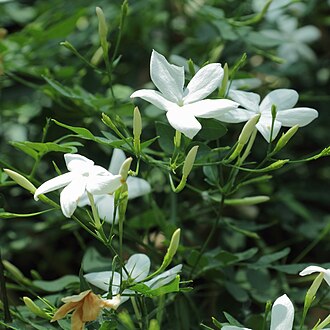
图:C T Johansson · CC BY-SA 3.0 · Wikimedia Commons
- 学名
- Jasminum officinale
- 分类等级
- 种
- 上级类群
- 素馨属
- 大类
- 被子植物
- 命名
- 卡尔·林奈,1753 年
- 中文别名
- 耶悉茗、大花素馨花、素馨子
- 用途
- 食物、医疗药物
- 数据库
- NCBI 分类 · GBIF
百科正文
种类
费欧娜(Jasminum officinale‘Siona Sunrise’)
台湾培育地点
三重社区大学 (页面存档备份,存于互联网档案馆)校长刘世伟、校务委员张明祥及林月于女士带领“三芦香花文史工作团”于新北市三重区进行培育。成功培育地点:二重疏洪道、忠孝码头、空军三重一村、三重区公所、正义国小、光荣国小、三光国小、五华国小、三重高中等地区
以上内容摘自维基百科「素方花」,按 CC BY-SA 4.0 使用,去掉了参考文献、外部链接等尾部小节,公式改写成了纯文本。全文、配图和出处见原文。
英文维基百科补充中文条目比较短,下面是英文条目「Jasminum officinale」的原文
Jasminum officinale, known as the common jasmine or simply jasmine, is a species of flowering plant in the olive family Oleaceae. It is native to the Caucasus and parts of Asia, also widely naturalized.
It is also known as summer jasmine, poet's jasmine, white jasmine, true jasmine or jessamine, and is particularly valued by gardeners throughout the temperate world for the intense fragrance of its flowers in summer. It is also the National flower of Pakistan.
Description
Jasminum officinale is a vigorous, twining deciduous climber with sharply pointed pinnate leaves and clusters of starry, pure white flowers in summer, which are the source of its heady scent. The leaf has 5 to 9 leaflets.
Etymology
The Latin specific epithet officinale means "useful".
Distribution
It is found in the Caucasus, northern Iran, Afghanistan, Pakistan, the Himalayas, Tajikistan, India, Nepal and western China (Guizhou, Sichuan, Xizang (Tibet), Yunnan). The species is also widely cultivated in many places, and is reportedly naturalized in Spain, France, Italy, Portugal, Romania, Croatia, Bosnia and Herzegovina, Montenegro, Serbia, Algeria, Florida and the West Indies.
Chemical composition
J. officinale has been found to contain alkaloids, coumarins, flavonoids, tannins, terpenoids, glycosides, emodine, leucoanthocyanins, steroids, anthocyanins, phlobatinins, essential oil and saponins.
Garden history
Jasminum officinale is so ancient in cultivation that its country of origin, though somewhere in Central Asia, is not certain. H.L. Li, The Garden Flowers of China, notes that in the third century CE, jasmines identifiable as J. officinale and J. sambac were recorded among "foreign" plants in Chinese texts, and that in ninth-century Chinese texts J. officinale was said to come from Byzantium. Its Chinese name, Yeh-hsi-ming is a version of the Persian and Arabic name.
Its entry into European gardens was most likely through the Arab-Norman culture of Sicily, but, as the garden historian John Harvey has said, "surprisingly little is known, historically or archaeologically, of the cultural life of pre-Norman Sicily". In the mid-14th century the Florentine author Boccaccio in his Decameron describes a walled garden in which "the sides of the alleys were all, as it were, walled in with roses white and red and jasmine; insomuch that there was no part of the garden but one might walk there not merely in the morning but at high noon in grateful shade." Jasmine water also features in the story of Salabaetto in the Decameron. Jasminum officinale, "of the household office" where perfumes were distilled, was so thoroughly naturalized that Linnaeus thought it was native to Switzerland. As a garden plant in London it features in William Turner's Names of Herbes, 1548.
Double forms, here as among many flowers, were treasured in the 16th and 17th centuries.
Cultivars
Numerous cultivars have been developed for garden use, often with variegated foliage. The cultivar 'Argenteovariegatum', with cream-white variegation on the leaves, has gained the Royal Horticultural Society's Award of Garden Merit.
Aromatherapy
The essential oil of Jasminum officinale is used in aromatherapy. Jasmine absolute has a heavy, sweet scent valued by perfumers. The flowers release their perfume at dusk, so flowers are picked at night and a tiny amount of oil is obtained from each blossom by solvent extraction. The result is an expensive oil which can be used in low concentrations.
Safety
Jasmine is "generally recognized as safe" (GRAS) as a food ingredient by the U.S. Food and Drug Administration.
It is unknown whether jasmine consumption affects breastmilk, as the safety and efficacy of jasmine in nursing mothers or infants has not been adequately studied. Drinking small amounts of jasmine tea likely are not harmful during nursing.
Allergic reactions to jasmine may occur.
以上内容摘自英文维基百科「Jasminum officinale」,按 CC BY-SA 4.0 使用,去掉了参考文献、外部链接等尾部小节,公式改写成了纯文本。全文、配图和出处见原文。