 格物
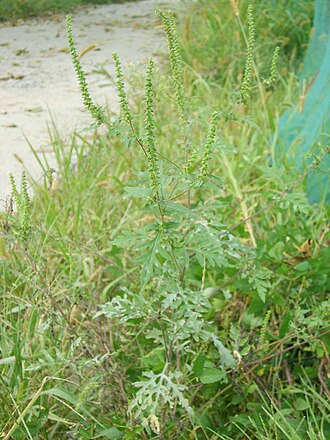
图:Dalgial · CC BY-SA 3.0 · Wikimedia Commons
- 学名
- Ambrosia artemisiifolia
- 分类等级
- 种
- 上级类群
- 豚草属
- 大类
- 被子植物
- 命名
- 卡尔·林奈,1753 年
- 中文别名
- 猪草、瘤果菊、豕草
- 数据库
- NCBI 分类 · GBIF
百科正文
在抗日战争期间,豚草的种子随着日本军队的马饲料传播到中国和亚洲大陆,已经开始泛滥,由于其极强的生命力,可以遮盖和压抑土生植物,造成原有生态系统的破坏,农业减产,消耗土地中的水分和营养,花粉造成空气污染,是一种有害植物。目前在中国东部,从东北到江南都发现豚草的入侵。尚没有任何有效的方法清除,但可以引入其天敌豚草卷蛾和广聚萤叶甲来抑制豚草的扩散。有指大气中的二氧化碳含量增加,豚草会产生更多的种子,因此随着温室气体排放量增加所造成的全球暖化,豚草将造成更大的危害。
2003年1月10日,中国国家环保总局与中国科学院联合发布的第一批“中国外来入侵物种名单” (2003环发11号)中列有豚草。
以上内容摘自维基百科「豚草」,按 CC BY-SA 4.0 使用,去掉了参考文献、外部链接等尾部小节,公式改写成了纯文本。全文、配图和出处见原文。
英文维基百科补充中文条目比较短,下面是英文条目「Ambrosia artemisiifolia」的原文
Ambrosia artemisiifolia, with the common names common ragweed, annual ragweed, and low ragweed, is a species of the genus Ambrosia native to regions of the Americas.
Taxonomy
The species name, artemisiifolia, is given because the leaves were thought to bear a resemblance to the leaves of Artemisia, the true wormwoods.
It has also been called the common names: American wormwood, bitterweed, blackweed, carrot weed, hay fever weed, Roman wormwood, short ragweed, stammerwort, stickweed, tassel weed.
Distribution
The plant is native to: North America across Canada, the eastern and central United States, the Great Plains, and in Alaska; the Caribbean on Cuba, Hispaniola, and Jamaica; and South America in the southern bioregion (Argentina, Chile, Paraguay, Uruguay), the western bioregion (Bolivia, Peru), and Brazil. The distribution of common ragweed in Europe is expected to expand northwards in the future due to climate change.
It is the most widespread species of the genus in North America, to which most of the other species of Ambrosia are endemic. During the summer it causes allergic reaction in those who are susceptible.
Description
Ambrosia artemisiifolia is an annual plant that emerges in late spring. It propagates by seed.
It is much-branched, and grows up to 70 centimetres (2.3 ft) in height. The pinnately divided soft and hairy leaves are 3–12 centimetres (1.2–4.7 in) long.
Its bloom period is July to October in North America. Its pollen is wind-dispersed, and can be a strong allergen to people with hay fever.
It produces 2–4 mm obconic green to brown fruit. It sets seed in later summer or autumn. Since the seeds persist into winter and are numerous and rich in oil, they are relished by songbirds and upland game birds.
Galls
- This species is host to the following insect-induced galls:
- Aceria ambrosiae Wilson, 1959 midge that forms bud-galls
- Asphondylia ambrosiae Gagné, 1975
- Aulacidea ambrosiaecola Ragweed stem gall wasp (see image)
- Epiblema strenuana (Walker, 1863) stem borer moth
Neolasioptera ambrosiae Felt, 1909 small stem midge.
- Procecidochares gibba (Loew, 1873) gall fly
- Rhopalomyia ambrosiae Gagné, 1975 bud gall midge
- external link to gallformers
Invasive species
Common ragweed, Ambrosia artemisiifolia, is a widespread invasive species, and can become a noxious weed, that has naturalized in Europe; temperate Asia and the Indian subcontinent; temperate northern and southern Africa and Macaronesia; Oceania in Australia, New Zealand, and Hawaii; and Southwestern North America in California and the Southwestern United States. A scientific study investigated the genomic basis of invasiveness in Ambrosia artemisiifolia, introduced to Europe in the late 19th century, by resequencing 655 ragweed genomes, including 308 herbarium specimens collected up to 190 years ago. In invasive European populations, the study found selection signatures in defense genes and lower prevalence of disease-inducing plant pathogens. Together with temporal changes in population structure associated with introgression from closely related Ambrosia species, escape from specific microbial enemies likely favored the remarkable success of common ragweed as an invasive species.
Common ragweed is a very competitive weed and can produce yield losses in soybeans as high as 30 percent. Control with night tillage reduces emergence by around 45 percent. Small grains in rotation will also suppress common ragweed if they are overseeded with clover. Otherwise, the ragweed will grow and mature and produce seeds in the small grain stubble.
Its wind-blown pollen is highly allergenic.
Chemical composition, and uses
Sesquiterpene lactones and molluscicide
Three sesquiterpene lactones isolated from the aerial parts of Ambrosia artemisiifolia were identified as psilostachyin A, psilostachyin B and psilostachyin C. All of them have some molluscicidal activity against the small tropical freshwater snail Oncomelania hupensis.
Medicinal
Ambrosia artemisiifolia has been a traditional medicinal plant for Native American tribes, including the Cherokee, Lakota, Iroquois, Dakota, and Delaware.
Historically, A. artemisiifolia was used by the Otoe Native American tribe in the Missouri River region as a remedy for nausea. It was used on the surface of the abdomen, where the patient was scarified and then dressed with the bruised leaves. It was also used by the Houma tribe in Louisiana for menstruation pain by making a tea out of the boiled roots.
Phytoremediation
Ambrosia artemisiifolia is used in phytoremediation projects remediating soil pollution, for removing heavy metals such as lead from contaminated soil.
以上节选摘自英文维基百科「Ambrosia artemisiifolia」,按 CC BY-SA 4.0 使用,去掉了参考文献、外部链接等尾部小节,公式改写成了纯文本。篇幅所限,较长的小节只摘了开头一部分,有的小节没有收;全文、配图和出处见原文。