 格物
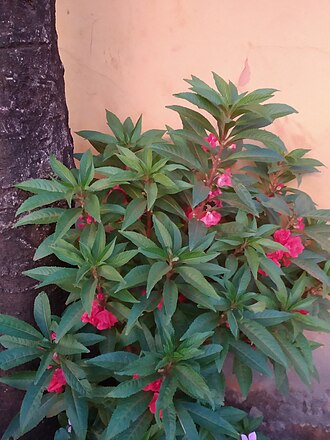
图:Florantsika · CC BY 4.0 · Wikimedia Commons
- 学名
- Impatiens balsamina
- 分类等级
- 种
- 上级类群
- 凤仙花属
- 大类
- 被子植物
- 命名
- 卡尔·林奈,1753 年
- 中文别名
- 指甲花、急性子、凤仙透骨草、透骨草、凤仙根
- 用途
- 药用植物、食物
- 数据库
- NCBI 分类 · GBIF
百科正文
形态
一年生草本。披针形的叶子互生,长约10厘米,顶端渐尖,边缘有锐齿,基部楔形;叶柄附近有几对腺体。
花期为6-8月,花二三朵同生叶腋,不整齐,花萼有一距,呈角状向下弯曲,花形似蝴蝶,花色有粉红、大红、紫、白黄、洒金等,善变异。有的品种同一株上能开数种颜色的花朵;凤仙花多单瓣,重瓣的称凤球花。
椭圆形蒴果,有白色茸毛,成熟时弹裂为5个旋卷的果瓣;种子多数,球形,黑色,状似桃形,成熟时外壳自行爆裂,将种子弹出,自播繁殖。
用途
凤仙花可供观赏;汁液可以用来染指甲。
花入药,有活血消肿的作用,治跌打损伤、毒蛇咬伤、白带等;种子入药(称“急性子”),性温、味微苦,有小毒,功能活血行瘀,主治妇女闭经、积块及骨鲠咽喉等症。
文化
琉球民谣《凤仙花》(てぃんさぐぬ花)就是以此来体现父母对子女的教导和爱以及成长的主题。
以上内容摘自维基百科「凤仙花」,按 CC BY-SA 4.0 使用,去掉了参考文献、外部链接等尾部小节,公式改写成了纯文本。全文、配图和出处见原文。
英文维基百科补充中文条目比较短,下面是英文条目「Impatiens balsamina」的原文
Impatiens balsamina, commonly known as balsam, garden balsam, rose balsam, touch-me-not or spotted snapweed, is a species of plant native to India and Myanmar.
It is an annual plant growing to 20–75 cm (7.9–29.5 in) tall, with a thick, but soft stem. The leaves are spirally-arranged, 2.5–9 cm (1.0–3.5 in) long and 1–2.5 cm broad, with a deeply toothed margin. The flowers are pink, red, mauve, purple, lilac, or white, and 2.5–5 cm diameter; they are pollinated by bees and other insects, and also by nectar-feeding birds. The ripe seed capsules undergo explosive dehiscence.
Human use
Different parts of the plant are used as traditional remedies for disease and skin afflictions. Juice from the leaves is used to treat warts and snakebite, and the flower is applied to burns. This species has been used as indigenous traditional medicine in Asia for rheumatism, fractures, and other ailments. In Korean folk medicine, this impatiens species is used as a medicine called bongseonhwa dae (봉선화대) for the treatment of constipation and gastritis. Chinese people used the plant to treat those bitten by snakes or who ingested poisonous fish. Juice from the stalk, pulverised dried stalks, and pastes from the flowers were also used to treat a variety of ailments. Vietnamese wash their hair with an extract of the plant to stimulate hair growth. One in vitro study found extracts of this impatiens species, especially of the seed pod, to be active against antibiotic-resistant strains of Helicobacter pylori. It is also an inhibitor of 5α-reductases, enzymes that converts testosterone to dihydrotestosterone (active form of testosterone), thus reducing action of testosterone in our body.
In Nepal, the balsam leaves are crushed to dye fingernails on the day of Shrawan Sakranti (Shrawan 1). The day is also observed as Luto Faalne Deen (Go Away-Itch Day). Similarly, in China and Korea, the flowers are crushed and mixed with alum to produce an orange dye that can be used to dye fingernails. Unlike common nail varnish, the dye is semi-permanent, requiring dyed nails to grow off over time in order to remove any traces of color.
Chemistry
The naphthoquinones lawsone, or hennotannic acid, and lawsone methyl ether and methylene-3,3'-bilawsone are some of the active compounds in I. balsamina leaves. It also contains kaempferol and several derivatives. Baccharane glycosides have been found in Chinese herbal remedies made from the seeds.
Ecology
It is widely cultivated as an ornamental plant, and has become naturalised and invasive on several Pacific Ocean islands.
In popular culture
Balsam flowers are referenced in the Okinawan folk song Tinsagu Nu Hana, where the way children use them to color their nails is compared to how parents color (teach and guide) the minds of their children.
The Japanese vocaloid song Housenka (鳳仙花, which translates to Impatiens balsamina) describes a person who doesn't fit in with a social group despite wanting to. In the music video, the singer laments this fate and compares herself to the plant. She references its "touch-me-not" nickname and the Hedgehog's Dilemma-esque explosive dehiscence of its seeds by saying: "Don't touch me," the balsam [says], fallen silent. And yet it can't leave seeds unless it breaks from its shell.
Hong Nan-pa's 1919 "Bongseonhwa", called Korea's first Western-style song, was named for the flower (bongseonhwa [봉선화] in Korean). In it, Hong uses the analogy of a spent I. balsamina in autumn for Korea under Japanese colonial rule, with the hope for rebirth in the spring. Several South Korean films and dramas, including the 1956 movie A Touch-Me-Not (Bongseonhwa), are also named for the flower.
以上内容摘自英文维基百科「Impatiens balsamina」,按 CC BY-SA 4.0 使用,去掉了参考文献、外部链接等尾部小节,公式改写成了纯文本。全文、配图和出处见原文。