 格物
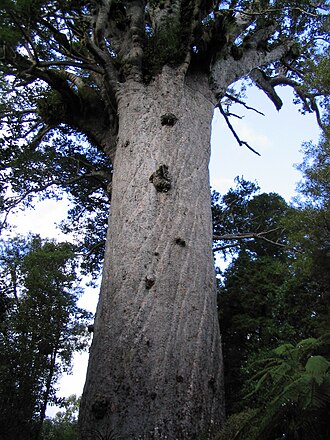
图:No machine-readable author provided. Webgoddess~commonswiki … · Public domain · Wikimedia Commons
- 学名
- Agathis australis
- 分类等级
- 种
- 上级类群
- 贝壳杉属
- 大类
- 其他植物
- 命名
- 约翰·林德利,1829 年
- 中文别名
- 新西兰贝壳杉、南方贝壳杉
- 特有于
- 新西兰
- 数据库
- NCBI 分类 · GBIF
百科正文
几千年来,与地球上其他陆块隔离的新西兰,发展出许多独特的植物。考里松这种笔直、高大、无节、木质坚韧、耐用的针叶树,便是其中一种极富经济价值的优良树种,也是世界上最好的木材之一。即使沉没于沼泽中,树龄高达四万五千年的考里松,至今乃未腐朽,可见其难以匹敌的耐久性与优越性。
19世纪当来自欧洲的殖民人士发现这种上好的木材之后,随即展开大规模的砍伐,因为它不仅是做船桅的绝佳材料,也是制作家具, 建筑, 货车枕木的不二选择. 此外,考里松的树胶也有很大的用途:它是油漆,蜡烛的主要原料, 也可做为假牙模型, 火种等, 毛利人甚至用它来当燃料煮食, 照明都少不了它。
19世纪以来, 由于殖民者过度砍伐, 使得这种只产于新西兰北岛,原本广达三百万公顷的考里松原始森林,如今只剩约一万公顷。
位于达格维尔 (Dargaville) 北方的怀波瓦考里松林 (Waipoua Kauri Forest), 这个保护区是新西兰现存最大的考里松林,游客可在此参观这种新西兰特有的原生树种,体验它的雄伟巨大. 若是对早期殖民的考里松伐木历史有兴趣, 在达格维尔海洋博物馆,可看到完整的图片纪录, 还有被炸沉的“彩虹勇士号”的纪念桅杆,及各种考里松树胶收藏品。
考里松的叶子的长度通常是到达3-7公分,在纹理上有1公分的宽广, 坚韧及似皮革, 而且没有叶主脉。
以上内容摘自维基百科「考里松」,按 CC BY-SA 4.0 使用,去掉了参考文献、外部链接等尾部小节,公式改写成了纯文本。全文、配图和出处见原文。
英文维基百科补充中文条目比较短,下面是英文条目「Agathis australis」的原文
Agathis australis, the kauri, is a species of coniferous tree in the family Araucariaceae, most commonly found north of 38°S in the northern regions of New Zealand's North Island.
It is the largest (by volume) but not tallest species of tree in New Zealand, standing up to 50 metres (160 ft) tall in the emergent layer above the forest's main canopy. The tree has smooth bark and small narrow leaves. Other common names to distinguish A. australis from other members of Agathis are southern kauri and New Zealand kauri.
With its podsolization capability and regeneration pattern it can compete with faster growing angiosperms. Because it is such a conspicuous species, forest containing kauri is generally known as kauri forest, although kauri need not be the most abundant tree. In the warmer northern climate, kauri forests have a higher species richness than those found further south. Kauri even act as a foundation species that modify the soil under their canopy to create unique plant communities.
Etymology
The Māori name is descended from Proto-Polynesian *kauquli, a name used to describe various dark-coloured trees in Polynesian languages, including Samoan ebony, or Diospyros samoensis.
Māori traditions
Some Te Tai Tokerau Māori traditions see kauri trees as the legs of Tāne Mahuta, the god of the forest, holding apart the sky and the earth. Other traditional stories describe kauri and sperm whales as siblings, both children of Tāne Mahuta, one who decided to stay on land, and the other who decided to swim in the oceans.
以上节选摘自英文维基百科「Agathis australis」,按 CC BY-SA 4.0 使用,去掉了参考文献、外部链接等尾部小节,公式改写成了纯文本。篇幅所限,较长的小节只摘了开头一部分,有的小节没有收;全文、配图和出处见原文。