格物
百科正文
男性个体的X染色体一定是来源他的母亲,而他本人又一定是将其传给女儿,不会传给他的儿子;然而,女性个体的两条X染色体分别来源于她的父亲和母亲,而她本人又可传给儿子,也可传给女儿,而且传给儿子和女儿的概率是相等的。然而,对于Y染色体,是来源于亲代男方,也一定是传给下一代的男方,所以它是在世代男性个体中直线下传。
对于男性个体来说,其性染色体上的基因座位都是半合子,由此导致其座位上基因的显隐性与常染色体上显隐性的表现形式的差异。
猫毛色是伴性遗传,造成的结果有橘子猫公猫较多,约占2/3, 三花猫99%是母猫及偶见不孕公猫。
大多数伴性遗传致病基因位于X染色体上,诸如上述红绿色盲、血友病以及蚕豆症等,也有少部分存在于Y染色体上,例如人类外耳道多毛症。
以上内容摘自维基百科「伴性遗传」,按 CC BY-SA 4.0 使用,去掉了参考文献、外部链接等尾部小节,公式改写成了纯文本。全文、配图和出处见原文。
英文维基百科补充中文条目比较短,下面是英文条目「Sex linkage」的原文
Sex linkage describes the sex-specific patterns of inheritance and presentation when a gene mutation (allele) is present on a sex chromosome (allosome) rather than a non-sex chromosome (autosome). In humans, these are termed X-linked recessive, X-linked dominant and Y-linked. The inheritance and presentation of all three differ depending on the sex of both the parent and the child. This makes them characteristically different from autosomal dominance and recessiveness.
There are many more X-linked conditions than Y-linked conditions, since humans have several times as many genes on the X chromosome than the Y chromosome. Only females are able to be carriers for X-linked conditions; males will always be affected by any X-linked condition, since they have no second X chromosome with a healthy copy of the gene. As such, X-linked recessive conditions affect males much more commonly than females.
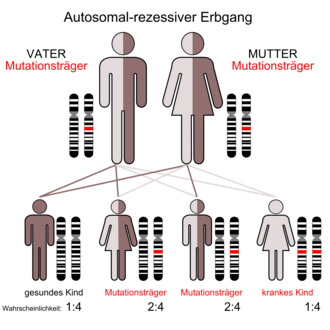
In X-linked recessive inheritance, a son born to a carrier mother and an unaffected father has a 50% chance of being affected, while a daughter has a 50% chance of being a carrier, however a fraction of carriers may display a milder (or even full) form of the condition due to a phenomenon known as skewed X-inactivation, in which the normal process of inactivating half of the female body's X chromosomes preferably targets a certain parent's X chromosome (the father's in this case). If the father is affected, the son will not be affected, as he does not inherit the father's X chromosome, but the daughter will always be a carrier (and may occasionally present with symptoms due to aforementioned skewed X-inactivation).
In X-linked dominant inheritance, a son or daughter born to an affected mother and an unaffected father both have a 50% chance of being affected (though a few X-linked dominant conditions are embryonic lethal for the son, making them appear to only occur in females). If the father is affected, the son will always be unaffected, but the daughter will always be affected.
A Y-linked condition will only be inherited from father to son and will always affect every generation.
The inheritance patterns are different in animals that use sex-determination systems other than XY. In the ZW sex-determination system used by birds, the mammalian pattern is reversed, since the male is the homogametic sex (ZZ) and the female is heterogametic (ZW).
以上节选摘自英文维基百科「Sex linkage」,按 CC BY-SA 4.0 使用,去掉了参考文献、外部链接等尾部小节,公式改写成了纯文本。篇幅所限,较长的小节只摘了开头一部分,有的小节没有收;全文、配图和出处见原文。