格物
- 类型
- 假说
- 上级概念
- 黑洞、假定科学对象
百科正文
根据大爆炸模型,在大爆炸之后最初的一小段时间内有着极高的压力与温度。如此情况下,物质密度的简单波动就可能造成局部区域的密度达到形成黑洞的条件。尽管大多数的高密度区域很快因宇宙的膨胀而散开,但原生的黑洞则会保持稳定直至今日。
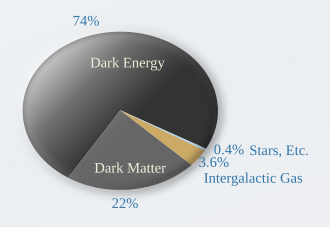
有科学家认为,那些质量在1014千克至1023千克之间的原初黑洞可能和暗物质有关。这是由于这些小质量原初黑洞的行为会与其他可能的暗物质粒子一致。在这一质量范围内,我们既能够剔除那些因质量太小而早已蒸发的黑洞,也能剔除那些无法解释引力透镜观测结果的大质量黑洞。
激光干涉引力波天文台(LIGO)于2015年9月14日探测到引力波事件GW150914,经过详细分析数据,学者估算,该事件所涉及到的两个黑洞,其质量皆大于25个太阳质量,大于通常由恒星灭亡产生的一般黑洞,因此,学者推测LIGO很可能探测到由暗物质形成的原初黑洞。
以上内容摘自维基百科「原初黑洞」,按 CC BY-SA 4.0 使用,去掉了参考文献、外部链接等尾部小节,公式改写成了纯文本。全文、配图和出处见原文。
英文维基百科补充中文条目比较短,下面是英文条目「Primordial black hole」的原文
In cosmology, primordial black holes (PBHs) are hypothetical black holes that formed soon after the Big Bang. In the inflationary era and early radiation-dominated universe, extremely dense pockets of subatomic matter may have been tightly packed to the point of gravitational collapse, creating primordial black holes without the supernova compression typically needed to make black holes today. Because the creation of primordial black holes would pre-date the first stars, they are not limited to the narrow mass range of stellar black holes.
First rejected in 1966 by Yakov Zeldovich and Igor Novikov then proposed by Stephen Hawking in 1971, these objects have been invoked to explain several issues in cosmology.
Properties
Depending on the model, primordial black holes could have initial masses ranging from 10−8 kg (the so-called Planck relics) to more than thousands of solar masses. However, primordial black holes originally having masses lower than 1012 kg would not have survived to the present due to Hawking radiation, which causes complete evaporation in a time much shorter than the age of the Universe. Primordial black holes form before the nucleosynthesis responsible for observed baryonic matter, and as such are plausible dark matter candidates.
History
In 1966, Yakov Zeldovich and Igor Novikov, reasoning on the basis of simplistic and flawed Newtonian model for accretion, concluded primordial black holes could not form. Stephen Hawking made a positive case in 1971 but assumed the resulting objects would be charged.
In 1974 Hawking recognized that quantum effects would be significant for small primordial black holes, leading him to predict they would emit radiation and evaporate.
Formation
Primordial black holes could have formed in the very early Universe (less than one second after the Big Bang) during the inflationary era, or in the very early radiation-dominated era. The essential ingredient for the formation of a primordial black hole is a fluctuation in the density of the Universe, inducing its gravitational collapse. One typically requires density contrasts δ ρ /ρ 0.1 (where ρ is the density of the Universe) to form a black hole.
Implications
Dark matter problem
The dark matter problem, proposed in 1933 by Swiss-American astronomer Fritz Zwicky, refers to the fact that scientists still do not know what form dark matter takes. PBHs can solve that in a few ways. First, if PBHs accounted for all or a significant amount of the dark matter in the universe, this could explain the gravitational effects seen in galaxies and galactic clusters. Secondly, PBHs have different proposed production mechanisms. Unlike WIMPs, they can emit gravitational waves that interact with regular matter.
Observational limits and detection strategies
A variety of observations have been interpreted to place limits on the abundance and mass of primordial black holes:
Lifetime, Hawking radiation and gamma-rays: One way to detect primordial black holes, or to constrain their mass and abundance, is by their Hawking radiation. Stephen Hawking theorized in 1974 that large numbers of such smaller primordial black holes might exist in the Milky Way in our galaxy's halo region. All black holes are theorized to emit Hawking radiation at a rate inversely proportional to their mass.
Measurement techniques
None of these facilities is focused on the direct detection of PBHs due to them being a theoretical phenomenon, but the information collected in each respective experiment provides secondary data that can help provide insight and constraints on the nature of PBHs.
GW-detectors
LIGO/VIRGO – These detectors already place important constraints on the limits of PBHs. However, they're always searching for new unexpected signals; if they detect a black hole in the mass range that does not correspond to stellar evolution theory, it could serve as evidence for PBHs.
Difference from direct collapse black holes
A direct collapse black hole is the result of the collapse of unusually dense and large regions of gas, after the radiation-dominated era, while primordial black holes would have resulted from the direct collapse of energy, ionized matter, or both, during the inflationary or radiation-dominated eras.
以上节选摘自英文维基百科「Primordial black hole」,按 CC BY-SA 4.0 使用,去掉了参考文献、外部链接等尾部小节,公式改写成了纯文本。篇幅所限,较长的小节只摘了开头一部分,有的小节没有收;全文、配图和出处见原文。