格物
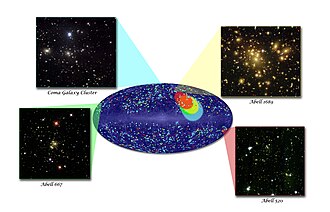
图:NASA/Goddard/A. Kashlinsky, et al. · Public domain · Wikimedia Commons
- 类型
- 科学假说、天体
- 时间
- 2008 年
- 是……的一个方面
- 星系团
- 起因
- missing mass、平行世界
百科正文
根据标准的宇宙学模型,相对于宇宙微波背景星系团的运动应该是随机分布在所有方向。然而,分析三年的威尔金森微波各向异性探测器(WMAP)使用的运动SZ效应数据,天文学家亚力山大.卡什林斯基等科学家发现了一个“令人惊讶的是一致的”600–1000公里/秒流集群,向20度天区的半人马座和船帆星座之间的证据。
简而述之,这是指可观测宇宙中,所有的星系团都在朝同一方向快速移动,就好比宇宙是一张倾斜的桌子,而宇宙中的物体正顺着倾斜的桌面滑下去。这是观察宇宙微波背景辐射看到的奇特天文现象,目前科学界还难以解释这种天文现象。
但是这个假说并没有得到多数科学家的支持,科学界对这种假说始终持怀疑和批评态度,原因在于宇宙暗流的具体情形完全无法预测,缺乏厚实的理论基础作为依据,只能通过逻辑思维及哲学来作出相对唯心的判断,因此,宇宙暗流及平行宇宙相关的假说仍然停留在理论假设层面上,因为人类目前还无法确定大爆炸只在可见宇宙才会出现。
以目前科学界尚未证明统一场理论的情况来说,很难做出更深入的研究以形成完善的理论,因此,此学说受到不小的非议。从宇宙暗流的诞生之日起,就饱受科学界的批评。在2013年,普朗克卫星探测到的资料中并没有显示出宇宙暗流存在的证据,使得这个现象是否存在这点再次受到质疑,不过离完全否定这个理论而言还言之过早。
以上内容摘自维基百科「宇宙暗流」,按 CC BY-SA 4.0 使用,去掉了参考文献、外部链接等尾部小节,公式改写成了纯文本。全文、配图和出处见原文。
英文维基百科补充中文条目比较短,下面是英文条目「Dark flow」的原文
In astrophysics, dark flow is a controversial hypothesis to explain certain non-random measurements of peculiar velocity of galaxy clusters. The actual measured velocity is the sum of the velocity predicted by Hubble's law plus a possible small velocity flowing in a common direction. Very large scale correlated flow, called bulk flow, is proposed in this model to be related to certain models of inflationary cosmology.
According to standard cosmological models, the motion of galaxy clusters with respect to the cosmic microwave background should be randomly distributed in all directions. However, analyzing the three-year Wilkinson Microwave Anisotropy Probe (WMAP) data using the kinematic Sunyaev–Zeldovich effect, a team of astronomers led by Alexander Kashlinsky found evidence of a "surprisingly coherent" 600–1000 km/s flow of clusters toward a 20-degree patch of sky between the constellations of Centaurus and Vela.
The researchers had suggested that the motion may be a remnant of the influence of no-longer-visible regions of the universe prior to inflation. Telescopes cannot see events earlier than about 380,000 years after the Big Bang, when the universe became transparent (the cosmic microwave background); this corresponds to the particle horizon at a distance of about 46 billion (4.6×10¹⁰) light years. Since the matter causing the net motion in this proposal is outside this range, it would in a certain sense be outside our visible universe; however, it would still be in our past light cone.
The results appeared in the October 20, 2008, issue of Astrophysical Journal Letters.
In 2013, data from the Planck space telescope showed no evidence of "dark flow" on that sort of scale, discounting the claims of evidence for either gravitational effects reaching beyond the visible universe or existence of a multiverse. However, in 2015 Atrio-Barandela et al. claim to have found support for its existence using both Planck and WMAP data. The paper stated that a more complete analysis was in preparation to exploit the full Planck cluster sample to further build evidence; however, the team have published no further papers on the topic.
Location
The dark flow was determined to be flowing in the direction of the Centaurus and Hydra constellations. This corresponds with the direction of the Great Attractor, which is a gravitational mystery originally discovered in 1973. However, the source of the Great Attractor's attraction was thought to originate from a massive cluster of galaxies called the Norma Cluster, located about 250 million light-years away from Earth.
In a study from March 2010, Kashlinsky extended his work from 2008, by using the 5-year WMAP results rather than the 3-year results, and doubling the number of galaxy clusters observed from 700. The team also sorted the cluster catalog into four "slices" representing different distance ranges. They then examined the preferred flow direction for the clusters within each slice. The report concluded that while the size and exact position of this direction display some variation, the overall trends among the slices exhibit remarkable agreement. "We detect motion along this axis, but right now our data cannot state as strongly as we'd like whether the clusters are coming or going," Kashlinsky said.
Criticisms
Astrophysicist Ned Wright posted an online response to the study arguing that its methods are flawed. The original authors released a statement in return, claiming that the criticism is largely invalid.
A more recent statistical work done by Ryan Keisler claims to rule out the possibility that the dark flow is a physical phenomenon because Kashlinsky et al. did not consider the primary anisotropies of the cosmic microwave background (CMB) to be as important as they are.
Some have suggested that this could be the effect of a sibling universe or a region of space-time fundamentally different from the observable universe. Data on more than 1,000 galaxy clusters have been measured, including some as distant as 3 billion light-years. Alexander Kashlinsky claims these measurements show the universe's steady flow is clearly not a statistical fluke. Kashlinsky said: "At this point we don't have enough information to see what it is, or to constrain it. We can only say with certainty that somewhere very far away the world is very different than what we see locally.
以上节选摘自英文维基百科「Dark flow」,按 CC BY-SA 4.0 使用,去掉了参考文献、外部链接等尾部小节,公式改写成了纯文本。篇幅所限,较长的小节只摘了开头一部分,有的小节没有收;全文、配图和出处见原文。