格物
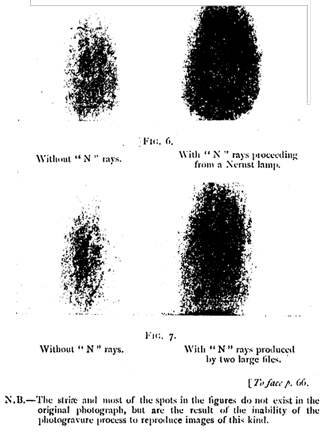
图:Prosper-René Blondlot (1849-1930) · Public domain · Wikimedia Commons
- 类型
- 已被取代的科学理论
- 发现 / 发明时间
- 1903 年
- 发现者 / 提出者
- 布朗洛
- 命名来源
- 南锡
- 学科
- 物理学
相关科学家
百科正文
英文维基百科补充中文条目比较短,下面是英文条目「N-ray」的原文
N-rays (or N rays) were a hypothesized form of radiation described by French physicist Prosper-René Blondlot in 1903. They were initially confirmed by others, but subsequently found to be illusory.
Background
The N-ray affair occurred shortly after a series of major breakthroughs in experimental physics. Victor Schumann discovered vacuum ultraviolet radiation in 1893, Wilhelm Röntgen discovered X-rays in 1895, Henri Becquerel discovered radioactivity in 1896, and, in 1897, J. J. Thomson discovered electrons, showing that they were the constituents of cathode rays. This created an expectation within the scientific community that other forms of radiation might be discovered.
At this time, Prosper-René Blondlot was a professor of physics at the University of Nancy studying electromagnetic radiation. Blondlot was a respected member of the scientific community: he was one of eight physicists who were corresponding members of the French Academy of Sciences and was awarded the Academy's Gaston Planté prize in 1893 and the LaCaze prize in 1899. His attempts to measure the speed of electromagnetic waves were commended by Thomson and Henri Poincaré.
Discovery
In 1903, Blondlot announced his discovery while working at the University of Nancy and attempting to polarize X-rays. He had perceived changes in the brightness of an electric spark in a spark gap placed in an X-ray beam which he photographed, and he later attributed to the novel form of radiation, naming this the N-rays for the University of Nancy. Blondlot, Augustin Charpentier, Arsène d'Arsonval, and approximately 120 other scientists in 300 published articles claimed to be able to detect N-rays emanating from most substances, including the human body, with the peculiar exceptions that they were not emitted by green wood and by some treated metals. Most researchers of the subject at the time used the perceived light of a dim phosphorescent surface as "detectors", although work in the period clearly showed the change in brightness to be a physiological phenomenon rather than some actual change in the level of illumination. Physicists Gustave le Bon and P.
Response
The "discovery" excited international interest and many physicists worked to replicate the effects. However, the notable physicists Lord Kelvin, William Crookes, Otto Lummer, and Heinrich Rubens failed to do so. Following his own failure, self-described as "wasting a whole morning", the American physicist Robert W. Wood, who had a reputation as a popular "debunker" of nonsense during the period, was prevailed upon by the British journal Nature to travel to Blondlot's laboratory in France to investigate further. Wood suggested that Rubens should go since he had been the most embarrassed when Kaiser Wilhelm II of Germany asked him to repeat the French experiments and, after two weeks, Rubens had to report his failure to do so. Rubens, however, felt it would look better if Wood went since Blondlot had been most polite in answering his many questions.
In the darkened room during Blondlot's demonstration, Wood surreptitiously removed an essential prism from the experimental apparatus, yet the experimenters still said that they observed N-rays.
Significance
The incident is used as a cautionary tale among scientists on the dangers of error introduced by experimenter bias. N-rays were cited as an example of pathological science by Irving Langmuir. Nearly identical properties of an equally unknown radiation had been recorded about 50 years before in another country by Carl Reichenbach in his treatise Researches on Magnetism, Electricity, Heat, Light, Crystallization, and Chemical Attraction in their relations to the Vital Force in 1850, and before that in Vienna by Franz Mesmer in his Mémoire on the Discovery of Animal-Magnetism in 1779. It is clear that Reichenbach was aware of Mesmer's work and that researchers in Paris working with Blondlot were aware of Reichenbach's work, although there is no proof that Blondlot was personally aware of it.
A park in central Nancy is named after Blondlot. He left his house and garden to the city, which transformed it into a public park.
以上节选摘自英文维基百科「N-ray」,按 CC BY-SA 4.0 使用,去掉了参考文献、外部链接等尾部小节,公式改写成了纯文本。篇幅所限,较长的小节只摘了开头一部分,有的小节没有收;全文、配图和出处见原文。