格物
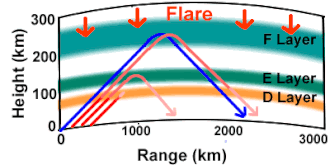
图:Naval Postgraduate School · Public domain · Wikimedia Commons
- 发现 / 发明时间
- 1930 年
- 发现者 / 提出者
- Hans Mögel
- 命名来源
- Hans Mögel、约翰·霍华德·德林格尔
- 学科
- 工程与发明
- 上级概念
- 干扰
- 起因
- 太阳活动
相关科学家
百科正文
发现
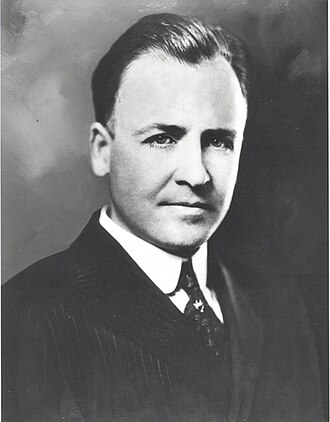
默格尔-德林格尔效应(英语:Mogel-Dellinger effect)是电离层突发扰动的另一种称谓。该效应由约翰·霍华德·德林格尔(英语:John Howard Dellinger)于1935年前后发现,德国物理学家汉斯·莫默格尔(德语:Hans Mögel)在1930年对此现象作出描述。
现象描述
出现此现象时,电离层的突然变化使短波的正常通讯条件受到破坏,无线电通信受到强烈干扰。伴随耀斑的1-8A的太阳X射线,辐射强度可比正常条件下增大数个量级;极紫外谱段强度也有增加,增强的辐射以光速到达地球,使电离层D层的电子数密度骤增,短波突然受到强烈吸收甚至使短波通信中断,延续时间从几分钟到几十分钟(参见电离层吸收)。
影响
通常无线电长波在D层底部和地面之间传播,由于其稳定性好而用于授时和全球导航,但在突发强扰期间则长波的相位和场强也突然变动;播发标准时间和标准频率的短波信号除遭到吸收外,还由于下层的突然变化而使标准频率偏移几到十几赫兹。
以上内容摘自维基百科「电离层突扰」,按 CC BY-SA 4.0 使用,去掉了参考文献、外部链接等尾部小节,公式改写成了纯文本。全文、配图和出处见原文。
英文维基百科补充中文条目比较短,下面是英文条目「Sudden ionospheric disturbance」的原文
A sudden ionospheric disturbance (SID) is any one of several ionospheric perturbations, resulting from abnormally high ionization/plasma density in the D region of the ionosphere and caused by a solar flare and/or solar particle event (SPE). The SID results in a sudden increase in radio-wave absorption that is most severe in the upper medium frequency (MF) and lower high frequency (HF) ranges, and as a result often interrupts or interferes with telecommunications systems.
Discovery
The Dellinger effect, or sometimes Mögel–Dellinger effect, is another name for a sudden ionospheric disturbance. The effect was discovered by John Howard Dellinger around 1935 and also described by the German physicist Hans Mögel (1900-1944) in 1930. The fadeouts are characterized by sudden onset and a recovery that takes minutes or hours.
Cause
When a solar flare occurs on the Sun a blast of intense ultraviolet (UV) and x-ray (sometimes even gamma ray) radiation hits the dayside of the Earth after a propagation time of about 8 minutes. This high energy radiation is absorbed by atmospheric particles, raising them to excited states and knocking electrons free in the process of photoionization. The low altitude ionospheric layers (D region and E region) immediately increase in density over the entire dayside. The ionospheric disturbance enhances VLF radio propagation. Scientists on the ground can use this enhancement to detect solar flares; by monitoring the signal strength of a distant VLF transmitter, sudden ionospheric disturbances (SIDs) are recorded and indicate when solar flares have taken place. The small geomagnetic effect in the lower ionosphere appears as a small hook on magnetic records and is therefore called "geomagnetic crochet effect" or "sudden field effect".
Effects on radio waves
Short wave radio waves (in the HF range) are absorbed by the increased particles in the low altitude D-region of the ionosphere, causing a complete blackout of radio communications. Solar flares can also contribute to short‑term disturbances in the upper atmosphere that influence its temperature structure and circulation patterns, linking sudden ionization events in the D‑region to broader space‑weather effects on atmospheric dynamics. This is called a short wave fadeout (SWF). These fadeouts last for a few minutes to a few hours and are most severe in the equatorial regions where the Sun is most directly overhead. Although High Frequency signals suffer a fadeout because of the enhanced D-layer, the Sudden Ionospheric Disturbance enhances long wave (VLF) radio propagation. SIDs are observed and recorded by monitoring the signal strength of a distant VLF transmitter.
A whole array of sub-classes of SIDs exist, detectable by different techniques at various wavelengths: the short-wave fadeout (SWF), the SPA (Sudden Phase Anomaly), SFD (Sudden Frequency Deviation), SCNA (Sudden Cosmic Noise Absorption), SEA (Sudden Enhancement of Atmospherics), etc.
以上内容摘自英文维基百科「Sudden ionospheric disturbance」,按 CC BY-SA 4.0 使用,去掉了参考文献、外部链接等尾部小节,公式改写成了纯文本。全文、配图和出处见原文。