格物
第五种力
fifth force
hypothesized fundamental force in addition to gravitational, electroweak and strong interactions
现代物理学认为有四种基本作用力存在。然而,物理学中并没有一个公认的统一理论,因此偶尔物理学家们也会假定存在一个额外的基本力——第五种力。大多数物理学家假定第五种力大约和引力的强度相近,而其力程则从一毫米到宇观尺度不等。基于交互作用力绘景,这种尺度的范围意味着第五种力最少有2种以上的型态。
摘自维基百科「第五种力」,CC BY-SA 4.0
- 类型
- 假说、基本相互作用
百科正文
实验尝试
关于额外的基本力的想法很难被验证,这是因为引力实在是太弱了,两个物体间的引力相互作用只有当其中一个物体质量很大时才无法被忽略。因此,想要测量比起地球还要小的物体间的引力,将需要非常精密的设备。尽管如此,在20世纪80年代末,一群研究者们(Fischbach等)在回顾20世纪早期由Loránd Eötvös所得出的关于第五种力的结论时,他们发现了作用尺度大约在100m量级的新的作用力。这一作用力被认为与超荷有关。然而,后来的实验均没能复现这一结果。2021年4月7日,一个费米实验室小组报告了与μ子相互作用的第五种基本力的“有力证据”。
以上内容摘自维基百科「第五种力」,按 CC BY-SA 4.0 使用,去掉了参考文献、外部链接等尾部小节,公式改写成了纯文本。全文、配图和出处见原文。
英文维基百科补充中文条目比较短,下面是英文条目「Fifth force」的原文
In physics, a fifth force is a hypothetical fundamental interaction (also known as fundamental force) beyond the four known interactions in nature: gravitational, electromagnetic, strong nuclear, and weak nuclear forces.
Some speculative theories have proposed a fifth force to explain various anomalous observations that do not fit existing theories. The specific characteristics of a putative fifth force depend on which hypothesis is being advanced. No evidence to support these models has been found.
The fifth force is also used when referring to a specific theory advanced by Ephraim Fischbach in 1986 to explain experimental deviations in the theory of gravity. Later analysis failed to reproduce those deviations.
History
The term fifth force originates in a 1986 paper by Ephraim Fischbach et al. who reanalyzed the data from the Eötvös experiment of Loránd Eötvös from earlier in the century; the reanalysis found a distance dependence to gravity that deviates from the inverse square law.
The reanalysis which was sparked by theoretical work in 1971 by Yasunori Fujii proposes a model that changes distance dependence with a Yukawa potential-like term: (公式略)
The parameter α characterizes the strength and λ the range of the interaction. Fischbach's paper found a strength around 1% of gravity and a range of a few hundred meters.
The effect of this potential can be described equivalently as exchange of vector and/or scalar bosons, that is a predicting as yet undetected new particles.
However, many subsequent attempts to reproduce the deviations have failed.
Theory
Theoretical proposals for a fifth force are driven by inconsistencies between the existing models of general relativity and quantum field theory, and also between the hierarchy problem and the cosmological constant problem. Both issues suggest the possibility of corrections to the gravitational potential around 100 μm.
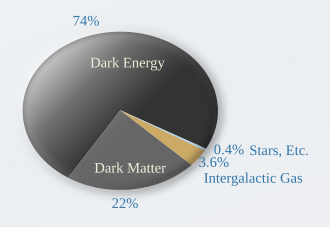
The accelerating expansion of the universe has been attributed to a form of energy called dark energy. Some physicists speculate that a form of dark energy called quintessence could be a fifth force.
Other theories that suggest a fifth-force assume spin-dependent exotic interactions, in which the putative force depends on the spin orientation of particles such as electrons, protons, or neutrons.
Experimental approaches
There are at least three kinds of searches that can be undertaken, which depend on the kind of force being considered, and its range.
Equivalence principle
One way to search for a fifth force is with tests of the strong equivalence principle, one of the most powerful tests of general relativity, also known as Einstein's theory of gravity. Alternative theories of gravity, such as Brans–Dicke theory, postulate a fifth force — possibly one with infinite range. This is because gravitational interactions, in theories other than general relativity, have degrees of freedom other than the "metric", which dictates the curvature of space, and different kinds of degrees of freedom produce different effects. For example, a scalar field cannot produce the bending of light rays.
The fifth force would manifest itself in an effect on solar system orbits, called the Nordtvedt effect. This is tested with Lunar Laser Ranging experiment and very-long-baseline interferometry.
Extra dimensions
Another kind of fifth force, which arises in Kaluza–Klein theory, where the universe has extra dimensions, or in supergravity or string theory is the Yukawa force, which is transmitted by a light scalar field (i.e. a scalar field with a long Compton wavelength, which determines the range). This concept is part of the motivation for an experimental effort to test gravity on very small scales that requires extremely sensitive experiments which search for a deviation from the inverse-square law of gravity over short distances. They are looking for signs of a Yukawa-like term in the interaction potential.
Australian researchers, attempting to measure the gravitational constant deep in a mine shaft, found a discrepancy between the predicted and measured value, with the measured value being two percent too small. They concluded that the results may be explained by a repulsive fifth force with a range from a few centimetres to a kilometre. Similar experiments have been carried out on board a submarine, USS Dolphin (AGSS-555), while deeply submerged.
以上节选摘自英文维基百科「Fifth force」,按 CC BY-SA 4.0 使用,去掉了参考文献、外部链接等尾部小节,公式改写成了纯文本。篇幅所限,较长的小节只摘了开头一部分,有的小节没有收;全文、配图和出处见原文。