格物
可燃冰喷射假说
clathrate gun hypothesis
hypothesis that climate change can trigger a release of methane buried in seabeds which leads to runaway warming
The clathrate gun hypothesis is a proposed explanation for the periods of rapid warming during the Quaternary. The hypothesis is that changes in fluxes in upper intermediate waters in the ocean caused temperature fluctuations that alternately accumulated and occasionally released methane clathrate on upper continental slopes. This would have had an immediate impact on the global temperature, as methane is a much more powerful greenhouse gas than carbon dioxide. Despite its atmospheric lifetime of around 12 years, methane's global warming potential is 72 times greater than that of carbon dioxide over 20 years, and 25 times over 100 years. It is further proposed that these warming events caused the Bond cycles and individual interstadial events, such as the Dansgaard–Oeschger interstadials.
摘自英文维基百科「Clathrate gun hypothesis」(英文维基百科,暂无中文条目),CC BY-SA 4.0
- 类型
- 假说
- 命名来源
- 甲烷水合物
- 组成部分
- 天然气水合物、永久冻土
- 起因
- 气候变化、温室效应
百科正文
本条目暂无中文维基百科条目,下面是英文维基百科原文。
The hypothesis was supported for the Bølling–Allerød warming and Preboreal periods, but not for Dansgaard–Oeschger interstadials, although there are still debates on the topic. While it may be important on the millennial timescales, it is no longer considered relevant for the near future climate change: the IPCC Sixth Assessment Report states "It is very unlikely that gas clathrates (mostly methane) in deeper terrestrial permafrost and subsea clathrates will lead to a detectable departure from the emissions trajectory during this century".
Mechanism
Methane clathrate, also known commonly as methane hydrate, is a form of water ice that contains a large amount of methane within its crystal structure. Potentially large deposits of methane clathrate have been found under sediments on the ocean floors of the Earth, although the estimates of total resource size given by various experts differ by many orders of magnitude, leaving doubt as to the size of methane clathrate deposits (particularly in the viability of extracting them as a fuel resource). Indeed, cores of greater than 10 centimeters' contiguous depth had only been found in three sites as of 2000, and some resource reserve size estimates for specific deposits/locations have been based primarily on seismology. The sudden release of large amounts of natural gas from methane clathrate deposits in runaway climate change could be a cause of past, future, and present climate changes.
In the Arctic Ocean, clathrates can exist in shallower water stabilized by lower temperatures rather than higher pressures; these may potentially be marginally stable much closer to the surface of the sea-bed, stabilized by a frozen 'lid' of permafrost preventing methane escape. The so-called self-preservation phenomenon has been studied by Russian geologists starting in the late 1980s. This metastable clathrate state can be a basis for release events of methane excursions, such as during the interval of the Last Glacial Maximum. A study from 2010 concluded with the possibility for a trigger of abrupt climate warming based on metastable methane clathrates in the East Siberian Arctic Shelf (ESAS) region.
Possible past releases
Studies published in 2000 considered this hypothetical effect to be responsible for warming events in and at the end of the Last Glacial Maximum. Although periods of increased atmospheric methane match periods of continental-slope failure, later work found that the distinct deuterium/hydrogen (D/H) isotope ratio indicated that wetland methane emissions was the main contributor to atmospheric methane concentrations. While there were major dissociation events during the last deglaciation, with Bølling–Allerød warming triggering the disappearance of the entire methane hydrate deposit in the Barents Sea within 5000 years, those events failed to counteract the onset of a major Younger Dryas cooling period, suggesting that most of the methane stayed within the seawater after being liberated from the seafloor deposits, with very little entering the atmosphere.
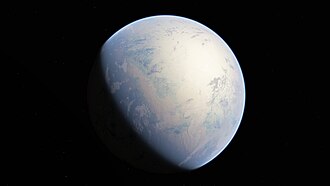
In 2008, it was suggested that equatorial permafrost methane clathrate may have had a role in the sudden warm-up of "Snowball Earth", 630 million years ago.
Other events potentially linked to methane hydrate excursions are the Permian–Triassic extinction event and the Paleocene–Eocene Thermal Maximum.
Climate change feedback
Modern deposits
Most deposits of methane clathrate are in sediments too deep to respond rapidly, and 2007 modelling by Archer suggests that the methane forcing derived from them should remain a minor component of the overall greenhouse effect. Clathrate deposits destabilize from the deepest part of their stability zone, which is typically hundreds of metres below the seabed. A sustained increase in sea temperature will warm its way through the sediment eventually, and cause the shallowest, most marginal clathrate to start to break down; but it will typically take on the order of a thousand years or more for the temperature change to get that far into the seabed. Further, subsequent research on midlatitude deposits in the Atlantic and Pacific Ocean found that any methane released from the seafloor, no matter the source, fails to reach the atmosphere once the depth exceeds 430 m (1,411 ft), while geological characteristics of the area make it impossible for hydrates to exist at depths shallower than 550 m (1,804 ft).
However, some methane clathrates deposits in the Arctic are much shallower than the rest, which could make them far more vulnerable to warming. A trapped gas deposit on the continental slope off Canada in the Beaufort Sea, located in an area of small conical hills on the ocean floor is just 290 m (951 ft) below sea level and considered the shallowest known deposit of methane hydrate. However, the East Siberian Arctic Shelf averages 45 meters in depth, and it is assumed that below the seafloor, sealed by sub-sea permafrost layers, hydrates deposits are located.
In fiction
The science fiction novel Mother of Storms by John Barnes offers a fictional example of catastrophic climate change caused by methane clathrate release.
In The Life Lottery by Ian Irvine unprecedented seismic activity triggers a release of methane hydrate, reversing global cooling.
The hypothesis is the basis of an experiment in the PlayStation 2 game Death By Degrees.
In Transcendent by Stephen Baxter, averting such a crisis is a major plotline.
The novel The Black Silent by author David Dun features this idea as a key scientific point.
In the anime Ergo Proxy, a string of explosions in the methane hydrate reserves wipes out 85% of species on Earth.
The novel The Far Shore of Time by Frederik Pohl features an alien race attempting to destroy humanity by bombing the methane clathrate reserves, thus releasing the gas into the atmosphere.
The novel The Swarm by Frank Schätzing features what first appear to be freak events related to the world's oceans.
In Charles Stross' Laundry Files universe, an intentionally triggered clathrate gun scenario is viewed as a possible retaliatory strategy that could be utilized by Blue Hades in response to terminal violation of the Benthic Treaty.
以上节选摘自英文维基百科「Clathrate gun hypothesis」,按 CC BY-SA 4.0 使用,去掉了参考文献、外部链接等尾部小节,公式改写成了纯文本。篇幅所限,较长的小节只摘了开头一部分,有的小节没有收;全文、配图和出处见原文。