格物
魏尔施特拉斯-卡索拉蒂定理
Casorati–Weierstrass theorem
in complex analysis, the theorem that a holomorphic function arbitrarily close to any complex value in every neighborhood of an essential singularity
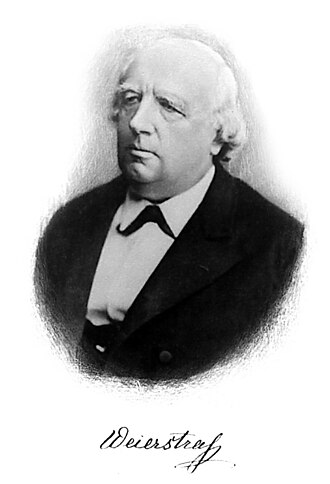
In complex analysis, a branch of mathematics, the Casorati–Weierstrass theorem describes the behaviour of holomorphic functions near their essential singularities. It is named for Karl Theodor Wilhelm Weierstrass and Felice Casorati. In Russian literature it is called Sokhotski's theorem, because it was discovered independently by Sokhotski in 1868.
摘自英文维基百科「Casorati–Weierstrass theorem」(英文维基百科,暂无中文条目),CC BY-SA 4.0
- 类型
- 定理
- 命名来源
- 卡尔·魏尔斯特拉斯、Felice Casorati、尤利安·索霍茨基
- 属于
- 数学定理列表
- 学科
- 数学、物理学