格物
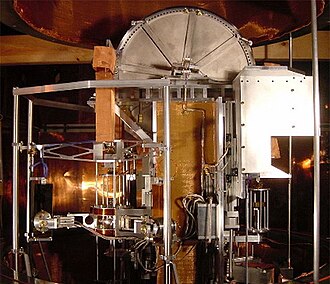
图:Photo by Richard Steiner (The original uploader was Greg L a… · CC BY-SA 3.0 · Wikimedia Commons
- 发现 / 发明时间
- 1975 年
- 发现者 / 提出者
- 布莱恩·基布尔
- 命名来源
- 布莱恩·基布尔
- 上级概念
- 计重秤
- 用到了
- 电流、电压
百科正文
由于测量的质量与电流和电压的乘积(即功率,单位为瓦特)成正比,所以该仪器又被称为瓦特秤。2016年6月,国际度量衡委员会的单位协商委员会的计量学家,同意以该仪器的发明者布莱恩·基布尔(彼时已故两个月)的名字对该仪器重新命名。
2019年之前,千克的定义基于一种被称为国际千克原器(IPK)的实物。2013年,国际度量衡大会(CGPM)在考虑了替代方案之后决定以基于基布尔秤的使用的定义代替这个定义,并确定了精度标准。在达到这些标准后,CGPM于2018年11月16日一致投票通过议案:改变千克和其他几个单位的定义,议案生效于2019年5月20日,以符合世界计量日。
设计
基布尔秤是安培秤的一种更精确的版本,安培秤是一种早期的电流测量仪器,它通过测量内部的两个载流线圈之间的力来计算电流的大小。基布尔秤的操作与此相反,它使用普朗克常数的定义测量线圈中的电流,从而“在无需使用IPK或任何实物的情况下测量质量。”,基布尔秤首先确定物体的重力,然后用重力仪准确测量局部地球重力(结合引力和离心作用的净加速度)并以此计算出物体的质量。这样物体的质量就由电流和电压定义了,即“电子千克”。
起源
基布尔秤是安培秤的一种更精确的版本,安培秤是一种早期的电流测量仪器,它通过测量内部的两个载流线圈之间的力来计算电流的大小。基布尔秤的操作与此相反,它使用普朗克常数的定义测量线圈中的电流,从而“在无需使用IPK或任何实物的情况下测量质量。”,基布尔秤首先确定物体的重力,然后用重力仪准确测量局部地球重力(结合引力和离心作用的净加速度)并以此计算出物体的质量。这样物体的质量就由电流和电压定义了,即“电子千克”。
以上内容摘自维基百科「基布尔秤」,按 CC BY-SA 4.0 使用,去掉了参考文献、外部链接等尾部小节,公式改写成了纯文本。全文、配图和出处见原文。
英文维基百科补充中文条目比较短,下面是英文条目「Kibble balance」的原文
A Kibble balance (also formerly known as a watt balance) is an electromechanical measuring instrument that measures the weight of a test object very precisely by the electric current and voltage needed to produce a compensating force. It is a metrological instrument that can realize the definition of the kilogram unit of mass based on fundamental constants.
It was originally known as a watt balance because the weight of the test mass is proportional to the product of current and voltage, which is measured in watts. In June 2016, two months after the death of its inventor, Bryan Kibble, metrologists of the Consultative Committee for Units of the International Committee for Weights and Measures agreed to rename the device in his honor.
Prior to 2019, the definition of the kilogram was based on a physical object known as the International Prototype of the Kilogram (IPK). After considering alternatives, in 2013 the General Conference on Weights and Measures (CGPM) agreed on accuracy criteria for replacing this definition with one based on the use of a Kibble balance. After these criteria had been achieved, the CGPM voted unanimously on November 16, 2018, to change the definition of the kilogram and several other units, effective May 20, 2019, to coincide with World Metrology Day. There is also a method called the joule balance. All methods that use the fixed numerical value of the Planck constant are sometimes called the Planck balance.
Design
The Kibble balance is an advanced and highly precise development of the earlier ampere balance, an instrument in which the force generated between two current-carrying coils is measured to determine the magnitude of an electric current. In contrast, the Kibble balance operates inversely: the current flowing through its coils is set with high precision using the fixed value of the Planck constant, and the resulting electromagnetic force is used to balance the weight of a test mass.
Origin
The principle that is used in the Kibble balance was proposed by Bryan Kibble (1938-2016) of the UK National Physical Laboratory (NPL) in 1975 for measurement of the gyromagnetic ratio. In 1978 the Mark I watt balance was built at the NPL with Ian Robinson and Ray Smith. It operated until 1988.
The main weakness of the ampere balance method is that the result depends on the accuracy with which the dimensions of the coils are measured.
Principle
A conducting wire of length L that carries an electric current I perpendicular to a magnetic field of strength B experiences a Lorentz force equal to the product of these variables. In the Kibble balance, the current is varied so that this force counteracts the weight w of a mass m to be measured. This principle is derived from the ampere balance. w is given by the mass m multiplied by the local gravitational acceleration g. Thus, w=mg=BLI.
Implementation
The Kibble balance is constructed so that the mass to be measured and the wire coil are suspended from one side of a balance scale, with a counterbalance mass on the other side. The system operates by alternating between two modes: "weighing" and "moving". The entire mechanical subsystem operates in a vacuum chamber to remove the effects of air buoyancy.
Measurements
Accurate measurements of electric current and potential difference are made in conventional electrical units (rather than SI units), which are based on fixed "conventional values" of the Josephson constant and the von Klitzing constant, K_(J-90) and R_(K-90) respectively. The current Kibble balance experiments are equivalent to measuring the value of the conventional watt in SI units.
Effect of gravity
Gravity and the nature of the Kibble balance, which oscillates test masses up and down against the local gravitational acceleration g, are exploited so that mechanical power is compared against electrical power, which is the square of voltage divided by electrical resistance. However, g varies significantly—by nearly 1%—depending on where on the Earth's surface the measurement is made (see Earth's gravity).
以上节选摘自英文维基百科「Kibble balance」,按 CC BY-SA 4.0 使用,去掉了参考文献、外部链接等尾部小节,公式改写成了纯文本。篇幅所限,较长的小节只摘了开头一部分,有的小节没有收;全文、配图和出处见原文。