 格物
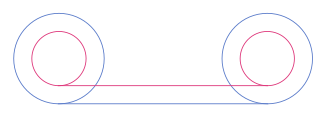
图:Mysid · Public domain · Wikimedia Commons
亚里士多德车轮悖论
Aristotle's wheel paradox
悖论
Aristotle's wheel paradox is a paradox or problem appearing in the pseudo-Aristotelian Greek work Mechanica. It states as follows: A wheel is depicted in two-dimensional space as two circles. Its larger, outer circle is tangential to a horizontal surface, while the smaller, inner one has the same center and is rigidly affixed to the larger. Assuming the larger circle rolls without slipping for one full revolution, the distances moved by both circles' circumferences are the same. The distance travelled by the larger circle is equal to its circumference, but for the smaller it is greater than its circumference, thereby creating a paradox.
摘自英文维基百科「Aristotle's wheel paradox」(英文维基百科,暂无中文条目),CC BY-SA 4.0
- 类型
- 悖论
- 命名来源
- 亚里士多德