 格物
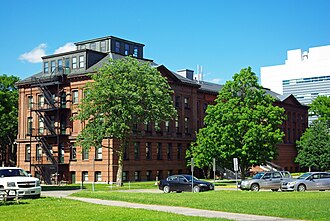
图:Bostonian13 · CC BY-SA 3.0 · Wikimedia Commons
庞德-雷布卡实验1959
Pound–Rebka experiment
Experiment designed to test Albert Einstein's theory of general relativity
The Pound–Rebka experiment monitored frequency shifts in gamma rays as they rose and fell in the gravitational field of the Earth. The experiment tested Albert Einstein's 1907 and 1911 predictions, based on the equivalence principle, that photons would gain energy when descending a gravitational potential, and would lose energy when rising through a gravitational potential. It was proposed by Robert Pound and his graduate student Glen A. Rebka Jr. in 1959, and was the last of the classical tests of general relativity to be verified. The measurement of gravitational redshift and blueshift by this experiment validated the prediction of the equivalence principle that clocks should be measured as running at different rates in different places of a gravitational field. It is considered to be the experiment that ushered in an era of precision tests of general relativity.
摘自英文维基百科「Pound–Rebka experiment」(英文维基百科,暂无中文条目),CC BY-SA 4.0
- 类型
- 物理学实验
- 发现 / 发明时间
- 1959 年
- 发现者 / 提出者
- 罗伯特·庞德、格伦·雷布卡
- 研究学科
- 相对论、实验物理学
- 学科
- 物理学