格物
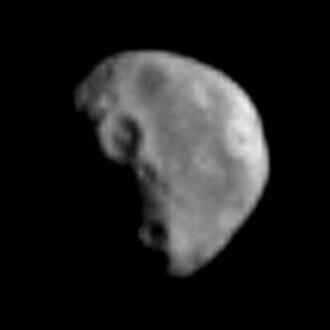
图:NASA · Public domain · Wikimedia Commons
- 类型
- 小行星卫星
- 发现 / 发明时间
- 1994 年
- 发现者 / 提出者
- 伽利略号探测器
- 命名来源
- 达克堤利
百科正文
艾卫一的编号为1993 (243) Ida I。国际天文联会在1994年将其命名为“Dactyl”,名称来自于希腊神话中住在克里特岛伊达山上的达克堤利(Dactyl)。
物理特性
艾卫一是一颗蛋形但极为近似球体的天体,尺寸为1.6乘1.4乘1.2公里。艾卫一上的撞击坑中央有突出物。就如艾女星,艾卫一的表面也布满了饱和了的撞击坑。有超过12个坑直径大于80米(260英尺),表示它过去受到许多撞击。至少有6个坑排成直线链状,表示这是近距离形成的碎片造成的,这些碎片很可能来自艾女星的喷射物。以上的特征,加上它的椭球形,显示艾卫一是有一定的自身引力,尽管它的体积如此之小。与艾女星一样,其表面温度约为200K。
艾卫一和艾女星有许多共同特征。它们的反射光谱接近。两者有相似反照率其中的细小分别显示,相对艾卫一,艾女星经历的太空风化作用较强。它的体积太小,使表岩屑不可能生成;艾女星则被厚厚一层表岩屑覆盖。
轨道特性
艾卫一绕艾女星的轨道并不确定。拍摄艾卫一的大部分照片时,伽利略号正处于它的轨道平面,很难推断其准确轨道。艾卫一以顺行轨道公转,轨道倾斜于艾女星赤道8°。根据电脑模拟,艾卫一的近心点必须与艾女星距离至少约65千米(40英里),才能保持稳定的轨道。在这电脑模拟中,轨道的可能性范围缩窄了,因为伽利略号在1993年8月28日16:52:05 UT观测到它位于艾女星经度85°上空90千米(56英里)处,模拟中艾卫一必须经过这一点。1994年4月26日,哈勃太空望远镜观测艾女星8小时,但并未看到艾卫一。艾卫一要距离艾女星超过约700 km(430 mi)才能被观测到。
以上内容摘自维基百科「艾卫一」,按 CC BY-SA 4.0 使用,去掉了参考文献、外部链接等尾部小节,公式改写成了纯文本。全文、配图和出处见原文。
英文维基百科补充中文条目比较短,下面是英文条目「Dactyl (moon)」的原文
Dactyl ( DAK-til), formal designation (243) Ida I, is a small asteroid moon 1,200 by 1,400 by 1,600 m (3,900 by 4,600 by 5,200 ft), in size) that orbits 243 Ida, a main-belt asteroid. It was imaged by the Galileo spacecraft on August 28, 1993; Dactyl was discovered while examining the delayed image downloads from Galileo on February 17, 1994. It was provisionally designated S/1993 (243) 1. The satellite was named after the mythical creatures called dactyls, who, according to Greek mythology, lived on Mount Ida.
Discovery
Dactyl was found on 17 February 1994 by Galileo mission member Ann Harch, while examining delayed image downloads from the spacecraft. Galileo recorded 47 images of Dactyl over an observation period of 5.5 hours in August 1993. The spacecraft was 10,760 kilometres (6,690 mi) from Ida and 10,870 kilometres (6,750 mi) from Dactyl when the first image of the moon was captured, 14 minutes before Galileo made its closest approach.
Dactyl was initially designated 1993 (243) 1. It was named by the International Astronomical Union in 1994, for the mythological Dactyls who inhabited Mount Ida on the island of Crete.
Physical characteristics
Dactyl is an "egg-shaped" but "remarkably spherical" object measuring 1.6 by 1.4 by 1.2 kilometres (0.99 by 0.87 by 0.75 mi). It is oriented with its longest axis pointing towards Ida. Like Ida, Dactyl's surface exhibits saturation cratering. It is marked by more than a dozen craters with a diameter greater than 80 m (260 ft), indicating that the moon has suffered many collisions during its history. At least six craters form a linear chain, suggesting that it was caused by locally produced debris, possibly ejected from Ida. Dactyl's craters may contain central peaks, unlike those found on Ida. These features, and Dactyl's spheroidal shape, imply that the moon is gravitationally controlled despite its small size. Like Ida, its average temperature is about 200 K (−73 °C; −100 °F).
Dactyl shares many characteristics with Ida. Their albedos and reflection spectra are very similar. The small differences indicate that the space weathering process is less active on Dactyl. Its small size would make the formation of significant amounts of regolith impossible. This contrasts with Ida, which is covered by a deep layer of regolith.
The two largest imaged craters on Dactyl were named Acmon and Celmis, after two of the mythological Dactyls. Acmon is the largest crater in the above image, and Celmis is near the bottom of the image, mostly obscured in shadow. The craters are 300 and 200 meters in diameter, respectively.
Orbit
Dactyl's orbit around Ida is not precisely known. Galileo was in the plane of Dactyl's orbit when most of the images were taken, which made determining its exact orbit difficult. Dactyl orbits in the prograde direction and is inclined about 8° to Ida's equator. Based on computer simulations, Dactyl's pericenter must be more than about 65 km (40 mi) from Ida for it to remain in a stable orbit. The range of orbits generated by the simulations was narrowed down by the necessity of having the orbits pass through points at which Galileo observed Dactyl to be at 16:52:05 UT on 28 August 1993, about 90 km (56 mi) from Ida at longitude 85°. On 26 April 1994, the Hubble Space Telescope observed Ida for eight hours and was unable to spot Dactyl. It would have been able to observe it if it were more than about 700 km (430 mi) from Ida.
If in a circular orbit at the distance at which it was seen, Dactyl's orbital period would be about 20 hours. Its orbital speed is roughly 10 m/s (33 ft/s), "about the speed of a fast run or a slowly thrown baseball".
Age and origin
Dactyl may have originated at the same time as Ida, from the disruption of the Koronis parent body. However, it may have formed more recently, perhaps as ejecta from a large impact on Ida. It is extremely unlikely that it was captured by Ida. Dactyl may have suffered a major impact around 100 million years ago, which reduced its size.
Dactyl was the first asteroid moon discovered. Its discovery settled the long debate over the existence of asteroid moons.
以上内容摘自英文维基百科「Dactyl (moon)」,按 CC BY-SA 4.0 使用,去掉了参考文献、外部链接等尾部小节,公式改写成了纯文本。全文、配图和出处见原文。