 格物
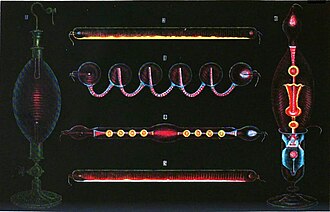
图:M. Rapine · Public domain · Wikimedia Commons
盖斯勒管1857
Geissler tube
gas-discharge lamp
A Geissler tube is a precursor to modern gas discharge tubes, demonstrating the principles of electrical glow discharge, akin to contemporary neon lights, and central to the discovery of the electron. This device was developed in 1857 by Heinrich Geissler, a German physicist and glassblower. A Geissler tube is composed of a sealed glass cylinder of various shapes, which is partially evacuated and equipped with a metal electrode at each end. It contains rarefied gases—such as neon or argon, air, mercury vapor, or other conductive substances, and sometimes ionizable minerals or metals like sodium. When a high voltage is applied between the electrodes, there is an electric current through the tube, causing gas molecules to ionize by shedding electrons. The free electrons reunite with the ions and the resulting energic atoms emit light, with the emitted color characteristic of the gas.
摘自英文维基百科「Geissler tube」(英文维基百科,暂无中文条目),CC BY-SA 4.0
- 类型
- 气体放电灯
- 发现 / 发明时间
- 1857 年
- 发现者 / 提出者
- 海因里希·盖斯勒
- 命名来源
- 海因里希·盖斯勒
- 学科
- 工程与发明