格物
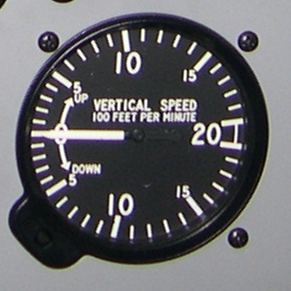
图:User:Bilou · CC BY-SA 3.0 · Wikimedia Commons
海拔趋势1929
variometer
flight instrument in an aircraft used to inform the pilot of the rate of descent or climb
垂直速度表 也称上升和下降率指示器 、爬升率指示器 、垂直速度指示器 或垂直速率指示器,是向飞行员告知航空器的上升或下降率的一种飞行仪表。取决于航空器所属的国家和款型,仪表刻度可能使用英尺/分钟、节(1节约等于100英尺/分钟)或米每秒(1米/秒约等于200英尺/分钟)。
摘自维基百科「垂直速度表」,CC BY-SA 4.0
- 发现 / 发明时间
- 1929 年
- 发现者 / 提出者
- 亚历山大·利皮施、Robert Kronfeld
- 上级概念
- flight monitoring device
百科正文
英文维基百科补充中文条目比较短,下面是英文条目「Variometer」的原文
In aviation, a variometer – also known as a rate of climb and descent indicator (RCDI), rate-of-climb indicator, vertical speed indicator (VSI), or vertical velocity indicator (VVI) – is one of the flight instruments in an aircraft used to inform the pilot of the rate of descent or climb. It can be calibrated in metres per second, feet per minute (1 ft/min = 0.00508 m/s) or knots (1 kn ≈ 0.514 m/s), depending on country and type of aircraft. It is typically connected to the aircraft's external static pressure source.
In powered flight, the pilot makes frequent use of the VSI to ascertain that level flight is being maintained, especially during turning maneuvers. In gliding, the instrument is used almost continuously during normal flight, often with an audible output, to inform the pilot of rising or sinking air. It is usual for gliders to be equipped with more than one type of variometer. The simpler type does not need an external source of power and can therefore be relied upon to function regardless of whether a battery or power source has been fitted. The electronic type with audio needs a power source to be operative during the flight. The instrument is of little interest during launching and landing, with the exception of aerotow, where the pilot will usually want to avoid releasing in sink.
History
In 1930, according to Ann Welch, "Kronfeld...was one of the first to use a variometer, a device suggested by Alexander Lippisch." Welch goes on to state that the "first real thermal soaring" occurred in 1930 by A. Haller and Wolf Hirth, with Hirth using a variometer in his Musterle. Frank Irving states that Arthur Kantrowitz first mentioned total energy in 1940.
Description
According to Paul MacCready, "A variometer is essentially a pressure altimeter with a leak which tends to make it read the altitude of a moment earlier. It consists of a container vented to the outside air in such a way that the pressure inside the flask lags slightly behind the outside static pressure. The rate of climb measurement comes from the rate-of-air inflow or outflow from the container."
Purpose
Human beings, unlike birds and other flying animals, are not able directly to sense climb and sink rates. Before the invention of the variometer, sailplane pilots found it very hard to soar. Although they could readily detect abrupt changes in vertical speed ("in the seat of the pants"), their senses did not allow them to distinguish lift from sink, or strong lift from weak lift.
Total energy compensation
As the sport of gliding developed, however, it was found that these very simple "uncompensated" instruments had their limitations. The information that glider pilots really need to soar is the total change in energy experienced by the glider, including both altitude and speed.
Netto variometer
A second type of compensated variometer is the Netto or airmass variometer. In addition to TE compensation, the Netto variometer adjusts for the intrinsic sink rate of the glider at a given speed (the polar curve) adjusted for the wing loading due to water ballast. The Netto variometer will always read zero in still air.
Electronic variometers
In 1954, MacCready pointed out the advantages of an Audio Variometer, "There is much to be gained if the variometer indication is presented to the pilot by sound. More than any other instrument except during blind flying, the variometer must be watched continuously.
Radio controlled soaring
Variometers are also used in radio controlled gliders. Each variometer system consists of a radio transmitter in the glider, and a receiver on the ground for use by the pilot. Depending on the design, the receiver may give the pilot the current altitude of the glider, and a display that indicates if the glider is gaining or losing altitude—often via an audio tone.
以上节选摘自英文维基百科「Variometer」,按 CC BY-SA 4.0 使用,去掉了参考文献、外部链接等尾部小节,公式改写成了纯文本。篇幅所限,较长的小节只摘了开头一部分,有的小节没有收;全文、配图和出处见原文。