格物
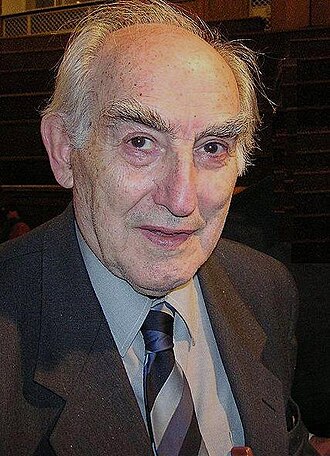
图:Emaus modified by Penarc · CC BY-SA 3.0 · Wikimedia Commons
维塔利·拉扎列维奇·金兹堡1916—2009
Vitaly Ginzburg
物理学家, 苏联
英国皇家天文学会金质奖章 1991罗蒙诺索夫金质奖章 1995沃尔夫物理学奖 1995诺贝尔物理学奖 2003
维塔利·拉扎列维奇·金兹堡,苏联著名理论物理学家和天体物理学家。
摘自维基百科「维塔利·金兹堡」,CC BY-SA 4.0
- 出生
- 1916 年 10 月 4 日,莫斯科
- 逝世
- 2009 年 11 月 8 日,莫斯科
- 国籍
- 苏联、俄罗斯
- 学科
- 物理学、天文学、工程与发明、博物与综合
- 职业
- 物理学家、天体物理学家、发明家、大学教师
- 母语 / 工作语言
- 俄语
- 母校
- MSU Faculty of Physics、莫斯科国立大学
- 工作单位
- 列别捷夫物理研究所
研究领域
师承
博士生10
学生1
来自 Wikidata 的「博士导师」「师从」「博士生」「学生」记录,可能不全。
所获奖项(19)
- 1948莫斯科建城八百周年纪念奖章
- 1953State Stalin Prize, 1st degree
- 1954列宁勋章
- 1966列宁奖
- 1970纪念列宁诞辰一百周年奖章
- 1987英国皇家学会外籍会员
- 1991英国皇家天文学会金质奖章
- 1995罗蒙诺索夫金质奖章
- 1995沃尔夫物理学奖
- 1996Order "For Merit to the Fatherland", 3rd class
- 1998UNESCO尼尔斯·玻尔奖章
- 1998Dwight Nicholson Medal for Outreach
- 2003诺贝尔物理学奖
- 2003美国物理学会会士
- 2006Order "For Merit to the Fatherland", 1st class
- —荣誉徽章勋章
- —红旗劳动勋章
- —1941-1945年大卫国战争中忘我劳动奖章
- —洪堡奖
学会与院士
百科正文
生平
金兹堡1916年出生于莫斯科。1938年毕业于莫斯科大学物理系。1942年在莫斯科大学获得物理学博士学位。1944年加入联共(布)。从1940年起,金兹堡一直在莫斯科列别捷夫物理研究所任职直至终生,并且曾任该研究所理论室主任。为俄罗斯科学院顾问(2003年)。
1950年,金兹堡同朗道在朗道二级相变理论的基础上提出了一个描述超导现象的模型(金兹堡-朗道方程)。在这个模型的基础上,苏联物理学家阿列克谢·阿布里科索夫在1957年对第二类超导体的特性做出了理论上的解释。为了表彰这个模型在超导理论研究中的突出贡献,2003年的诺贝尔物理学奖授予了这两位科学家以及安东尼·莱格特(以表彰其对超流理论的贡献)。
此外,金兹堡对物理学的贡献还包括电磁波在等离子体中的传播理论、宇宙射线的形成理论。在20世纪五十年代苏联研制氢弹的过程中,金兹堡也扮演了关键角色。
2009年11月8日在莫斯科因病逝世。
以上内容摘自维基百科「维塔利·金兹堡」,按 CC BY-SA 4.0 使用,去掉了参考文献、外部链接等尾部小节,公式改写成了纯文本。全文、配图和出处见原文。
英文维基百科补充中文条目比较短,下面是英文条目「Vitaly Ginzburg」的原文
Vitaly Lazarevich Ginzburg ForMemRS (Russian: Вита́лий Ла́заревич Ги́нзбург; 4 October [O.S. 21 September] 1916 – 8 November 2009) was a Russian physicist who was honored with the Nobel Prize in Physics in 2003, together with Alexei Abrikosov and Anthony Leggett for their "pioneering contributions to the theory of superconductors and superfluids."
He spent his career in the former Soviet Union and was one of the leading figure in former Soviet program of nuclear weapons, working towards designs of the thermonuclear devices. He became a member of the Russian Academy of Sciences and succeeded Igor Tamm as head of the Department of Theoretical Physics of the Lebedev Physical Institute of the Russian Academy of Sciences (FIAN). After the fall of the Soviet-Union Ginzburg presented himself as an atheist and became an outspoken critic of the Russian Orthodox clergy's influence in Russian society. Yet simultaneously, he publicly identified as an agnostic Jew, served on the board of directors of the Russian Jewish Congress, vocally fought what he considered anti-semitism in Russian society and was a very active supporter and fundraiser for Israel and Zionist causes.
Biography
Vitaly Ginzburg was born to a Jewish family in Moscow on 4 October 1916— the son of an engineer, Lazar Yefimovich Ginzburg, and a doctor, Augusta Wildauer who was a graduate from the Physics Faculty of Moscow State University in 1938. After attending his mother's alma mater, he defended his qualifications of the candidate's (Kandidat Nauk) dissertation in 1940, and his comprehensive thesis for the doctor's (Doktor Nauk) qualification in 1942. In 1944, he became a member of the Communist Party of the Soviet Union.
Stance on religion
Ginzburg was an avowed atheist, both under the primarily atheist Soviet government and in post-Communist Russia when religion made a strong revival. He criticized clericalism in the press and wrote several books devoted to the questions of religion and atheism. Because of this, some Orthodox Christian groups denounced him and said no science award could excuse his verbal attacks on the Russian Orthodox Church. He was one of the signers of the Open letter to the President Vladimir V.
Nobel Prize
Vitaly Ginzburg, along with Anthony Leggett and Alexei Abrikosov were awarded the Nobel Prize in Physics in 2003 for their groundbreaking work on the theory of superconductors. The Nobel Prize recognized Ginzburg's work in theoretical physics, specifically his contributions to understanding the behavior of matter at extremely low temperatures.
His collaboration with Lev Landau in 1950 led to the development of the Ginzburg-Landau theory, which became paramount to later work on superconductors.
Death
A spokeswoman for the Russian Academy of Sciences announced that Ginzburg died in Moscow on 8 November 2009 from cardiac arrest. He had been suffering from ill health for several years, and three years before his death said "In general, I envy believers. I am 90, and [am] being overcome by illnesses. For believers, it is easier to deal with them and with life's other hardships. But what can be done? I cannot believe in resurrection after death."
Ginzburg's list
Over the years, Ginzburg compiled a list of unsolved problems in physics. In 1971 the list included 17 problems, and 20 problems in 1985. In 1999, he published his list of 30 problems for the 21st century. During his 2003 Nobel lecture he presented the list, and was finally published in his About Science, Myself and Others in 2005. Physicist Ivan Bozovic who knew the Ginzburg family referred to it as "The Ginzburg's list". The list includes:
Alongside the list he also discussed three "great problems":
Family
The first wife (in 1937–1946) is a graduate of the Faculty of Physics of Moscow State University (1938) Olga Ivanovna Zamsha (born 1915, Yeysk), candidate of physical and mathematical sciences (1945), associate professor at MEPhI (1949–1985), author of the "Collection of problems on general physics" (with co-authors, 1968, 1972, 1975).
The second wife (since 1946) is a graduate of the Faculty of Mechanics and Mathematics of Moscow State University, experimental physicist Nina Ivanovna Ginzburg (née Ermakova) (October 2, 1922 — May 19, 2019).
以上节选摘自英文维基百科「Vitaly Ginzburg」,按 CC BY-SA 4.0 使用,去掉了参考文献、外部链接等尾部小节,公式改写成了纯文本。篇幅所限,较长的小节只摘了开头一部分,有的小节没有收;全文、配图和出处见原文。
同年获同一奖项
同一学科、同时代的科学家

同一学科的科学家
更多 ›