格物
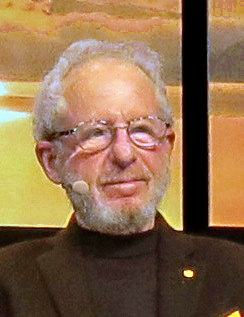
图:Vogler · CC BY-SA 3.0 · Wikimedia Commons
- 出生
- 1936 年 1 月 22 日,苏城
- 国籍
- 美国
- 学科
- 物理学、化学、工程与发明、博物与综合
- 职业
- 物理学家、化学家、工程师、大学教师
- 母语 / 工作语言
- 英语
- 母校
- 内布拉斯加大学林肯分校(学士)、加州大学伯克利分校(哲学博士,1961 年)、奥马哈中央高中
- 工作单位
- 宾夕法尼亚大学、加利福尼亚大学圣巴巴拉分校、犹他大学、日内瓦大学
研究领域
师承
博士导师1
博士生2
来自 Wikidata 的「博士导师」「师从」「博士生」「学生」记录,可能不全。
所获奖项(9)
- 1983奥利弗·巴克利奖
- 1989约翰·斯科特奖
- 1995巴仁奖
- 2000诺贝尔化学奖
- 2007Gold medal of the Spanish National Research Council
- 2011美国科学促进会会士
- —古根海姆学者奖
- —honorary doctor of the University of Alicante
- —美国物理学会会士
学会与院士
百科正文
生平
黑格出生于衣阿华州苏城。1957年在内布拉斯加大学林肯分校获得物理及数学学士学位。1961年在伯克利加州大学获得物理学博士学位。2000年,由于对导电聚合物的研究和艾伦·麦克迪尔米德、白川英树一起获得了诺贝尔化学奖。如今他是圣塔芭芭拉加利福尼亚大学的教授。
以上内容摘自维基百科「艾伦·黑格」,按 CC BY-SA 4.0 使用,去掉了参考文献、外部链接等尾部小节,公式改写成了纯文本。全文、配图和出处见原文。
英文维基百科补充中文条目比较短,下面是英文条目「Alan J. Heeger」的原文
Alan Jay Heeger (born January 22, 1936) is an American physicist, academic and Nobel Prize laureate in chemistry.
Heeger was elected as a member into the National Academy of Engineering in 2002 for co-founding the field of conducting polymers and for pioneering work in making these novel materials available for technological applications.
Life and career
Heeger was born in Sioux City, Iowa, into a Jewish family. He grew up in Akron, Iowa, where his father owned a general store. At age nine, following his father's death, the family moved back to Sioux City.
Heeger earned a B.S. in physics and mathematics from the University of Nebraska in 1957, and a Ph.D in physics from the University of California, Berkeley in 1961. From 1962 to 1982 he was on the faculty of the University of Pennsylvania. In 1982 he commenced his present appointment as a professor in the Physics Department and the Materials Department at the University of California, Santa Barbara. His research has led to the formation of numerous start-up companies including Uniax, Konarka, and Sirigen, founded in 2003 by Guillermo C. Bazan, Patrick J. Dietzen, Brent S. Gaylord. Alan Heeger was a founder of Uniax, which was acquired by DuPont.
He won the Nobel Prize for Chemistry in 2000 along with Alan G. MacDiarmid and Hideki Shirakawa "for their discovery and development of conductive polymers"; They published their results on polyacetylene a conductive polymer in 1977. This led to the construction of the Su–Schrieffer–Heeger model, a simple model for topological insulators.
He had won the Oliver E. Buckley Prize of the American Physical Society in 1983 and, in 1995, the Balzan Prize for Science of Non-Biological Materials.
His sons are the neuroscientist David Heeger and the immunologist Peter Heeger.
In October 2010, Heeger participated in the USA Science and Engineering Festival's Lunch with a Laureate program where middle and high school students engage in an informal conversation with a Nobel Prize-winning scientist over a brown-bag lunch. Heeger is also a member of the USA Science and Engineering Festival's Advisory Board. Heeger has been a judge of the STAGE International Script Competition three times (2006, 2007, 2010).
"Perhaps the greatest pleasure of being a scientist is to have an abstract idea, then to do an experiment (more often a series of experiments is required) that demonstrates the idea was correct; that is, Nature actually behaves as conceived in the mind of the scientist. This process is the essence of creativity in science. I have been fortunate to have experienced this intense pleasure many times in my life."
Alan J Heeger, Never Lose Your Nerve!
Autobiography
Heeger, Alan J (2015). Never Lose Your Nerve!. doi:10.1142/9724. ISBN 978-981-4704-85-4., World Scientific Publishing, ISBN 978-981-4704-85-4
以上内容摘自英文维基百科「Alan J. Heeger」,按 CC BY-SA 4.0 使用,去掉了参考文献、外部链接等尾部小节,公式改写成了纯文本。全文、配图和出处见原文。
同年获同一奖项
同一学科、同时代的科学家


同一学科的科学家
更多 ›