格物

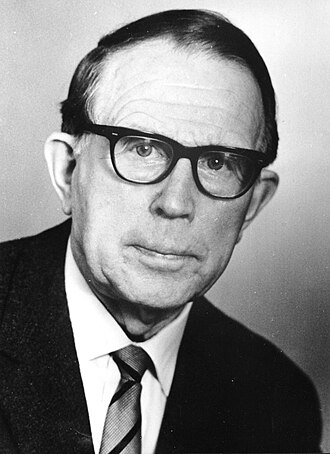
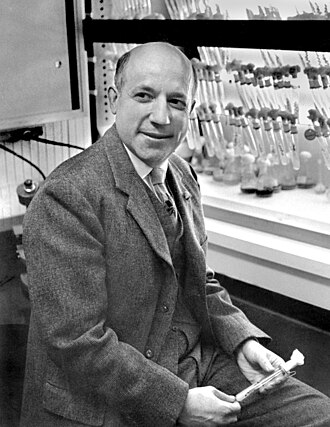
图:作者不详 · Public domain · Wikimedia Commons
乔治·波特1920—2002
George Porter
化学家, 英国
诺贝尔化学奖 1967戴维奖章 1971科普利奖章 1992
乔治·波特,陆登汉姆的波特男爵,OM,FRS,英国化学家,1967年获诺贝尔化学奖。
摘自维基百科「乔治·波特」,CC BY-SA 4.0
- 出生
- 1920 年 12 月 6 日,斯坦恩佛夫
- 逝世
- 2002 年 8 月 31 日,坎特伯雷
- 国籍
- 英国
- 学科
- 化学
- 职业
- 化学家、政治人物、大学教师
- 母语 / 工作语言
- 英语
- 母校
- 利兹大学(学士)、剑桥大学伊曼纽尔学院、剑桥大学、Trinity Academy
- 工作单位
- 谢菲尔德大学、伦敦大学学院、伦敦帝国学院、剑桥大学
研究领域
师承
博士生1
来自 Wikidata 的「博士导师」「师从」「博士生」「学生」记录,可能不全。
所获奖项(20)
学会与院士
百科正文
英文维基百科补充中文条目比较短,下面是英文条目「George Porter」的原文
George Porter, Baron Porter of Luddenham, (6 December 1920 – 31 August 2002) was a British chemist. He was awarded the Nobel Prize in Chemistry in 1967.
Education and early life
Porter was born in Stainforth, near Thorne, in the then West Riding of Yorkshire. He was educated at Thorne Grammar School, then won a scholarship to the University of Leeds and gained his first degree in chemistry. During his degree, Porter was taught by Meredith Gwynne Evans, who he said was the most brilliant chemist he had ever met. He was awarded a PhD from the University of Cambridge in 1949 for research investigating free radicals produced by photochemical means. He later became a Fellow of Emmanuel College, Cambridge.
Career and research
During the Second World War Porter served in the Royal Naval Volunteer Reserve. He then went on to do research supervised by Ronald George Wreyford Norrish at the University of Cambridge, where he began the work that ultimately led to them becoming Nobel laureates.
His original research in developing the technique of flash photolysis to obtain information on short-lived molecular species provided the first evidence of free radicals. His later research utilised the technique to study the detailed aspects of the light-dependent reactions of photosynthesis, with particular regard to possible applications to a hydrogen economy, of which he was a strong advocate.
From 1953 to 1954 he served as Assistant Director of the British Rayon Research Association, where he studied the phototendering of dyed cellulose fabrics in sunlight.
Porter served as professor in the Chemistry department at the University of Sheffield from 1954 to 1965. Here he started his work on flash photolysis with equipment designed and made in the departmental workshop. During this tenure he took part in a television programme describing his work in the "Eye on Research" series. Porter became Fullerian Professor of Chemistry at the Royal Institution in London and Director of the Royal Institution in 1966. During his directorship of the Royal Institution, Porter was instrumental in the setting up of Applied Photophysics, a company formed to supply instrumentation based on his group's work. He was awarded the Nobel Prize in Chemistry in 1967 along with Manfred Eigen and Ronald George Wreyford Norrish. In the same year he became a visiting professor at University College London.
Porter was a major contributor to the public understanding of science, and championed the cause of "not-yet-applied science".
He became president of the British Association in 1985 and was the founding Chair of the Committee on the Public Understanding of Science (COPUS). He gave the Romanes Lecture, entitled "Science and the human purpose", at the University of Oxford in 1978; and in 1988 he gave the Dimbleby Lecture, "Knowledge itself is power". From 1990 to 1993 he gave the Gresham lectures in astronomy.
Awards and honours
Porter was elected a Fellow of the Royal Society (FRS) in 1960, a member of the American Academy of Arts and Sciences in 1979, a member of the American Philosophical Society in 1986, and served as President of the Royal Society from 1985 to 1990. He was also awarded the Davy Medal in 1971, the Rumford Medal in 1978, the Ellison-Cliffe Medal in 1991 and the Copley Medal in 1992.
Porter received an Honorary Doctorate from Heriot-Watt University in 1971.
He was knighted in 1972, appointed to the Order of Merit in 1989, and became a life peer as Baron Porter of Luddenham, of Luddenham in the County of Kent, in 1990. In 1995, he was awarded an Honorary Degree (Doctor of Laws) from the University of Bath.
In 1976 he gave the Royal Institution Christmas Lecture on The Natural History of a Sunbeam.
Porter served as Chancellor of the University of Leicester between 1984 and 1995. In 2001, the university named its chemistry building the George Porter Building in his honour.
Family
In 1949 Porter married Stella Jean Brooke.
以上内容摘自英文维基百科「George Porter」,按 CC BY-SA 4.0 使用,去掉了参考文献、外部链接等尾部小节,公式改写成了纯文本。全文、配图和出处见原文。
同年获同一奖项
同一学科、同时代的科学家


同一学科的科学家
更多 ›