格物
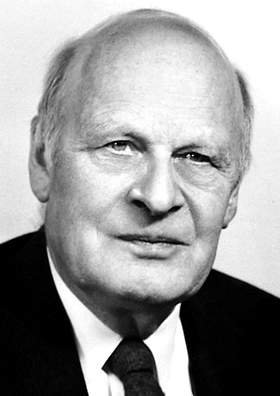
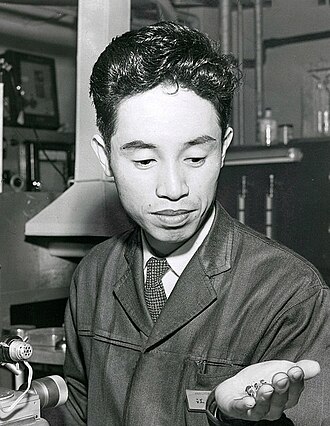
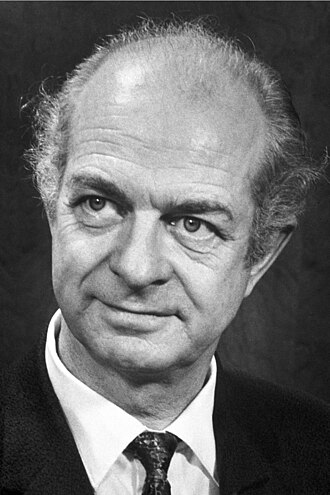
图:作者不详 · Public domain · Wikimedia Commons
拉斯·昂萨格1903—1976
Lars Onsager
物理学家, 挪威
拉斯·昂萨格,挪威出生的美国化学家。他因发现非平衡态热力学的一般关系,提出了倒易关系而获得1968年诺贝尔化学奖。
摘自维基百科「拉斯·昂萨格」,CC BY-SA 4.0
- 出生
- 1903 年 11 月 27 日,克里斯蒂安尼亚
- 逝世
- 1976 年 10 月 5 日,科勒尔盖布尔斯
- 国籍
- 挪威、美国、荷兰王国
- 学科
- 物理学、化学、工程与发明、博物与综合
- 职业
- 物理学家、工程师、化学家、理论物理学家
- 母语 / 工作语言
- 荷兰语
- 母校
- 耶鲁大学、挪威理工学院(1925 年)
- 工作单位
- 布朗大学(?—1933)、苏黎世联邦理工学院(1926—1928)、约翰·霍普金斯大学(1928—)、耶鲁大学(1933—)、莱顿大学、圣迭戈加利福尼亚大学、莱顿大学(1969—)
研究领域
主要贡献
本站收录的发现与发明
以他 / 她命名
师承
博士导师1
博士生5
来自 Wikidata 的「博士导师」「师从」「博士生」「学生」记录,可能不全。
所获奖项(11)
- 1953伦福德奖金
- 1954名誉博士
- 1958洛仑兹奖章
- 1962威拉德·吉布斯奖
- 1964约西亚·威拉德·吉布斯讲座
- 1965彼得·德拜奖
- 1968诺贝尔化学奖
- 1968美国国家科学奖章
- 1972Wilbur Lucius Cross奖章
- 1975英国皇家学会外籍会员
- —美国物理学会会士
学会与院士
百科正文
生平
拉斯·昂萨格1903年出生于挪威奥斯陆。1925年,他取得挪威理工学院化学工程学学位,并于同年前往当时欧洲物理化学研究的中心——瑞士苏黎世联邦理工学院从事电解质溶液的研究。1928年,昂萨格转往美国,开始在霍普金斯大学担任教职。1929年,由于教学成绩欠佳,昂萨格被霍普金斯大学解聘,被迫前往布朗大学。他于1935年在耶鲁大学完成博士论文并与1945年成为耶鲁大学教授。1976年去世于佛罗里达州迈阿密。
以上内容摘自维基百科「拉斯·昂萨格」,按 CC BY-SA 4.0 使用,去掉了参考文献、外部链接等尾部小节,公式改写成了纯文本。全文、配图和出处见原文。
英文维基百科补充中文条目比较短,下面是英文条目「Lars Onsager」的原文
Lars Onsager (27 November 1903 – 5 October 1976) was a Norwegian American physical chemist and theoretical physicist. He held the Gibbs Professorship of Theoretical Chemistry at Yale University. He was awarded the Nobel Prize in Chemistry in 1968.
Education and early life
Lars Onsager was born in Kristiania (now Oslo), Norway. His father was a lawyer. After completing secondary school in Oslo, he attended the Norwegian Institute of Technology (NTH) in Trondheim, graduating as a chemical engineer in 1925. While there, he worked through A Course of Modern Analysis, which was instrumental in his later work.
Career and research
In 1925, he arrived at a correction to the Debye–Hückel theory of electrolytic solutions, to specify Brownian movement of ions in solution, and during 1926 published it. He traveled to Zürich, where Peter Debye was teaching, and confronted Debye, telling him his theory was wrong. He impressed Debye so much that he was invited to become Debye's assistant at the Eidgenössische Technische Hochschule (ETH), where he remained until 1928.
Johns Hopkins University
In 1928, he went to the United States to take a faculty position at the Johns Hopkins University (JHU) in Baltimore, Maryland. At JHU, he had to teach freshman classes in chemistry, and it quickly became apparent that, while he was a genius at developing theories in physical chemistry, he had little talent for teaching. He was dismissed by JHU after one semester.
Brown University
On leaving JHU, he accepted a position (involving the teaching of statistical mechanics to graduate students in chemistry) at Brown University in Providence, Rhode Island, where it became clear that he was no better at teaching advanced students than freshmen, but he made significant contributions to statistical mechanics and thermodynamics. His graduate student Raymond Fuoss worked under him and eventually joined him on the Yale chemistry faculty. His statistical mechanics course was nicknamed "Sadistical Mechanics" by the students.
His research at Brown was concerned mainly with the effects on diffusion of temperature gradients, and produced the Onsager reciprocal relations in statistical mechanics, a set of equations published in 1929 and, in an expanded form, in 1931, whose importance went unrecognized for many years. However, their value became apparent during the decades following World War II, and by 1968 they were considered important enough to gain Onsager that year's Nobel Prize in Chemistry.
Research
Exact solution of the 2D Ising model
To solve the 2D Ising model, Onsager began by diagonalizing increasingly large transfer matrices. He said that this was because he had a lot of time during WWII. He began by computing the 2 × 2 transfer matrix of the 1D Ising model, which had already been solved by Ernst Ising himself. He then computed the transfer matrix of the "Ising ladder", meaning two 1D Ising models side-by-side, connected by links. The transfer matrix is then 4 × 4. He repeated this for up to six 1D Ising models, resulting in transfer matrices of up to 64 × 64. He diagonalized all of them and found that all the eigenvalues were of a special form, so he guessed that the algebra of the problem was an associative algebra (later called the Onsager algebra).
The solution involved generalized quaternion algebra and the theory of elliptic functions, which he learned from A Course of Modern Analysis.
Personal life
He remained in Florida until his death from an aneurysm in Coral Gables, Florida in 1976. Onsager was buried next to John Gamble Kirkwood at New Haven's Grove Street Cemetery. While Kirkwood's tombstone has a long list of awards and positions, including the American Chemical Society Award in Pure Chemistry, the Richards Medal, and the Lewis Award, Onsager's tombstone, in its original form, simply said "Nobel Laureate". When Onsager's wife, Gretel, died in 1991 and was buried there, his children added an asterisk after "Nobel Laureate" and "*etc." in the lower-right corner of the stone. He was identified as a Protestant.
Legacy
The Norwegian Institute of Technology established the Lars Onsager Lecture and The Lars Onsager Professorship in 1993 to award outstanding scientists in the scientific fields of Lars Onsager; Chemistry, Physics and Mathematics. The American Physical Society established Lars Onsager Prize in statistical physics in 1993. In 1997, his sons and daughter donated his scientific works and professional belongings to NTNU (before 1996, NTH) in Trondheim, Norway, his alma mater. These are now organized as The Lars Onsager Archive at the Gunnerus Library in Trondheim.
以上节选摘自英文维基百科「Lars Onsager」,按 CC BY-SA 4.0 使用,去掉了参考文献、外部链接等尾部小节,公式改写成了纯文本。篇幅所限,较长的小节只摘了开头一部分,有的小节没有收;全文、配图和出处见原文。
同一学科、同时代的科学家

同一学科的科学家
更多 ›