格物
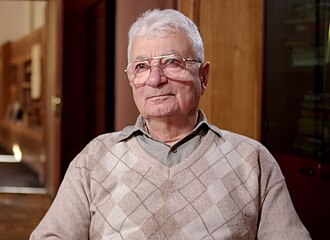
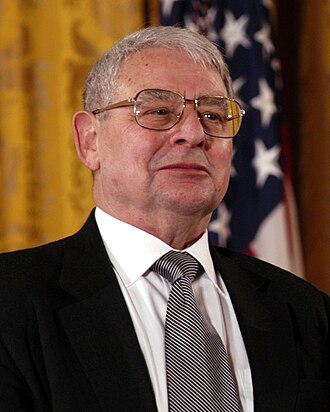
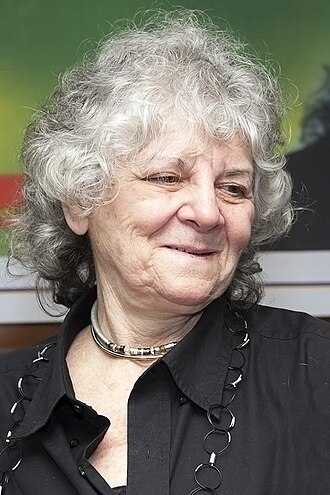
图:VPRO · CC BY-SA 3.0 nl · Wikimedia Commons
尤里·奥加涅相1933—
Yuri Oganessian
Russian nuclear physicist
尤里·特索罗克维奇·奥加涅相,亚美尼亚裔俄罗斯原子核物理学家。出生于俄罗斯著名城市顿河畔罗斯托夫,曾与其领导的实验小组发现元素周期表最重的元素。他是继格伦·西奥多·西博格之后第二位在世时名字被用来命名化学元素的人。
摘自维基百科「尤里·奥加涅相」,CC BY-SA 4.0
- 出生
- 1933 年 4 月 14 日,顿河畔罗斯托夫
- 国籍
- 俄罗斯、亚美尼亚、苏联
- 学科
- 物理学、博物与综合
- 职业
- 核物理学家、物理学家
- 母语 / 工作语言
- 英语、俄语
- 母校
- 国家核子研究大学(1956 年)
- 工作单位
- 杜布纳联合原子核研究所
研究领域
主要贡献
代表成就
发现的元素
以他 / 她命名
师承
博士导师1
来自 Wikidata 的「博士导师」「师从」「博士生」「学生」记录,可能不全。
所获奖项(25)
- 1975苏联国家奖
- 1989Kurchatov Medal
- 2000Lise Meitner Prize
- 2000Ernst Mach Medal
- 2017Order "For Merit to the Fatherland", 2nd class
- 2017罗蒙诺索夫金质奖章
- —荣誉勋章
- —红旗劳动勋章
- —各民族人民友谊勋章
- —荣誉徽章勋章
- —“纪念莫斯科诞辰850周年”奖章
- —列宁共青团奖
- —honorary doctorate of the Johann Wolfgang Goethe University Frankfurt
- —Officer's Cross of the Order of Merit of the Republic of Poland
- —honorary doctor of the Yerevan State University
- —honorary doctor of the D. Mendeleev University of Chemical Technology of Russia
- —纪念列宁诞辰一百周年奖章
- —圣梅斯罗布奖章
- —Order of the Badge of Honour
- —Medal of Friendship
- —波兰共和国功绩勋章
- —俄罗斯联邦国家奖
- —杰米多夫奖
- —俄罗斯联邦政府荣誉证书
- —honorary citizen of Moscow Oblast
学会与院士
百科正文
经历
奥加涅相于1956年毕业于莫斯科工程物理学院,并分配到杜布纳联合原子核研究所工作,后担任该所弗廖罗夫核反应实验室主任和首席科学家。2009年,国际纯粹与应用物理学会承认了他所发现的新元素𫓧,并用弗廖罗夫核反应实验室命名(Flerovium)。2016年11月,国际纯化学和应用化学联合会宣布把奥加涅相发现的第118号元素命名为鿫。
以上内容摘自维基百科「尤里·奥加涅相」,按 CC BY-SA 4.0 使用,去掉了参考文献、外部链接等尾部小节,公式改写成了纯文本。全文、配图和出处见原文。
英文维基百科补充中文条目比较短,下面是英文条目「Yuri Oganessian」的原文
Yuri Tsolakovich Oganessian (born 14 April 1933) is a Russian and Armenian nuclear physicist who is best known as a researcher of superheavy elements. He has led the discovery of multiple chemical elements. He succeeded Georgy Flyorov as director of the Flyorov Laboratory of Nuclear Reactions at the Joint Institute for Nuclear Research in 1989 and is now its scientific director. The heaviest known element, oganesson, is named after him, only the second time that an element was named after a living person, and the only one who is still alive (the other is seaborgium, named for Glenn T. Seaborg, who died in 1999).
Personal life
Yuri Tsolakovich Oganessian was born in Rostov-on-Don, Russian SFSR, USSR on 14 April 1933 to Armenian parents. His father, Tsolak, was from Igdir (now in Turkey), while his mother was from Armavir in what is now Russia's Krasnodar Krai. Oganessian spent his childhood in Yerevan, the capital of Soviet Armenia, where his family relocated in 1939. His father, a thermal engineer, was invited to work on the synthetic rubber plant in Yerevan. After the Eastern Front of World War II commenced, his family decided to not return to Rostov since it was occupied by Germans. Yuri attended and finished school in Yerevan. He initially wanted to become a painter.
Oganessian was married to Irina Levonovna (1932–2010), a violinist and a music teacher in Dubna, with whom he had two daughters. As of 2017, his daughters resided in the U.S.
Oganessian speaks Russian, Armenian, and English.
Career
Oganessian graduated from the Moscow Engineering Physics Institute (MEPhI) in 1956. He thereafter sought to join the Kurchatov Institute of Atomic Energy in Moscow, but as there were no vacancies left in Gersh Budker's team, he was instead recruited by Georgy Flyorov and began working at the Joint Institute for Nuclear Research (JINR) in Dubna, near Moscow.
Oganessian became director of the Flyorov Laboratory of Nuclear Reactions at JINR in 1989, after Flyorov retired, and had the job until 1996, when he was named the scientific director of the Flyorov laboratory.
Discovery of superheavy chemical elements
During the 1970s, Oganessian invented the "cold fusion" method, a technique to produce transactinide elements (superheavy elements). Though they share a name, this process is unrelated to the unproven energy-producing process also named cold fusion. Oganessian's process was crucial for the discoveries of elements from 106 to 113. From the mid-1970s to the mid-1990s, the partnership of JINR, directed by Oganessian, and the GSI Helmholtz Centre for Heavy Ion Research in Germany resulted in the discovery of six chemical elements (107 to 112): bohrium, meitnerium, hassium, darmstadtium, roentgenium, and copernicium.
His newer technique, termed "hot fusion" (also unrelated to nuclear fusion as an energy process), helped lead to the discovery of elements 113 to 118, completing the seventh row of the periodic table.
Recognition
Sherry Yennello has called him the "grandfather of superheavy elements". Oganessian is the author of three discoveries, a monograph, 11 inventions, and more than 300 scientific papers.
Oganessian has been considered worthy of a Nobel laureate in Chemistry, including by Alexander Sergeev, former head of the Russian Academy of Sciences.
Oganesson
During early 2016, science writers and bloggers speculated that one of the superheavy elements would be named oganessium or oganesson. The International Union of Pure and Applied Chemistry (IUPAC) announced in November 2016 that element 118 would be named oganesson to honor Oganessian. It was first observed in 2002 at JINR, by a joint team of Russian and American scientists. Directed by Oganessian, the team included American scientists of the Lawrence Livermore National Laboratory, California. Prior to this announcement, a dozen elements had been named after people, but of those, only seaborgium was likewise named while its namesake (Glenn T. Seaborg) was alive. (The names einsteinium and fermium were suggested when their namesakes, respectively Albert Einstein and Enrico Fermi, were still alive; however, by the time the names became official, Einstein and Fermi had both died.) As Seaborg died in 1999, Oganessian is the only currently living namesake of an element.
Honors and awards
In 1990, Oganessian was elected Corresponding Member of the Soviet Academy of Sciences and in 2003 a Full Member (Academician) of the Russian Academy of Sciences.
以上节选摘自英文维基百科「Yuri Oganessian」,按 CC BY-SA 4.0 使用,去掉了参考文献、外部链接等尾部小节,公式改写成了纯文本。篇幅所限,较长的小节只摘了开头一部分,有的小节没有收;全文、配图和出处见原文。
同年获同一奖项
同一学科、同时代的科学家


同一学科的科学家
更多 ›