格物
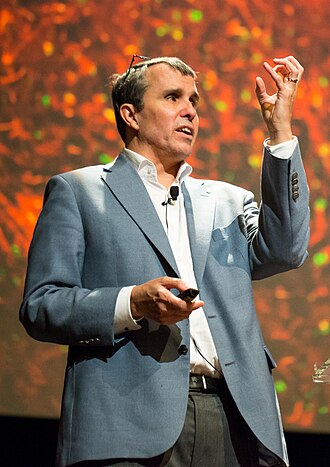
图:Ecole polytechnique Université Paris-Saclay · CC BY-SA 2.0 · Wikimedia Commons
艾力克·贝齐格1960—
Eric Betzig
物理学家, 美国
埃里克·贝齐格,美国神经科学家、发明家、应用物理学家,美国加州大学伯克利分校物理学教授、分子生物学教授。 贝齐格还担任弗吉尼亚州的珍利亚农场研究园区的高级研究员。
摘自维基百科「艾力克·貝齊格」,CC BY-SA 4.0
- 出生
- 1960 年 1 月 13 日,安阿伯
- 国籍
- 美国
- 学科
- 物理学、化学、博物与综合
- 职业
- 物理学家、化学家
- 母语 / 工作语言
- 英语
- 母校
- 加州理工学院、康奈尔大学、康乃尔大学工学院、Pioneer High School
- 工作单位
- 霍华德·休斯医学研究所
研究领域
所获奖项(3)
- 1993国家科学院创新研究奖
- 2014诺贝尔化学奖
- —纽科姆·克利夫兰奖
学会与院士
百科正文
贝齐格先后毕业于加州理工学院的物理学系和康奈尔大学的工程物理学博士专业,后在贝尔实验室工作。其主要贡献是研发了用于分子生物学、神经科学的光学成像工具。2014年,因研制出“超分辨率萤光显微镜”,与斯特凡·W·黑尔、W·E·莫纳共同获得诺贝尔化学奖。
生活和事业
贝齐格出生于美国密歇根州的安娜堡,他是罗伯特·贝齐格的儿子。在大学时,贝齐格在加州理工学院学习物理,并且于1983年毕业获得了学士学位。然后,他继续在康奈尔大学学习,分别在1985年和1988年,他在应用物理学和工程物理学分别获得了硕士学位和博士学位。
在获得博士学位后,贝齐格就职于贝尔实验室半导体物理研究部门。在1996年,贝齐格离开学术界,到当时他父亲拥有的安娜堡机械公司,成为研究开发的副总裁。在这里,他开发了灵活的自适应液压伺服技术(FAST),但并没有取得商业上的成功。
然后,贝齐格回到显微镜领域,开发光敏定位显微镜(PALM),并在2006年,他加入了霍华德·休斯医学研究所的珍利亚农场研究园区作为组长,开发超高分辨率的荧光显微镜技术。
他的妻子吉娜是安徽蚌埠人,毕业于蚌埠市第一中学和中国科学技术大学,两人在加州大学伯克利分校认识并结婚。
获奖
在1992年,贝齐格被授予威廉·麦克米兰奖,并且在1993年,他获得美国国家科学院的研究倡议科学奖。在2014年,贝齐格与斯特凡·W·黑尔、W·E·莫纳共同获得诺贝尔化学奖。
以上内容摘自维基百科「艾力克·貝齊格」,按 CC BY-SA 4.0 使用,去掉了参考文献、外部链接等尾部小节,公式改写成了纯文本。全文、配图和出处见原文。
英文维基百科补充中文条目比较短,下面是英文条目「Eric Betzig」的原文
Robert Eric Betzig (born January 13, 1960) is an American physicist who works as a professor of physics and professor of molecular and cell biology at the University of California, Berkeley. He is also a senior fellow at the Janelia Farm Research Campus in Ashburn, Virginia.
Betzig has worked to develop the field of fluorescence microscopy and photoactivated localization microscopy. He was awarded the 2014 Nobel Prize in Chemistry for "the development of super-resolved fluorescence microscopy" along with Stefan Hell and fellow Cornell alumnus William E. Moerner.
Early life and education
Betzig was born in Ann Arbor, Michigan, in 1960, the son of Helen Betzig and engineer Robert Betzig. Aspiring to work in the aerospace industry, Betzig studied physics at the California Institute of Technology and graduated with a BS degree in 1983. He then went on to study at Cornell University where Michael Isaacson was his supervisor, and he also worked with Aaron Lewis. There he obtained an MS degree and a PhD degree in applied physics and engineering physics in 1985 and 1988, respectively. For his PhD he focused on developing high-resolution optical microscopes that could see past the theoretical limit of 0.2 micrometers.
Career
Bell Laboratories
After receiving his doctorate, Betzig was hired by AT&T Bell Laboratories in the Semiconductor Physics Research Department in 1989. That year Betzig's colleague, William E. Moerner, developed the first optical microscope that could see past the.2 micrometer limit, known as the Abbe limit, but it could only function at temperatures near absolute zero. Inspired by Moerner's research, Betzig became the first person to image individual fluorescent molecules at room temperature while determining their positions within less than.2 micrometers in 1993. For this he received the William O. Baker Award for Initiatives in Research (previously known as the National Academy of Sciences Award for Initiatives in Research). Betzig was also awarded the William L. McMillan Award in 1992.
Ann Arbor Machine Company
In 1994, Betzig became frustrated with the academic community and the uncertainty of the corporate structure of Bell Laboratories, prompting him to leave both. He spent some years as a stay-at-home dad before reentering the workforce in 1996, when he took up the position of vice president of research and development at Ann Arbor Machine Company, which was partially owned by the Betzig family. Here he developed Flexible Adaptive Servohydraulic Technology (FAST), but after spending millions of dollars on development he only sold two devices.
Return to academia
In 2002, Betzig returned to the field of microscopy and founded New Millennium Research in Okemos, Michigan. Inspired by Mike Davidson's work with fluorescent proteins, he developed photoactivated localization microscopy (PALM), a method of controlling fluorescent proteins that used pulses of light to create images of a higher resolution than were previously thought possible. In the living room of his old Bell Labs collaborator Harald Hess, Betzig and Hess developed the first optical microscope based on this technology. They built their first prototype in under two months, earning them widespread attention. In October of that year, the Howard Hughes Medical Institute's Janelia Farm Research Campus hired him, but his lab was still under construction at the time.
In early 2006, he formally joined Janelia as a group leader to work on developing super high-resolution fluorescence microscopy techniques. He used this technique to study the division of cells in human embryos. In 2010, he was offered the Max Delbruck Prize, but he declined it and Xiaowei Zhuang received the award. In 2014, Betzig was jointly awarded the Nobel Prize in Chemistry along with Stefan Hell and William E. Moerner.
Selected research papers
1993: Single molecules observed by near-field scanning optical microscopy, E Betzig, RJ Chichester – Science
1992: Near-field optics: microscopy, spectroscopy, and surface modification beyond the diffraction limit, E Betzig, JK Trautman – Science
2006: Imaging intracellular fluorescent proteins at nanometer resolution, E Betzig, GH Patterson, R Sougrat.
2014: Lattice light-sheet microscopy: imaging molecules to embryos at high spatiotemporal resolution, G Seydoux, US Tulu, DP Kiehart, E Betzig
Personal life
Betzig has married twice. His first wife was condensed matter physicist Ruby Ghosh, with whom he has two sons, Cayden and Ravi. His second wife is biophysicist Na Ji, with whom he has three children, Max, Mia and Zoe.
以上节选摘自英文维基百科「Eric Betzig」,按 CC BY-SA 4.0 使用,去掉了参考文献、外部链接等尾部小节,公式改写成了纯文本。篇幅所限,较长的小节只摘了开头一部分,有的小节没有收;全文、配图和出处见原文。
同年获同一奖项
同一学科、同时代的科学家





同一学科的科学家
更多 ›