格物
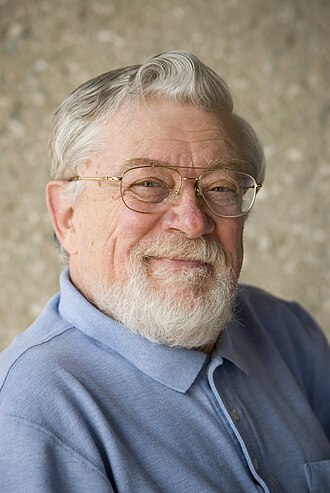
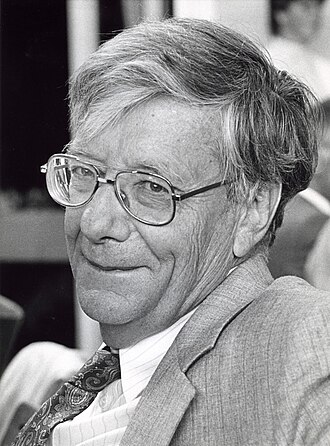
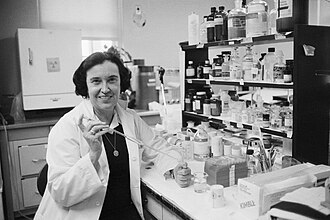
图:Bill Youngblood/California Institute of Technology · CC BY-SA 4.0 · Wikimedia Commons
唐·L·安德森1933—2014
Don L. Anderson
American geophysicist (1933-2014)
Don Lynn Anderson was an American geophysicist who made significant contributions to the understanding of the origin, evolution, structure, and composition of Earth and other planets. An expert in numerous scientific disciplines, Anderson's work combined seismology, solid state physics, geochemistry and petrology to explain how the Earth works. Anderson was best known for his contributions to the understanding of the Earth's deep interior, and more recently, for the plate theory hypothesis that hotspots are the product of plate tectonics rather than narrow plumes emanating from the deep Earth. Anderson was Professor (Emeritus) of Geophysics in the Division of Geological and Planetary Sciences at the California Institute of Technology (Caltech). He received numerous awards from geophysical, geological and astronomical societies. In 1998 he was awarded the Crafoord Prize by the Royal Swedish Academy of Sciences along with Adam Dziewonski. Later that year, Anderson received the National Medal of Science. He held honorary doctorates from Rensselaer Polytechnic Institute and the University of Paris (Sorbonne), and served on numerous university advisory committees, including those at Harvard, Princeton, Yale, University of Chicago, Stanford, University of Paris, Purdue University, and Rice University. Anderson's wide-ranging research resulted in hundreds of published papers in the fields of planetary science, seismology, mineral physics, petrology, geochemistry, tectonics and the philosophy of science.
摘自英文维基百科「Don L. Anderson」(英文维基百科,暂无中文条目),CC BY-SA 4.0
- 出生
- 1933 年 3 月 5 日,弗雷德里克
- 逝世
- 2014 年 12 月 2 日,坎布里亚
- 国籍
- 美国
- 学科
- 物理学、化学、地球科学、博物与综合
- 职业
- 地质学家、大学教师、地球物理学家、地震学家
- 母语 / 工作语言
- 英语
- 母校
- 加州理工学院、伦斯勒理工学院、Baltimore Polytechnic Institute
- 工作单位
- 加州理工学院
研究领域
师承
博士导师1
博士生2
来自 Wikidata 的「博士导师」「师从」「博士生」「学生」记录,可能不全。
所获奖项(11)
- 1966James B. Macelwane Medal
- 1973美国地球物理联盟会士
- 1986Emil Wiechert Medal
- 1987Arthur L. Day Medal
- 1988英国皇家天文学会金质奖章
- 1991威廉·鲍伊奖章
- 1998美国国家科学奖章
- 1998Crafoord Prize in Geosciences
- —古根海姆学者奖
- —美国科学促进会会士
- —美国文理科学院院士
学会与院士
百科正文
本条目暂无中文维基百科条目,下面是英文维基百科原文。
Life and main scientific contributions
Born in Frederick, Maryland, in 1933, Anderson moved to Baltimore when he was six. He graduated from Baltimore Polytechnic Institute then attended Rensselaer Polytechnic Institute (RPI) where he earned a Bachelor of Science in geology and geophysics in 1955. He then worked in the oil industry in California, Montana and Wyoming, and served in the Air Force in Massachusetts and Thule, Greenland before moving to California, where he received a Ph.D. in geophysics and mathematics at Caltech in 1962. He spent most of his subsequent academic career at Caltech's Seismological Laboratory, becoming its second longest serving director from 1967 to 1989. He was married to Nancy Ruth Anderson, had two children, Lynn Anderson Rodriguez and Lee Weston Anderson, and four granddaughters.
Anderson began his scientific career while serving in the U.S. Air Force. In Greenland, he studied the properties of sea ice. Anderson was charged with determining whether the ice was strong enough to withstand the landing of heavy aircraft. In working with his colleague, Dr. Wilford Weeks, on scientific papers resulting from the research, it became clear to Anderson that he needed more education. He chose to attend Caltech in geophysics. Anderson's thesis focused on the anisotropic, or directionally dependent, properties of the mantle. It analyzed wave propagation in layered complex media. Prior to Anderson's work, seismologists had assumed that the Earth's interior behaved like glass, and was isotropic. After completing his Ph.D.
Technical details
Showed that anisotropy and anelasticity were important in the propagation of seismic waves in the Earth.
Introduced frequency dependent and polarization effects into modern seismology. This made it possible to resolve discrepancies between various types of seismic data (body waves, normal models; Rayleigh-Love wave discrepancy) and to combine all types of data into a single inversion.
Developed theory for frequency dependence of both wavespeeds and anelasticity (Q) and applied this to the mantle and core (Absorption Band Model).
Developed methods for inverting surface waves for anisotropic structures (Universal Dispersion Curves).
Showed (with Minster) how microphysics could explain how short period phenomena could be related to long term rheology.
With Nataf, Nakanishi, Tanimoto, Montagner, Regan developed first 3D structures of the anisotropic mantle.
Awards and honors
- James B. Macelwane Medal of the American Geophysical Union (1966)
- Apollo Achievement Award of the National Aeronautics and Space Administration 1969
- Fellow of the American Academy of Arts and Sciences (1972)
- Fellow of the American Geophysical Union (1973)
Newcomb Cleveland Prize of the American Association for the Advancement of Science (1977) (Viking Mission Scientists)
- NASA Exceptional Scientific Achievement Medal (1977)
- Member of the National Academy of Sciences (1982)
- Honorary Foreign Fellow of the European Union of Geosciences (1985)
- Emil Wiechert Medal of the German Geophysical Society (1986)
- Arthur L. Day Medal of the Geological Society of America (1987)
- Fellow of the American Association for the Advancement of Science (1988)
- Gold Medal of the Royal Astronomical Society (1988)
- Member of the American Philosophical Society (1990)
- William Bowie Medal of the American Geophysical Union (1991)
- Guggenheim Fellow (1998)
- Crafoord Prize of the Royal Swedish Academy of Science (1998 with Dziewonski)
- National Medal of Science (1998)
Honorary doctorates from Rensselaer Polytechnic Institute (RPI) and University of Paris (Sorbonne)
Important publications
A. M. Dziewonski; D. L. Anderson. (1981). Preliminary reference Earth model; Physics of the Earth and Planetary Interiors 25, S.297–356.
D. L. Anderson. (2007). New Theory of the Earth; Cambridge University Press, New York.
D. L. Anderson. (1989). Theory of the Earth; Blackwell Scientific Publications.
Don L. Anderson and James H. Natland. (2014) Mantle updrafts and mechanisms of oceanic volcanism; Proceedings of the National Academy of Sciences [1] vol. 111 no. 41. doi:10.1073/pnas.1410229111.
D. L. Anderson. (2013). The persistent mantle plume myth - Do plumes exist?; Australian Journal of Earth Sciences: and James H. Natland. doi:10.1080/08120099.2013.835283
Anderson, Don L. (2011). Hawaii, Boundary Layers and Ambient Mantle - Geophysical Constraints, J. Petrol., 52, 1547–1577; doi:10.1093/petrology/egq068.
G. R. Foulger, D. L. Anderson. (2005). A cool model for the Iceland hotspot; Journal of Volcanology and Geothermal Research 141.
Anderson, D. L. (2005). Self-gravity, self-consistency, and self-organization in geodynamics and geochemistry, in Earth's Deep Mantle: Structure, Composition, and Evolution, Eds. R.D. van der Hilst, J. Bass, J. Matas & J. Trampert, AGU Geophysical Monograph Series 160, 165–186.
Anderson, D. L. (2005). Scoring hotspots: The plume and plate paradigms, in Foulger, G.R., Natland, J.H., Presnall, D.C., and Anderson, D.L., eds., Plates, plumes, and paradigms: Geological Society of America Special Paper 388, p. 31–54.
以上节选摘自英文维基百科「Don L. Anderson」,按 CC BY-SA 4.0 使用,去掉了参考文献、外部链接等尾部小节,公式改写成了纯文本。篇幅所限,较长的小节只摘了开头一部分,有的小节没有收;全文、配图和出处见原文。
同年获同一奖项
同一学科、同时代的科学家


同一学科的科学家
更多 ›