格物
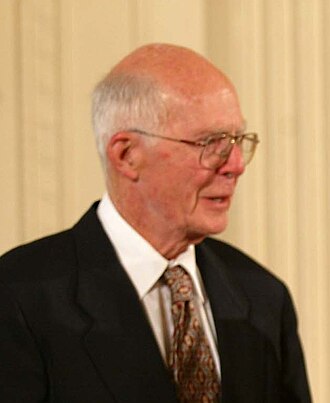
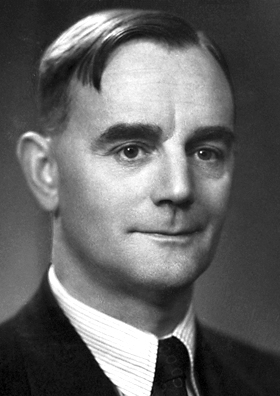
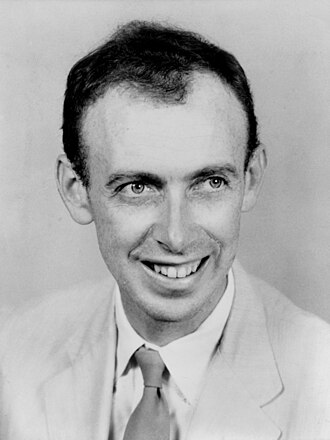
图:National Science Foundation · Public domain · Wikimedia Commons
雷蒙德·戴维斯1914—2006
Raymond Davis Jr.
物理学家, 美国
小雷蒙德·“雷”·戴维斯,美国物理学家、化学家,戴维斯、小柴昌俊与里卡尔多·贾科尼,共同获颁2002年诺贝尔物理学奖,戴维斯与小柴昌俊因“在天体物理学中的开创性贡献,特别是探测宇宙中微子”共享一半奖金、另一半颁给里卡尔多·贾科尼。
摘自维基百科「小雷蒙德·戴维斯」,CC BY-SA 4.0
- 出生
- 1914 年 10 月 14 日,华盛顿哥伦比亚特区
- 逝世
- 2006 年 5 月 31 日,纽约
- 国籍
- 美国
- 学科
- 物理学、化学、博物与综合
- 职业
- 物理学家、化学家、大学教师
- 母语 / 工作语言
- 英语
- 母校
- 耶鲁大学
- 工作单位
- 布鲁克黑文国家实验室、孟山都、宾夕法尼亚大学
研究领域
所获奖项(11)
学会与院士
百科正文
生平
1942年,戴维斯以预备役军官身份加入陆军,随后在犹他州的达格韦试验场(Dugway Proving Ground)度过了第二次世界大战的大部分时光;在那里,他既观察化学武器的试验结果,也考察大盐湖盆地,以寻找该湖前身—邦纳维尔湖(Lake Bonneville)存在的证据。
1945年退休后,戴维斯进入俄亥俄州迈阿米斯堡(Miamisburg)孟山都公司芒德实验室(Mound Laboratory)工作,从事美国原子能委员会感兴趣的应用放射化学研究。1948年,他加入布鲁克海文国家实验室,当时正致力于探索核能的和平利用途径。
据戴维斯回忆,当时他被要求“找一个有趣的研究主题”,于是他将整个职业生涯投入了中微子的研究中。中微子是一种为解释β衰变过程而预言存在的粒子,但在当时,其独立存在的特性尚未被证实。戴维斯着手研究如何透过β衰变来探测中微子-也就是利用中微子向原子核传递足够的能量,使某些稳定同位素转变为放射性同位素的过程。由于该过程的发生率极低,中微子实验中产生的放射性原子数量微乎其微;因此,戴维斯开始研究除β衰变以外、可能产生类似中微子讯号的其他过程及其发生率。
以上内容摘自维基百科「小雷蒙德·戴维斯」,按 CC BY-SA 4.0 使用,去掉了参考文献、外部链接等尾部小节,公式改写成了纯文本。全文、配图和出处见原文。
英文维基百科补充中文条目比较短,下面是英文条目「Raymond Davis Jr.」的原文
Raymond Davis Jr. (October 14, 1914 – May 31, 2006) was an American chemist and physicist. He is best known as the leader of the Homestake experiment in the 1960s-1980s, which was the first experiment to detect neutrinos emitted from the Sun; for this he shared the 2002
Nobel Prize in Physics.
Early life and education
Davis was born in Washington, D.C., where his father was a photographer for the National Bureau of Standards. He spent several years as a choirboy to please his mother, although he could not carry a tune. He enjoyed attending the concerts at the Watergate before air traffic was loud enough to drown out the music. His brother Warren, 14 months younger than he, was his constant companion in boyhood. He received his B.S. from the University of Maryland in 1938 in chemistry, which is part of the University of Maryland College of Computer, Mathematical, and Natural Sciences. He also received a master's degree from that school and a Ph.D. from Yale University in physical chemistry in 1942.
Career
After entering the Army as a reserve officer in 1942, Davis spent most of World War II at Dugway Proving Ground, Utah observing the results of chemical weapons tests and exploring the Great Salt Lake basin for evidence of its predecessor, Lake Bonneville.
After his discharge from the Army in 1945, Davis went to work at Monsanto's Mound Laboratory, in Miamisburg, Ohio, doing applied radiochemistry of interest to the United States Atomic Energy Commission. In 1948, he joined Brookhaven National Laboratory, which was attempting to find peaceful uses for nuclear power.
Davis reports that he was asked "to find something interesting to work on," and dedicated his career to the study of neutrinos, particles which had been predicted to explain the process of beta decay, but whose separate existence had not been confirmed. Davis investigated the detection of neutrinos by beta decay, the process by which a neutrino brings enough energy to a nucleus to make certain stable isotopes into radioactive ones.
Personal life
Davis met his wife Anna Torrey at Brookhaven and together they built a 21-foot wooden sailboat, the Halcyon. They had five children and lived in the same house in Blue Point, New York for over 50 years. On May 31, 2006, he died in Blue Point, New York, from complications of Alzheimer's disease.
Honors and awards
- 2003, Benjamin Franklin Medal (with John N. Bahcall and Masatoshi Koshiba)
- 2002, Nobel Prize in Physics (with Masatoshi Koshiba)
- 2001, National Medal of Science
- 2000, Wolf Prize in Physics
- 1996, George Ellery Hale Prize of the American Astronomical Society
- 1994, Beatrice M. Tinsley Prize of the American Astronomical Society
- 1992, W. K. H. Panofsky Prize of the American Physical Society
- 1988, Tom W. Bonner Prize of the American Physical Society
- 1978, Comstock Prize in Physics of the National Academy of Sciences
Notable works
Davis, Raymond Jr. (1953). "Attempt to detect the Antineutrinos from a Nuclear Reactor by the 37Cl (ν, e−) 37Ar Reaction". Physical Review. 97 (3): 766. Bibcode:1955PhRv...97..766D. doi:10.1103/PhysRev.97.766. – Non-detection of antineutrinos with chlorine
Davis, Raymond Jr. (1964). "Solar Neutrinos II, Experimental". Physical Review Letters. 12 (11): 303. Bibcode:1964PhRvL..12..303D. doi:10.1103/PhysRevLett.12.303. – Proposal for Homestake Experiment
Cleveland, B. T.; et al. (1998). "Measurement of the solar electron neutrino flux with the Homestake chlorine detector". Astrophysical Journal. 496 (1): 505–526. Bibcode:1998ApJ...496..505C. doi:10.1086/305343. – final results of Homestake Experiment
Other publications
Davis, R. Jr. & D. S. Harmer. "Solar Neutrinos", Brookhaven National Laboratory (BNL), (December 1964).
Davis, R. Jr. "Search for Neutrinos from the Sun", Brookhaven National Laboratory (BNL), United States Department of Energy (through predecessor agency the Atomic Energy Commission), (1968).
Davis, R. Jr. & J.C. Evans Jr. "Report on the Brookhaven Solar Neutrino Experiment", Brookhaven National Laboratory (BNL), (September 22, 1976).
Davis, R. Jr., Evans, J. C. & B. T. Cleveland. "Solar Neutrino Problem", Brookhaven National Laboratory (BNL), (April 28, 1978).
Davis, R. Jr., Cleveland, B. T. & J. K. Rowley. "Variations in the Solar Neutrino Flux", Department of Astronomy and Astrophysics at University of Pennsylvania, Los Alamos National Laboratory (LANL), Brookhaven National Laboratory (BNL), (August 2, 1987).
以上节选摘自英文维基百科「Raymond Davis Jr.」,按 CC BY-SA 4.0 使用,去掉了参考文献、外部链接等尾部小节,公式改写成了纯文本。篇幅所限,较长的小节只摘了开头一部分,有的小节没有收;全文、配图和出处见原文。
同年获同一奖项
同一学科、同时代的科学家

同一学科的科学家
更多 ›