格物
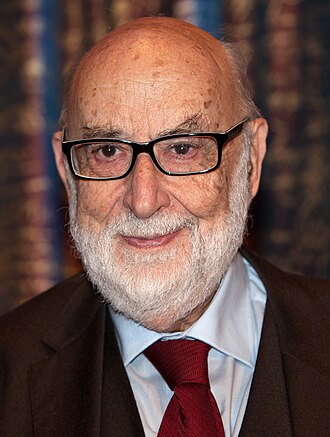
图:Dominique Morisseau Laboratoire de Physique et d'Etude des M… · CC BY-SA 4.0 · Wikimedia Commons
皮埃尔-吉勒·德热纳1932—2007
Pierre-Gilles de Gennes
物理学家, 法国
皮埃尔-吉勒·德热纳,法国物理学家,1991年获诺贝尔物理学奖。2007年5月18日于奥赛逝世。
摘自维基百科「皮埃尔-吉勒·德热纳」,CC BY-SA 4.0
- 出生
- 1932 年 10 月 24 日,巴黎十六区
- 逝世
- 2007 年 5 月 18 日,奥赛
- 国籍
- 法国
- 学科
- 物理学、博物与综合
- 职业
- 物理学家、理论物理学家、教授、大学教师
- 母语 / 工作语言
- 法语
- 母校
- 克洛德·贝尔纳中学、高等师范学校、圣路易中学、Les Houches School of Physics
- 工作单位
- 法兰西公学院(1971—2007)、加州大学伯克利分校、莱顿大学(1978—1978)、巴黎第十一大学、莱顿大学(1978—)、居里研究所、巴黎高等物理化工学院
研究领域
师承
博士导师3
博士生3
来自 Wikidata 的「博士导师」「师从」「博士生」「学生」记录,可能不全。
所获奖项(26)
- 1959Prize Louis Ancel
- 1960法国国家科学研究中心银质奖章
- 1968Holweck Prize
- 1976Bourke Award
- 1977法国电力安培奖
- 1980CNRS金奖
- 1982高分子物理奖
- 1983盖-吕萨克-洪堡奖
- 1984英国皇家学会外籍会员
- 1987马泰乌奇奖章
- 1988哈维奖
- 1988honorary doctor of the University of Sherbrooke
- 1988ACS Award in Polymer Chemistry
- 1990洛仑兹奖章
- 1990沃尔夫物理学奖
- 1991诺贝尔物理学奖
- 1991Wolfgang Ostwald Prize
- 1995honorary doctorate at the Laval University
- 1996澳大利亚科学院院士
- 1997honorary doctorate of the University of Vigo
- 1997F. A. Cotton Medal
- 1998埃连根奖章
- —Onsager Medal
- —Humboldt Research Fellowship
- —耶路撒冷希伯来大学荣誉博士
- —洪堡奖
学会与院士
百科正文
生平
德热纳1932年生于巴黎,1961年成为奥尔塞巴黎大学固态物理学教授。其研究领域广泛,涉及物理、化学及生物学多个方面。1971年以来,他一直在法兰西学院教授公共课;1976年开始任巴黎物理和化学学院院长。1974年,他编著了《液晶物理学》一书,此书至今仍是该领域的权威著作。1990年,他获沃尔夫物理学奖。德热纳发现,为研究简单系统中有序现象而创造的方法能推广到比较复杂的物质形式,特别是能推广到液晶和聚合物。1991年。他因此单独获得诺贝尔物理学奖。瑞典斯德哥尔摩科学院诺贝尔奖评审委员会称他为“世界性人才、当代之牛顿”。德热纳晚年热衷于科普工作。
法国总统尼古拉·萨科齐称赞德热纳是“非同寻常的物理学家和我们最伟大的科学家之一”,“这位伟大的研究者一直在把他对科学的挚爱传递给下一代学生和公众。”
以上内容摘自维基百科「皮埃尔-吉勒·德热纳」,按 CC BY-SA 4.0 使用,去掉了参考文献、外部链接等尾部小节,公式改写成了纯文本。全文、配图和出处见原文。
英文维基百科补充中文条目比较短,下面是英文条目「Pierre-Gilles de Gennes」的原文
Pierre-Gilles de Gennes (French: [pjɛʁ ʒil də ʒɛn]; 24 October 1932 – 18 May 2007) was a French physicist and the Nobel Prize laureate in physics in 1991.
Education and early life
He was born in Paris, France, and was home-schooled to the age of 12. By the age of 13, he had adopted adult reading habits and was visiting museums. Later, de Gennes studied at the École Normale Supérieure. After leaving the École in 1955, he became a research engineer at the Saclay center of the Commissariat à l'Énergie Atomique, working mainly on neutron scattering and magnetism, with advice from Anatole Abragam and Jacques Friedel. He defended his Ph.D. in 1957 at the University of Paris.
Career and research
In 1959, he was a postdoctoral research visitor with Charles Kittel at the University of California, Berkeley, and then spent 27 months in the French Navy. In 1961, he was assistant professor in Orsay and soon started the Orsay group on superconductors. In 1968, he switched to studying liquid crystals.
In 1971, he became professor at the Collège de France, and participated in STRASACOL (a joint action of Strasbourg, Saclay and Collège de France) on polymer physics. From 1980 on, he became interested in interfacial problems: the dynamics of wetting and adhesion.
He worked on granular materials and on the nature of memory objects in the brain.
Awards and honours
Awarded the Fernand Holweck Medal and Prize in 1968.
He was awarded the Harvey Prize, Lorentz Medal and Wolf Prize in 1988 and 1990. In 1991, he received the Nobel Prize in Physics. He was then director of the École Supérieure de Physique et de Chimie Industrielles de la Ville de Paris (ESPCI), a post he held from 1976 until his retirement in 2002.
P.G. de Gennes has also received the F.A. Cotton Medal for Excellence in Chemical Research of the American Chemical Society in 1997, the Holweck Prize from the joint French and British Physical Society; the Ampere Prize, French Academy of Science; the gold medal from the French CNRS; the Matteuci Medal, Italian Academy; the Harvey Prize, Israel; and polymer awards from both APS and ACS.
He was awarded the above-mentioned Nobel Prize for discovering that "methods developed for studying order phenomena in simple systems can be generalized to more complex forms of matter, in particular to liquid crystals and polymers".
The Royal Society of Chemistry awards the De Gennes Prize biennially, in his honour. He was elected a Foreign Member of the Royal Society (ForMemRS) in 1984. He was awarded A. Cemal Eringen Medal in 1998.
Personal life
He married Anne-Marie Rouet (born in 1933) in June 1954. They remained married until his death and had three children together: Christian (born 9 December 1954), Dominique (born 6 May 1956) and Marie-Christine (born 11 January 1958).
He also had four children with physicist Françoise Brochard-Wyart (born in 1944) who was one of his former doctoral students and then colleague and co-author. The children are: Claire Wyart (born 16 February 1977), Matthieu Wyart (born 24 May 1978), Olivier Wyart (born 3 August 1984) and Marc de Gennes (born 16 January 1991).
Professors John Goodby and George Gray noted in an obituary: "Pierre was a man of great charm and humour, capable of making others believe they, too, were wise. We will remember him as an inspirational lecturer and teacher, an authority on Shakespeare, an expert skier who attended conference lectures appropriately attired with skis to hand, and, robed in red, at the Bordeaux liquid crystal conference in 1978, took great delight in being inaugurated as a Vignoble de St Émilion."
In 2003 he was one of 22 Nobel Laureates who signed the Humanist Manifesto.
On 22 May 2007, his death was made public as official messages and tributes poured in.
以上内容摘自英文维基百科「Pierre-Gilles de Gennes」,按 CC BY-SA 4.0 使用,去掉了参考文献、外部链接等尾部小节,公式改写成了纯文本。全文、配图和出处见原文。
同年获同一奖项
同一学科、同时代的科学家


同一学科的科学家
更多 ›