格物
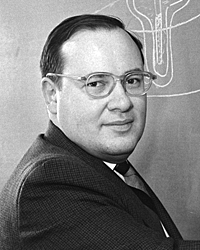
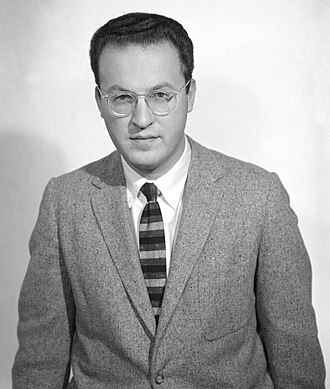
图:Jose Mercado / Stanford News Service · CC BY 3.0 · Wikimedia Commons
阿瑟·肖洛1921—1999
Arthur Leonard Schawlow
物理学家, 美国
阿瑟·肖洛,出生于纽约州弗农山,美国物理学家,1981年获诺贝尔物理学奖。
摘自维基百科「阿瑟·肖洛」,CC BY-SA 4.0
- 出生
- 1921 年 5 月 5 日,芒特弗农
- 逝世
- 1999 年 4 月 28 日,帕洛阿尔托
- 国籍
- 美国
- 学科
- 物理学、工程与发明、博物与综合
- 职业
- 物理学家、大学教师、发明家
- 母语 / 工作语言
- 英语
- 母校
- 多伦多大学、沃恩路学院
- 工作单位
- 哥伦比亚大学
研究领域
师承
博士生1
来自 Wikidata 的「博士导师」「师从」「博士生」「学生」记录,可能不全。
所获奖项(12)
- 1962斯图尔特·巴兰坦奖章
- 1963杨氏奖
- 1964IEEE Morris N. Liebmann纪念奖
- 1970里克特迈耶纪念奖
- 1976Frederic Ives Medal
- 1977马可尼奖
- 1981诺贝尔物理学奖
- 1991美国国家科学奖章
- 1996美国发明家名人堂
- —Humboldt Research Fellowship
- —洪堡奖
- —Fellow of the Optical Society
学会与院士
百科正文
生平
1999年4月28日,逝世于加利福尼亚州帕洛阿尔托。
以上内容摘自维基百科「阿瑟·肖洛」,按 CC BY-SA 4.0 使用,去掉了参考文献、外部链接等尾部小节,公式改写成了纯文本。全文、配图和出处见原文。
英文维基百科补充中文条目比较短,下面是英文条目「Arthur Leonard Schawlow」的原文
Arthur Leonard Schawlow (May 5, 1921 – April 28, 1999) was an American physicist who, along with Charles Townes, developed the theoretical basis for laser science. His central insight was the use of two mirrors as the resonant cavity to take maser action from microwaves to visible wavelengths. He shared the 1981 Nobel Prize in Physics with Nicolaas Bloembergen and Kai Siegbahn for his work using lasers to determine atomic energy levels with great precision.
Biography
Arthur Leonard Schawlow was born on May 5, 1921, in Mount Vernon, New York, to a Jewish father from Riga and a Canadian mother. Schawlow was raised in his mother's Protestant faith. When Arthur was three years old, they moved to Toronto, Ontario, Canada.
At the age of 16, Schawlow completed high school at Vaughan Road Collegiate Institute, and received a scholarship in science at the University of Toronto (Victoria College). He obtained his B.A. in 1941 and his M.A. the following year. He received his Ph.D. in 1949 under Professor Malcolm F. Crawford. Schawlow then took a postdoctoral position with Charles Townes in the Physics Department of Columbia University in the fall of 1949.
Schawlow went on to accept a position at Bell Telephone Laboratories in late 1951. He left in 1961 to become Professor of Physics at Stanford University, where he remained until his retirement in 1991.
Although his research focused on optics, in particular lasers and their use in spectroscopy, Schawlow also pursued investigations in the areas of superconductivity and nuclear resonance. Schawlow shared the 1981 Nobel Prize in Physics with Nicolaas Bloembergen and Kai Siegbahn for their contributions to the development of laser spectroscopy.
Schawlow co-authored the widely used text Microwave Spectroscopy (1955) with Charles Townes. Schawlow and Townes were the first to publish the theory of laser design and operation in their seminal 1958 paper on "optical masers", although Gordon Gould is often credited with the "invention" of the laser, due to his unpublished work that predated Schawlow and Townes by a few months. The first working laser was made in 1960 by Theodore Maiman.
Science and religion
Schawlow participated in science and religion discussions. Regarding God, he stated, "I find a need for God in the universe and in my own life."
Personal life
In 1951, Schawlow married Aurelia Townes, the younger sister of Charles Townes. They had three children: Arthur Jr., Helen, and Edith. Arthur Jr. is autistic, with very little speech ability. Aurelia died in 1991 following a vehicle accident.
Schawlow and Professor Robert Hofstadter at Stanford, who also had an autistic child, teamed up to help each other find solutions to the condition. Arthur Jr. was put in a special center for autistic individuals, and later, Schawlow put together an institution to care for people with autism in Paradise, California. It was later named the Arthur Schawlow Center in 1999, shortly before his death. Schawlow was a promoter of the controversial method of facilitated communication with patients of autism.
Schawlow considered himself to be an orthodox Protestant Christian, and attended a Methodist church.
Arthur Schawlow was an intense fan and collector of traditional American jazz recordings, as well as a supporter of instrumental groups performing this type of music.
Schawlow died of leukemia on April 28, 1999, in Palo Alto, California, at the age of 77.
Recognition
Commemoration
In 1991, the American Physical Society established the Arthur L. Schawlow Prize in Laser Science. The Prize is awarded annually to "candidates who have made outstanding contributions to basic research using lasers."
以上内容摘自英文维基百科「Arthur Leonard Schawlow」,按 CC BY-SA 4.0 使用,去掉了参考文献、外部链接等尾部小节,公式改写成了纯文本。全文、配图和出处见原文。
同年获同一奖项
同一学科、同时代的科学家


同一学科的科学家
更多 ›