格物
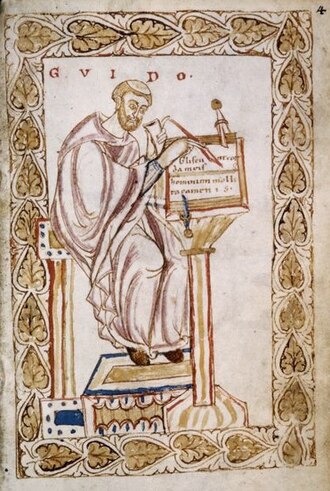
图:The original uploader was Robbot at Dutch Wikipedia. · Public domain · Wikimedia Commons
- 出生
- 992 年,阿雷佐
- 逝世
- 1050 年,阿雷佐
- 学科
- 工程与发明
- 职业
- 音乐理论家、音乐学家、发明家、作家
- 母语 / 工作语言
- 拉丁语
研究领域
师承
师从1
来自 Wikidata 的「博士导师」「师从」「博士生」「学生」记录,可能不全。
百科正文
英文维基百科补充中文条目比较短,下面是英文条目「Guido of Arezzo」的原文
Guido of Arezzo (Italian: Guido d'Arezzo; c. 991–992 – after 1033) was an Italian music theorist and pedagogue of High medieval music. A monk from the Order of Saint Benedict, he is regarded as the inventor—or by some, developer—of the modern staff notation that had a massive influence on the development of Western musical notation and practice. Perhaps the most significant European writer on music between Boethius and Johannes Tinctoris, Guido wrote the Micrologus, the most widely distributed medieval treatise on music, after Boethius's De institutione musica.
Biographical information on Guido is only available from two contemporary documents; though they give limited background, a basic understanding of his life can be unravelled. By around 1013 he began teaching at Pomposa Abbey, but his antiphonary Prologus in antiphonarium and novel teaching methods based on staff notation brought considerable resentment from his colleagues. He thus moved to Arezzo in 1025 and under the patronage of Bishop Tedald of Arezzo he taught singers at the Arezzo Cathedral. Using staff notation, he was able to teach large amounts of music quickly, and he wrote the multifaceted Micrologus, attracting attention from around Italy. Interested in his innovations, Pope John XIX called him to Rome. After arriving and beginning to explain his methods to the clergy, sickness sent him away in the summer. The rest of his life is largely unknown, but he settled in a monastery near Arezzo, probably one of the Avellana of the Camaldolese order.
Context and sources
Information on Guido's life is scarce; Charles Burney, a music historian, asserted that the paucity of records was because Guido was a monk. Burney furthered that, in the words of musicologist Samuel D. Miller, "Guido's modesty, selfless abandon from material gain life, and obedience to authority tended to obscure his moves, work, and motivations". The scholarly outline of Guido's life has been subject to much mythologization and misunderstandings.
Life and career
Early life
Guido was born sometime between 990 and 999. This birthdate range was conjectured from a now lost and undated manuscript of the Micrologus, where he stated that he was age 34 while John XIX was pope (1024–1033). Swiss musicologist Hans Oesch's dating of the manuscript to 1025–1026 is agreed by scholars Claude V. Palisca, Dolores Pesce and Angelo Mafucci, with Mafucci noting that it is "now unanimously accepted". This would suggest a birthdate of c. 991–992.
Music theory and innovations
Solmization
Guido developed new techniques for teaching, such as staff notation and the use of the "ut–re–mi–fa–sol–la" (do–re–mi–fa–so–la) mnemonic (solmization).
Legacy
Almost immediately after his death, commentaries were written on Guido's work, particularly the Micrologus. One of the most noted is the De musica of Johannes Cotto (fl. c. 1100), whose influential treatise was largely a commentary that expanded and revised the Micrologus. Aribo (fl. c. 1068–78) also dedicated a substantial part of his De musica as a commentary on chapter 15 of the Micrologus. Other significant commentaries are anonymous, including the Liber argumentorum and Liber specierum (both Italian, 1050–1100); the Commentarius anonymus in Micrologum (Belgian or Bavarian, c.
Editions
Guido of Arezzo (1955). van Waesberghe, Jos Smits [in Dutch] (ed.). Micrologus. Corpus Scriptorum de Musica. Vol. 4. Rome: American Institute of Musicology. OCLC 1229808694.
—— (1975). van Waesberghe, Jos Smits [in Dutch] (ed.). Prologus in antiphonarium. Divitiae Musicae Artis. Buren: Frits Knuf. OCLC 251805291.
—— (1978). "Micrologus". In Palisca, Claude V. (ed.). Hucbald, Guido, and John on music: Three Medieval Treatises. Translated by Babb, Warren. Index of chants by Alejandro Enrique Planchart. New Haven and London: Yale University Press. ISBN 978-0-300-02040-3.
以上节选摘自英文维基百科「Guido of Arezzo」,按 CC BY-SA 4.0 使用,去掉了参考文献、外部链接等尾部小节,公式改写成了纯文本。篇幅所限,较长的小节只摘了开头一部分,有的小节没有收;全文、配图和出处见原文。