格物
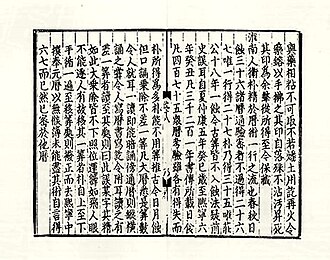
图:. The original uploader was Mtiovinelli at Italian Wikipedia… · Public domain · Wikimedia Commons
- 出生
- 10 世纪,英山县
- 逝世
- 1051 年
- 国籍
- 北宋
- 学科
- 工程与发明
- 职业
- 发明家、印刷者
百科正文
生平
毕升的发明是世界上最早的活字印刷技术。宋朝的沈括所著的《梦溪笔谈》记载了毕升的活字印刷术:
版印书籍,唐人尚未盛为之,自冯瀛王始印五经,已后典籍,皆为版本。庆历中,有布衣毕升,又为活版。其法用胶泥刻字,薄如钱唇,每字为一印,火烧令坚。先设一铁版,其上以松脂腊和纸灰之类冒之。欲印则以一铁范置铁板上,乃密布字印。满铁范为一板,持就火炀之,药稍镕,则以一平板按其面,则字平如砥。若止印三、二本,未为简易;若印数十百千本,则极为神速。常作二铁板,一板印刷,一板已自布字。此印者才毕,则第二板已具。更互用之,瞬息可就。每一字皆有数印,如之、也等字,每字有二十余印,以备一板内有重复者。不用则以纸贴之,每韵为一贴,木格贮之。有奇字素无备者,旋刻之,以草火烧,瞬息可成。不以木为之者,木理有疏密,沾水则高下不平,兼与药相粘,不可取。不若燔土,用讫再火令药镕,以手拂之,其印自落,殊不沾污。升死,其印为余群从所得,至今保藏。
毕升在宋庆历年间(1041年-1048年)发明在胶泥上刻字,一字一印,用火烧硬后,便成活字;排版前先在置有铁框的铁板上,敷有一层搀和纸灰的松脂蜡,活字依次排在上面,加热,使蜡稍熔化,以平板压字平面,冷却,泥字即固着在铁板上,可以像雕版一样印刷;此外他还尝试过木活字排版,但因为高低不平而未采用;活字可以多次使用,比雕版印刷经济方便。毕升的活字后来为沈括的门客收藏。
毕升的活字原料“胶泥”,指烧陶器用的黏土,制成活字后在陶窑中烧,烧成后的泥活字坚硬光滑。
1990年秋,湖北省英山县草盘地镇五桂墩村睡狮山麓出土了一方墓碑,据考证为毕升的墓碑,任昉发现该墓志的形制和风格有明显的外来文化和外来宗教的色彩,他认为毕升很可能是信仰摩尼教的昭武九姓后裔。
以上内容摘自维基百科「毕昇」,按 CC BY-SA 4.0 使用,去掉了参考文献、外部链接等尾部小节,公式改写成了纯文本。全文、配图和出处见原文。
英文维基百科补充中文条目比较短,下面是英文条目「Bi Sheng」的原文
Bi Sheng (died 1051) was a Chinese artisan and engineer during the Song dynasty (960–1279), who invented the world's first movable type. Bi's system used fired clay tiles, one for each Chinese character, and was invented between 1039 and 1048. Printing was one of the Four Great Inventions. Because Bi was a commoner, not an educated person, little is known about his life besides this invention.
Movable type printing
Bi Sheng's invention was only recorded in the Dream Pool Essays by Chinese scholar-official and polymath Shen Kuo (1031–1095). The book provides a detailed description of the technical details of Bi Sheng's invention of movable type printing:
During the reign of Chingli 慶曆 (Qìnglì), 1041–1048, Bi Sheng, a man of unofficial position, made movable type. His method was as follows: He prepared an iron plate. Then he took sticky clay and cut in its characters as thin as the edge of a coin. Each character formed, as it were, a single type. He baked them in the fire to make them hard. He had covered the plate with a mixture of pine resin, wax, and paper ashes. When he wished to print, he took an iron frame and set it on the iron plate. In this, he placed the types, set close together. When the frame was full, the whole made one solid block of type. He then placed it near the fire to warm it. When the paste [at the back] was slightly melted, he took a smooth board and pressed it over the surface, so that the block of type became as even as a whetstone.
If one were to print only two or three copies, this method would be neither simple nor easy. But for printing hundreds or thousands of copies, it was marvelously quick. As a rule he kept two formes going. While the impression was being made from the one forme, the type was being put in place on the other. When the printing of the one forme was finished, the other was then ready. In this way the two formes alternated and the printing was done with great rapidity.
For each character, there were several types, and for certain common characters, there were twenty or more types each, in order to be prepared for the repetition of characters on the same page. When the characters were not in use he had them arranged with paper labels, one label for each rhyme-group, and kept them in wooden cases.
Bi Sheng also developed wooden movable type, but it was abandoned in favor of ceramic types due to the presence of wood grains and the unevenness of the wooden type after being soaked in ink.
After his death, ceramic movable type may have spread to the Tangut kingdom of Western Xia, where a Buddhist text known as the Vimalakirti Nirdesa Sutra was found in modern Wuwei, Gansu, dating to the reign of Emperor Renzong of Western Xia (r. 1125-1193). The text features traits that have been identified as hallmarks of clay movable type such as the hollowness of the character strokes and deformed and broken strokes. The ceramic movable-type also passed onto Bi Sheng's descendants. The next mention of movable type occurred in 1193 when a Southern Song chief counselor, Zhou Bida (周必大), attributed the movable-type method of printing to Shen Kuo. However Shen Kuo did not invent the movable type but credited it to Bi Sheng in his Dream Pool Essays. The ceramic movable type was also mentioned by Kublai Khan's councilor Yao Shu, who convinced his pupil Yang Gu to print language primers using this method.
The government official Wang Zhen (fl. 1290–1333) improved Bi Sheng's clay types by innovation through the wood, as his process increased the speed of typesetting as well.
By 1490, bronze movable type was developed by the wealthy printer Hua Sui (1439–1513).
Wooden movable-type printing became widespread in the Qing dynasty (1644–1912), but did not replace woodblock printing, probably because of the expense of creating a font of so many pieces or the low cost of a copyist.
Legacy
His gravestone was located in Hubei province in 1990. A park and museum opened on that site in April 2023.
Bisheng Subdistrict (畢昇社區) in Wenquan, Huanggang, Hubei is named for Bi Sheng. The Bi Sheng crater located in the LAC-7 quadrant near the northern pole on the far side of the Moon was named after Bi Sheng by the IAU on August 2, 2010.
He also appears in a commemorative stamp by the Liberian post office due to his invention of movable printing.
以上内容摘自英文维基百科「Bi Sheng」,按 CC BY-SA 4.0 使用,去掉了参考文献、外部链接等尾部小节,公式改写成了纯文本。全文、配图和出处见原文。
同一学科、同时代的科学家
同一学科的科学家
更多 ›