格物
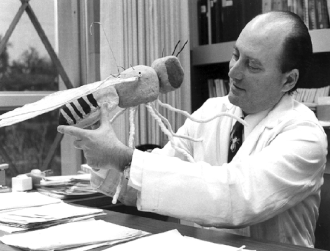
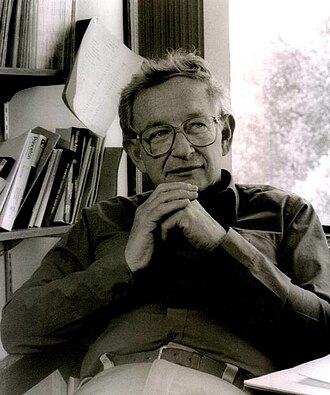
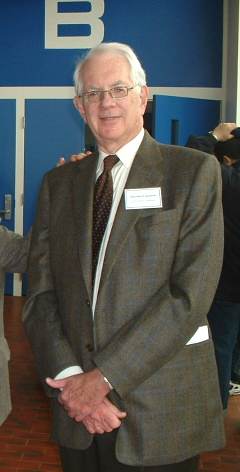
图:Harris WA · CC BY 2.5 · Wikimedia Commons
西摩·本泽1921—2007
Seymour Benzer
American geneticist (1921–2007)
西摩·本泽,为美国物理学家、分子生物学家和行为遗传学家。
摘自维基百科「西摩·本泽」,CC BY-SA 4.0
- 出生
- 1921 年 10 月 15 日,布朗克斯
- 逝世
- 2007 年 11 月 30 日,帕萨迪纳
- 国籍
- 美国
- 学科
- 物理学、生物学、博物与综合
- 职业
- 物理学家、遗传学家、大学教师、生物物理学家
- 母语 / 工作语言
- 英语
- 母校
- 布鲁克林学院、普渡大学、新乌得勒支高中
- 工作单位
- 加州理工学院、普渡大学
研究领域
所获奖项(26)
- 1961Howard Taylor Ricketts Prize
- 1964盖尔德纳国际奖
- 1968honorary doctor of Purdue University
- 1971拉斯克基础医学研究奖
- 1976路易莎·格罗斯·霍维茨奖
- 1976英国皇家学会外籍会员
- 1977哈维奖
- 1979Dickson Prize in Science
- 1982美国国家科学奖章
- 1982克鲁内演讲
- 1983doctor honoris causa from the Pierre and Marie Curie University
- 1985罗森斯特尔奖
- 1986托马斯·亨特·摩尔根奖
- 1988Karl Spencer Lashley Award
- 1989Ralph W. Gerard Prize
- 1991沃尔夫医学奖
- 1992Bristol-Myers Squibb Award for Distinguished Achievement in Neuroscience Research
- 1993Crafoord Prize in Biosciences
- 1994Mendel Medal
- 2000国际生物学奖
- 2001NAS Award in the Neurosciences
- 2001Robert J. and Claire Pasarow Foundation Award for Distinguished Contributions to Neuropsychiatric Research
- 2002March of Dimes Prize in Developmental Biology
- 2004格鲁伯神经科学奖
- 2004Bower Award and Prize for Achievement in Science
- 2006奥尔巴尼医疗中心奖
学会与院士
百科正文
生平
他的职业生涯开始于20世纪50年代的分子生物学革命的时期,最终在分子和行为遗传学领域上做出了突出贡献。他在美国普渡大学领导一个多产的遗传学研究实验室,并且是加州理工学院詹姆斯·G·博斯韦尔神经科学名誉教授。
奖项和荣誉
1964年获盖尔德纳国际奖,1971年获拉斯克基础医学研究奖,1982年获国家科学奖章,1991年获沃尔夫医学奖,1993年获克拉福德奖。
以上内容摘自维基百科「西摩·本泽」,按 CC BY-SA 4.0 使用,去掉了参考文献、外部链接等尾部小节,公式改写成了纯文本。全文、配图和出处见原文。
英文维基百科补充中文条目比较短,下面是英文条目「Seymour Benzer」的原文
Seymour Benzer (October 15, 1921 – November 30, 2007) was an American physicist, molecular biologist and behavioral geneticist. His career began during the molecular biology revolution of the 1950s, and he eventually rose to prominence in the fields of molecular and behavioral genetics. He led a productive genetics research lab both at Purdue University and as the James G. Boswell Professor of Neuroscience, emeritus, at the California Institute of Technology.
Biography
Early life and education
Benzer was born in the South Bronx to Meir Benzer and Eva Naidorf, both Jews from Poland. He had two older sisters, and his parents favored him as the only boy. One of Benzer's earliest scientific experiences was dissecting frogs he had caught as a boy. In an interview at Caltech, Benzer also remembered receiving a microscope for his 13th birthday, "and that opened up the whole world." The book Arrowsmith by Sinclair Lewis heavily influenced the young Benzer, and he even imitated the handwriting of Max Gottlieb, a scientist character in the novel. Benzer graduated from New Utrecht High School at 15 years old.
In 1938 he enrolled at Brooklyn College where he majored in physics. Benzer then moved on to Purdue University to earn his Ph.D. in solid state physics. While there he was recruited for a secret military project to develop improved radar. He performed research that led to the development of stable germanium rectifiers and discovered a germanium crystal able to be used at high voltages, among the scientific work that led to the first transistor.
Personal life
At Brooklyn College, as a sixteen-year-old freshman, Benzer met Dorothy Vlosky (nicknamed Dotty), a twenty-one-year-old nurse. He later married her in New York City in 1942. They had two daughters.
Benzer died of a stroke at the Huntington Hospital in Pasadena, California.
Scientific career
Molecular biology
Upon receiving his Ph.D. in 1947, he was immediately hired as an assistant professor in physics at Purdue. However, Benzer was inspired by Erwin Schrödinger's book What Is Life?, in which the physicist pondered the physical nature of the gene and a "code" of life. This catalyzed Benzer's shift in interest to biology, and he moved into the area of bacteriophage genetics., spending two years as a postdoctoral fellow in Max Delbrück's laboratory at California Institute of Technology, and then returning to Purdue. At Purdue University, Benzer developed the T4 rII system, a new genetic technique involving recombination in T4 bacteriophage rII mutants. After observing that a particular rII mutant, a mutation that caused the bacteriophage to eliminate bacteria more rapidly than usual, was not exhibiting the expected phenotype, it occurred to Benzer that this strain might have come from a cross between two different rII mutants (each having part of the rII gene intact) wherein a recombination event resulted in a normal rII sequence. Benzer realized that by generating many r mutants and recording the recombination frequency between different r strains, one could create a detailed map of the gene, much as Alfred Sturtevant had done for chromosomes. Taking advantage of the enormous number of recombinants that could be analyzed in the rII mutant system, Benzer was eventually able to map over 2400 rII mutations. The data he collected provided the first evidence that the gene is not an indivisible entity, as previously believed, and that genes were linear.
Honors and awards
- Fellow of the American Academy of Arts and Sciences (1959)
- Gairdner Foundation International Award (1964)
- Albert Lasker Award for Basic Medical Research (1971)
- Louisa Gross Horwitz Prize from Columbia University (1976),
- Harvey Prize (1977)
- Dickson Prize in Science (1978)
- National Medal of Science (1982)
- Rosenstiel Award (1985)
- Thomas Hunt Morgan Medal (1986)
- Ralph W. Gerard Prize in Neuroscience (1989)
- Wolf Prize in Medicine (1991)
- Crafoord Prize (1993)
- Feltrinelli Prize (1994)
- International Prize for Biology (2000)
- NAS Award in the Neurosciences from the National Academy of Sciences (2001)
- March of Dimes Prize in Developmental Biology (2002)
- Gairdner Foundation International Award (2004) (second award)
- Bower Award and Prize for Achievement in Science (2004)
- Albany Medical Center Prize (2006)
He was a member of the French Academy of Sciences, the U.S. National Academy of Sciences, the American Philosophical Society and the Royal Society.
以上节选摘自英文维基百科「Seymour Benzer」,按 CC BY-SA 4.0 使用,去掉了参考文献、外部链接等尾部小节,公式改写成了纯文本。篇幅所限,较长的小节只摘了开头一部分,有的小节没有收;全文、配图和出处见原文。
同一学科、同时代的科学家




同一学科的科学家
更多 ›