格物
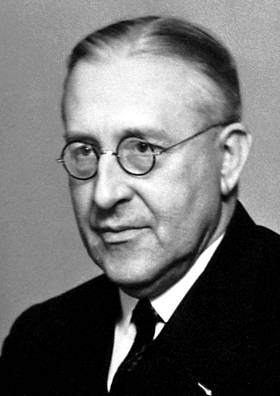
华伦泰·巴格曼1908—1989
Valentine Bargmann
German-American physicist
华伦泰·巴格曼,出生于德国柏林的物理学家与数学家。
摘自维基百科「華倫泰·巴格曼」,CC BY-SA 4.0
- 出生
- 1908 年 4 月 6 日,柏林
- 逝世
- 1989 年 7 月 20 日,普林斯顿
- 国籍
- 美国
- 学科
- 物理学、数学、博物与综合
- 职业
- 数学家、理论物理学家、大学教师、物理学家
- 母语 / 工作语言
- 英语
- 母校
- 苏黎世大学(哲学博士)
- 工作单位
- 普林斯顿大学、普林斯顿高等研究院
师承
博士导师1
博士生1
来自 Wikidata 的「博士导师」「师从」「博士生」「学生」记录,可能不全。
所获奖项(3)
- 1978维格纳奖章
- 1988马克斯·普朗克奖章
- —美国文理科学院院士
学会与院士
百科正文
生平
从1925到1933年,巴格曼就读于柏林大学。希特勒夺得德国政权后,巴格曼转到瑞士的苏黎世大学求学。在恩师文策(Gregor Wentzel)地悉心教导下,他得到博士学位。
毕业以后,由于整个欧洲弥漫着战争的气息,他决定申请移民美国。很幸运地,在他的护照失效前两天,终于得到美国驻德大使馆的签证。他立刻启程前往美国。1937 年,到了美国后,很快地,他进入普林斯顿高等研究院继续研究工作。后来,又被聘请为阿尔伯特·爱因斯坦的助理。因为巴格曼严谨的治学精神和解答问题的能力,他得到了一个“要求巴格曼”的绰号。休闲时候,巴格曼是一位很有天分的钢琴演奏者,常常与爱因斯坦及同事们合奏莫扎特和巴赫的室内音乐。1941 年,他开始在普林斯顿大学教书,一直教到1976 年退休。因心脏病,1989 年逝世于普林斯顿。
巴格曼发现了SL2(R)的不可约表示(irreducible unitary representations of SL2(R))与洛伦兹群的不可约表示(Lorentz group)。
1978 年,巴格曼得到维格纳奖(The Wigner Medal),奖励他在群论与基础物理上优异的研究成果。与他一同得奖的是尤金·维格纳本人。这也是开始颁发维格纳奖的第一年。1988 年,德国物理学会因为巴格曼在理论物理学的杰出贡献,授予他最高荣誉,马克斯·普朗克奖章。
以上内容摘自维基百科「華倫泰·巴格曼」,按 CC BY-SA 4.0 使用,去掉了参考文献、外部链接等尾部小节,公式改写成了纯文本。全文、配图和出处见原文。
英文维基百科补充中文条目比较短,下面是英文条目「Valentine Bargmann」的原文
Valentine "Valya" Bargmann (April 6, 1908 – July 20, 1989) was a German-American mathematician and theoretical physicist.
Biography
Born in Berlin, Germany, to a German Jewish family, Bargmann studied there from 1925 to 1933. After the National Socialist Machtergreifung, he moved to Switzerland to the University of Zürich where he received his Ph.D. under Gregor Wentzel.
He emigrated to the U.S., barely managing immigration acceptance, as his German passport was to be revoked with only two days of validity left.
At the Institute for Advanced Study in Princeton (1937–1946) he worked as an assistant to Albert Einstein, publishing with him and Peter Bergmann on classical five-dimensional Kaluza–Klein theory (1941). He taught at Princeton University from 1946 for the rest of his career.
He pioneered understanding of the irreducible unitary representations of SL2(R) and the Lorentz group (1947). He further formulated the Bargmann–Wigner equations with Eugene Wigner (1948), for particles of arbitrary spin, building up on work of several theorists who pioneered quantum mechanics.
Bargmann's theorem (1954) on projective unitary representations of Lie groups gives a condition for when a projective unitary representation of a Lie group comes from an ordinary unitary representation of its universal cover.
Bargmann further discovered the Bargmann–Michel–Telegdi equation (1959) describing relativistic precession; Bargmann's limit of the maximum number of QM bound states of a potential (1952);
the notion of Bargmann potentials for the radial Schrödinger equations with bound states but no non-trivial scattering, which play a basic role in the theory of Solitons, and the holomorphic representation in the Segal–Bargmann space (1961), including the Bargmann kernel.
Bargmann was elected a Fellow of the American Academy of Arts and Sciences in 1968. In 1978, he received the Wigner Medal, together with Wigner himself, in the founding year of the prize. In 1979, Bargmann was elected to the US National Academy of Sciences. In 1988, he received the Max Planck Medal of the German Physical Society.
He was also a talented pianist.
He died in Princeton in 1989.
以上内容摘自英文维基百科「Valentine Bargmann」,按 CC BY-SA 4.0 使用,去掉了参考文献、外部链接等尾部小节,公式改写成了纯文本。全文、配图和出处见原文。
同一学科、同时代的科学家


同一学科的科学家
更多 ›