格物
谢尔盖·彼得罗维奇·诺维科夫1938—2024
Sergei Novikov
俄罗斯数学家(1938—2024)
菲尔兹奖 1970沃尔夫数学奖 2005罗蒙诺索夫金质奖章 2020
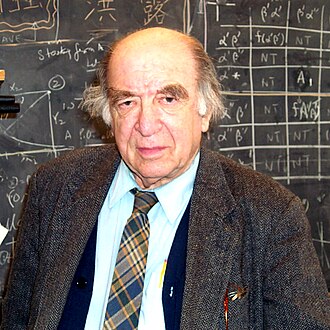
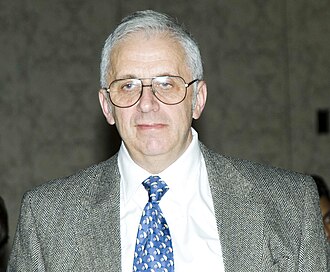
谢尔盖·彼得罗维奇·诺维科夫,俄国数学家,专长代数拓扑和孤波理论。他获得1970年菲尔兹奖和2005年沃尔夫数学奖。也是郎道理论物理研究所重要数学家。
摘自维基百科「謝爾蓋·彼得羅維奇·諾維科夫」,CC BY-SA 4.0
- 出生
- 1938 年 3 月 20 日,下诺夫哥罗德
- 逝世
- 2024 年 6 月 6 日,莫斯科
- 国籍
- 俄罗斯、苏联
- 学科
- 数学、博物与综合
- 职业
- 数学家、大学教师
- 母语 / 工作语言
- 俄语、英语
- 母校
- 莫斯科国立大学数学力学系(物理和数学博士,1960 年)
- 工作单位
- 斯捷克洛夫数学研究所(1963—2024)、莫斯科国立大学数学力学系(1964—2024)、郎道理论物理研究所(1971—2024)、马里兰大学科利奇帕克分校
研究领域
主要贡献
代表成就
师承
博士生36
来自 Wikidata 的「博士导师」「师从」「博士生」「学生」记录,可能不全。
所获奖项(9)
学会与院士
百科正文
家庭背景
诺维科夫生于苏联的高尔基(今俄罗斯下诺夫哥罗德),成长于一个满是有才华的数学家的家庭。他的父亲彼得·诺维科夫研究群论,母亲卢德米拉·克尔德什和舅父姆斯季斯拉夫·克尔德什也是重要的数学家。
以上内容摘自维基百科「謝爾蓋·彼得羅維奇·諾維科夫」,按 CC BY-SA 4.0 使用,去掉了参考文献、外部链接等尾部小节,公式改写成了纯文本。全文、配图和出处见原文。
英文维基百科补充中文条目比较短,下面是英文条目「Sergei Novikov (mathematician)」的原文
Sergei Petrovich Novikov (Russian: Серге́й Петро́вич Но́виков [sʲɪrˈɡʲej pʲɪˈtrovʲɪtɕ ˈnovʲɪkəf]; 20 March 1938 – 6 June 2024) was a Soviet and Russian mathematician, noted for work in both algebraic topology and soliton theory. He became the first Soviet mathematician to receive the Fields Medal in 1970.
Biography
Novikov was born on 20 March 1938 in Gorky, Soviet Union (now Nizhny Novgorod, Russia). He grew up in a family of talented mathematicians. His father was Pyotr Sergeyevich Novikov, who gave a negative solution to the word problem for groups. His mother, Lyudmila Vsevolodovna Keldysh, and maternal uncle, Mstislav Vsevolodovich Keldysh, were also important mathematicians.
Novikov entered Moscow State University in 1955 and graduated in 1960. In 1964, he received the Moscow Mathematical Society Award for young mathematicians and defended a dissertation for the Candidate of Science in Physics and Mathematics degree (equivalent to the PhD) under Mikhail Postnikov at Moscow State University. In 1965, he defended a dissertation for the Doctor of Science in Physics and Mathematics degree there.
Novikov died on 6 June 2024, at the age of 86.
Career
In 1966, Novikov became a corresponding member of the Academy of Sciences of the Soviet Union. In 1971, he became head of the Mathematics Division of the Landau Institute for Theoretical Physics of the USSR Academy of Sciences. In 1983, Novikov was also appointed the head of the Department of Higher Geometry and Topology at Moscow State University. He became President of the Moscow Mathematical Society in 1985 and remained in that role until 1996, when he moved to the University of Maryland College of Computer, Mathematical, and Natural Sciences at the University of Maryland, College Park. He continued to maintain research appointments at the Landau Institute for Theoretical Physics, Moscow State University, and the Department of Geometry and Topology at the Steklov Mathematical Institute after his move to Maryland.
Research
Novikov's early work was in cobordism theory, in relative isolation. Among other advances he showed how the Adams spectral sequence, a powerful tool for proceeding from homology theory to the calculation of homotopy groups, could be adapted to the new (at that time) cohomology theory typified by cobordism and K-theory. This required the development of the idea of cohomology operations in the general setting, since the basis of the spectral sequence is the initial data of Ext functors taken with respect to a ring of such operations, generalising the Steenrod algebra. The resulting Adams–Novikov spectral sequence is now a basic tool in stable homotopy theory.
Novikov also carried out important research in geometric topology, being one of the pioneers with William Browder, Dennis Sullivan, and C. T. C. Wall of the surgery theory method for classifying high-dimensional manifolds. He proved the topological invariance of the rational Pontryagin classes, and posed the Novikov conjecture. From about 1971, he moved to work in the field of isospectral flows, with connections to the theory of theta functions.
Awards and honours
In 1967, Novikov received the Lenin Prize. In 1970, Novikov became the first Soviet mathematician to be awarded the Fields Medal. He was not allowed to travel to the International Congress of Mathematicians in Nice to accept his medal by the Soviet government due to his support for people who had been arrested and sent to mental institutions for speaking out against the regime, but he received it in 1971 when the International Mathematical Union met in Moscow. In 2005, he was awarded the Wolf Prize for his contributions to algebraic topology, differential topology and to mathematical physics. He is one of just eleven mathematicians who received both the Fields Medal and the Wolf Prize. In 2020, he received the Lomonosov Gold Medal of the Russian Academy of Sciences.
In 1981, he was elected a full member of the USSR Academy of Sciences (Russian Academy of Sciences since 1991).
以上节选摘自英文维基百科「Sergei Novikov (mathematician)」,按 CC BY-SA 4.0 使用,去掉了参考文献、外部链接等尾部小节,公式改写成了纯文本。篇幅所限,较长的小节只摘了开头一部分,有的小节没有收;全文、配图和出处见原文。
同年获同一奖项
同一学科、同时代的科学家



同一学科的科学家
更多 ›