格物
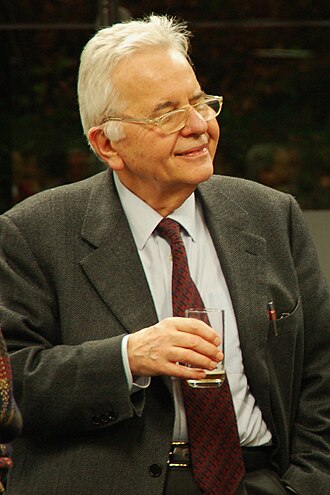
图:Marcella Bona · CC BY-SA 2.0 · Wikimedia Commons
尼古拉·卡比博1935—2010
Nicola Cabibbo
Italian physicist (1935–2010)
尼古拉·卡比博,意大利物理学家。1983年至1992年间他曾任意大利国家核物理研究院(INFN)院长。从1993年起至今,他是宗座科学院的院长。
摘自维基百科「尼古拉·卡比博」,CC BY-SA 4.0
- 出生
- 1935 年 4 月 10 日,罗马
- 逝世
- 2010 年 8 月 16 日,罗马
- 国籍
- 意大利、意大利王国
- 学科
- 物理学、博物与综合
- 职业
- 理论物理学家、大学教师、物理学家、核物理学家
- 母语 / 工作语言
- 意大利语
- 母校
- 罗马大学
- 工作单位
- 罗马大学、罗马第二大学、欧洲核子研究组织
研究领域
师承
博士导师1
来自 Wikidata 的「博士导师」「师从」「博士生」「学生」记录,可能不全。
所获奖项(9)
- 1989樱井奖
- 1991高能和粒子物理奖
- 1993Order of Minerva
- 2002马泰乌奇奖章
- 2003Enrico Fermi Prize
- 2009波梅兰丘克奖
- 2010狄拉克奖章(ICTP)
- 2011富兰克林研究所奖项
- —意大利共和国功绩大十字骑士勋章
学会与院士
百科正文
生平
卡比博以核子弱作用的工作出名。他在此领域的主要工作源于对以下二个现象的解释:
上夸克和下夸克间,电子和电子型中微子间,以及μ子和μ子型中微子间有相似的转移强度;
奇异数改变过程的强度大约是奇异数守恒过程的1/4。
为解决第一个问题,他提出了弱作用普适性假说,即不同代粒子弱作用耦合强度的相似性。对第二个问题,他提出了下夸克和奇异夸克间的混合角 θ _(c)。现在此角被称为卡比博角。
1973年在发现第三代夸克之前,小林诚和益川敏英把卡比博的工作推广到卡比博-小林-益川矩阵。2008年他们也由此获得了诺贝尔物理学奖。许多物理学家对诺贝尔委员会这一决定非常不满。当被问到对诺贝尔奖的反应时,卡比博不做任何评论。但据接近他的人说,他对诺贝尔委员会怀有很大怨恨。
现今卡比博的研究主要是超级计算机在现代物理实验中的应用。
以上内容摘自维基百科「尼古拉·卡比博」,按 CC BY-SA 4.0 使用,去掉了参考文献、外部链接等尾部小节,公式改写成了纯文本。全文、配图和出处见原文。
英文维基百科补充中文条目比较短,下面是英文条目「Nicola Cabibbo」的原文
Nicola Cabibbo (10 April 1935 – 16 August 2010) was an Italian physicist best known for his work on the weak interaction, particularly his introduction of the Cabibbo angle. Interested in science from a young age, he studied physics at the Sapienza University of Rome, graduating in 1958 with a thesis completed under Bruno Touschek.
Early life and education
Nicola Cabibbo was born on 10 April 1935 in Rome, Italy to Silician parents; his father, Emanuele, was a lawyer and his mother was a housewife. He was interested in mathematics, physics and astronomy from an early age, and built his own radios. Despite growing up during World War II, his elementary school education ran uninterrupted, and he subsequently attended the Liceo Torquato Tasso. There, a textbook titled What Is Mathematics? sparked Cabibbo's interest in pursuing scientific studies.
After the end of the war, Cabibbo also developed an interest in American literature and often frequented the library of the United States embassy to read and borrow books. His favourite authors were Ernest Hemingway, Theodore Dreiser and Herman Melville, but he also enjoyed science fiction and books on arctic expeditions.
Cabibbo enrolled at the Sapienza University of Rome in 1952 and graduated with a degree in physics in 1958. His thesis, which focused on weak interactions and muon decay, was completed under the supervision of Bruno Touschek and was done in collaboration with fellow students Francesco Calogero and Paolo Guidoni.
Career
After graduating, Cabibbo began working for the Rome Division of the Istituto Nazionale di Fisica Nucleare. Two years later, in 1960, he was hired at the Laboratori Nazionali di Frascati, becoming the first theoretical physicist stationed there.
In 1963, while working at CERN, Cabibbo found the solution to the puzzle of the weak decays of strange particles, formulating what came to be known as Cabibbo universality. In 1967 Nicola settled back in Rome where he taught theoretical physics and created a large school. He was president of the INFN from 1983 to 1992, during which time the Gran Sasso Laboratory was inaugurated. He was also president of the Italian energy agency, ENEA, from 1993 to 1998, and was president of the Pontifical Academy of Sciences from 1993 until his death. In 2004, Cabibbo spent a year at CERN as guest professor, joining the NA48/2 collaboration.
Research
Cabibbo's major work on the weak interaction originated from a need to explain two observed phenomena:
The transitions between up and down quarks, between electrons and electron neutrinos, and between muons and muon neutrinos had similar likelihood of occurring (similar amplitudes); and
The transitions with change in strangeness had amplitudes equal to one fourth of those with no change in strangeness.
Cabibbo addressed these issues, following Murray Gell-Mann and Maurice Lévy, by postulating weak universality, which involves a similarity in the weak interaction coupling strength between different generations of particles. He addressed the second issue with a mixing angle θC (now called the Cabibbo angle), between the down and strange quarks. Modern measurements show that θC = 13.04°.
He was awarded the High Energy Particle Physics Prize of the European Physical Society in 1991, "for the theory of weak interactions leading to the concept of quark mixing". Before the discovery of the third generation of quarks, this work was extended by Makoto Kobayashi and Toshihide Maskawa to the Cabibbo–Kobayashi–Maskawa matrix. In 2008, Kobayashi and Maskawa shared one half of the Nobel Prize in Physics for their work. Some physicists had bitter feelings that the Nobel Prize committee failed to reward Cabibbo for his vital part. Asked for a reaction on the prize, Cabibbo preferred to give no comment. According to sources close to him, however, he was embittered.
Later, Cabibbo researched applications of supercomputers to address problems in modern physics with the experiments APE 100 and APE 1000.
Personal life and death
In 1962, Cabibbo married Paola Iandolo, who became a professor of North American literature at the University of Salerno and then of American Literature at the Sapienza University of Rome. The couple had one son, Andrea, who was born in 1966 and is a molecular biologist. Cabibbo died on August 16, 2010 at the Fatebenefratelli Hospital in Rome, at the age of 75, after having been admitted for a respiratory failure. He had been suffering from a tumour for several years.
以上节选摘自英文维基百科「Nicola Cabibbo」,按 CC BY-SA 4.0 使用,去掉了参考文献、外部链接等尾部小节,公式改写成了纯文本。篇幅所限,较长的小节只摘了开头一部分,有的小节没有收;全文、配图和出处见原文。
同年获同一奖项
同一学科、同时代的科学家


同一学科的科学家
更多 ›