格物
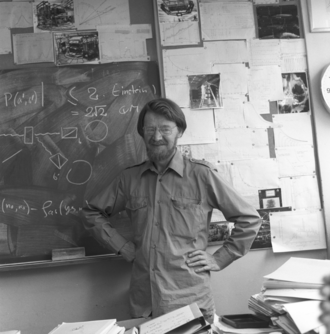
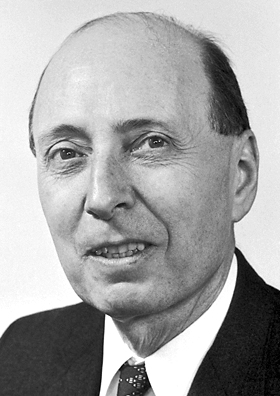
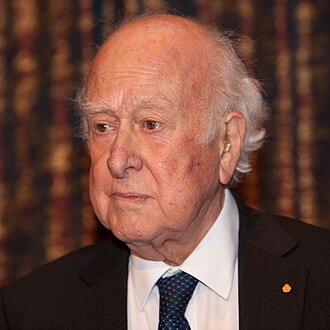
图:CERN · CC BY 4.0 · Wikimedia Commons
- 出生
- 1928 年 7 月 28 日,贝尔法斯特
- 逝世
- 1990 年 10 月 1 日,日内瓦
- 国籍
- 英国
- 学科
- 物理学、数学、博物与综合
- 职业
- 数学家、物理学家、译者
- 母语 / 工作语言
- 英语
- 母校
- 贝尔法斯特女王大学(1949 年)、伯明翰大学(博士,1956 年)
- 工作单位
- 贝尔法斯特女王大学(1944—1945)、英国原子能科学研究院(1949—1960)、欧洲核子研究组织(1960—1990)
研究领域
主要贡献
代表成就
以他 / 她命名
师承
博士导师1
来自 Wikidata 的「博士导师」「师从」「博士生」「学生」记录,可能不全。
所获奖项(5)
- 1972英国皇家学会院士
- 1987美国文理科学院院士
- 1988IOP Dirac Medal
- 1989休斯奖章
- 1989希纳曼数学物理奖
学会与院士
百科正文
生平
早年
约翰·贝尔出生于北爱尔兰的贝尔法斯特。
11岁时他立志成为一名科学家,16岁时便从贝尔法斯特技术学校毕业。
之后贝尔进入贝尔法斯特女王大学就读,1948年取得了实验物理的学士学位,隔年再取得了数学物理学位。
接着他到了伯明翰大学研究核物理与量子场论,并在1956年获得博士学位。
这段期间里,他认识了在从事粒子加速器研究的物理学家玛莉·罗斯,两人在1954年结婚。
辞世
约翰·贝尔于1990年因一场突发的脑溢血,于日内瓦过世。贝尔并不知道当年已被提名角逐诺贝尔奖,而诺贝尔奖惯例只颁发予生者。尽管如此,其对EPR佯谬的贡献仍显重要,一些学者认为他指出局域实在性(Local realism)的失败,亦即局域隐变量理论(Local hidden variables)的不可行。
以上内容摘自维基百科「约翰·斯图尔特·贝尔」,按 CC BY-SA 4.0 使用,去掉了参考文献、外部链接等尾部小节,公式改写成了纯文本。全文、配图和出处见原文。
英文维基百科补充中文条目比较短,下面是英文条目「John Stewart Bell」的原文
John Stewart Bell (28 July 1928 – 1 October 1990) was a physicist from Northern Ireland and the originator of Bell's theorem, an important theorem in quantum physics regarding hidden-variable theories.
In 2022, the Nobel Prize in Physics was awarded to Alain Aspect, John Clauser, and Anton Zeilinger for work on Bell inequalities and the experimental validation of Bell's theorem.
Biography
Early life and work
Bell was born in Belfast, Northern Ireland to a working class family. Due to financial hardship, neither parent and none of his three older siblings completed high school, typically dropping out of school by age 14 to work. When he was 11 years old, he decided to be a scientist, and encouraged by his mother, at 16 he graduated from Belfast Technical High School. Then in an exceptionally rare occurrence for someone of his background, Bell attended the Queen's University of Belfast, where, in 1948, he obtained a bachelor's degree in experimental physics and, a year later, a bachelor's degree in mathematical physics. He went on to complete a PhD in physics at the University of Birmingham in 1956, specialising in nuclear physics and quantum field theory. In 1954, he married Mary Ross, also a physicist, whom he had met while working on accelerator physics at Malvern, UK. Bell became a vegetarian in his teen years. According to his wife, Bell was an atheist.
Bell's career began with the UK Atomic Energy Research Establishment, near Harwell, Oxfordshire, known as AERE or Harwell Laboratory. In 1960, he moved to work for the European Organization for Nuclear Research (CERN, Conseil Européen pour la Recherche Nucléaire), in Geneva, Switzerland. There he worked almost exclusively on theoretical particle physics and on accelerator design, but found time to pursue a major avocation, investigating the foundations of quantum theory. He was elected a Foreign Honorary Member of the American Academy of Arts and Sciences in 1987. Also of significance during his career, Bell, together with John Bradbury Sykes, M. J. Kearsley, and W. H. Reid, translated several volumes of the ten-volume Course of Theoretical Physics of Lev Landau and Evgeny Lifshitz, making these works available to an English-speaking audience in translation, all of which remain in print.
Bell was a proponent of pilot wave theory. In 1987, inspired by Ghirardi–Rimini–Weber theory, he also advocated collapse theories.
Legacy
In 2008, the John Stewart Bell Prize was created by the Centre for Quantum Information and Quantum Control at the University of Toronto. The prize is awarded every other year for significant contributions first published during the six preceding years. The award recognizes major advances relating to the foundations of quantum mechanics and to the applications of these principles. In 2009, the first award was presented by Alain Aspect to Nicolas Gisin for his theoretical and experimental work on foundations and applications of quantum physics — notably quantum nonlocality, quantum cryptography, and quantum teleportation.
At the CERN site in Meyrin, close to Geneva, there is a street called Route Bell in honour of John Stewart Bell.
In 2016, his colleague from CERN, Reinhold Bertlmann, wrote a lengthy piece, "Bell's Universe: A Personal Recollection", explaining in some detail his amazement at finding out about Bell's paper on Bertlmann's socks, in which Bell compared the EPR paradox with socks.
A day was named after him, referring to the date he released Bell's Theorem, 4 November.
Northern Ireland
Since 2015, a street has been named "Bell's Theorem Crescent" in his city of birth, Belfast.
The John Bell House, named in his honour, finished construction in 2016 and houses over 400 students in Belfast city centre.
The pedestrian entrance to the Olympia leisure centre in Belfast located 200 meters from Bell's childhood home is named the "John Stewart Bell Entrance" in honour of the local man.
In the Queen's University of Belfast one of the Physics lecture theatres is named in honour of John Stewart Bell.
There is a blue plaque commemorating John Stewart Bell in Queen's University of Belfast main campus
There is a blue plaque commemorating John Stewart Bell at his childhood home in Tates Avenue in Belfast
以上节选摘自英文维基百科「John Stewart Bell」,按 CC BY-SA 4.0 使用,去掉了参考文献、外部链接等尾部小节,公式改写成了纯文本。篇幅所限,较长的小节只摘了开头一部分,有的小节没有收;全文、配图和出处见原文。
同一学科、同时代的科学家


同一学科的科学家
更多 ›