格物

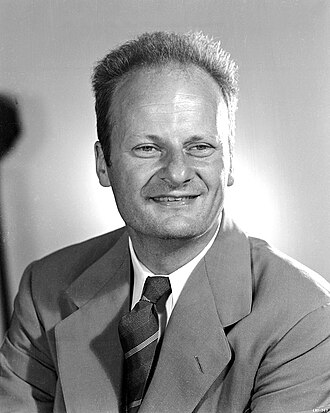
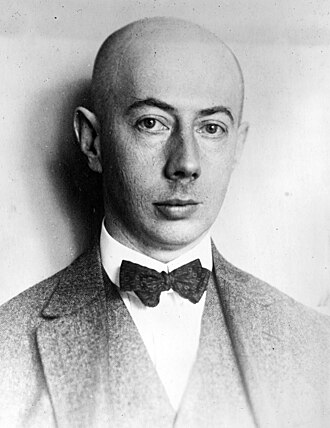
图:Deloye Burrell · Public domain · Wikimedia Commons
保罗·彼得·埃瓦尔德1888—1985
Paul Peter Ewald
German physicist (1888–1985)
保罗·彼得·埃瓦尔德,FRS,生于德国柏林,卒于美国纽约州伊萨卡,是一位德国晶体学家和物理学家,X射线衍射方法的先驱之一。
摘自维基百科「保罗·彼得·埃瓦尔德」,CC BY-SA 4.0
- 出生
- 1888 年 1 月 23 日,柏林
- 逝世
- 1985 年 8 月 22 日,伊萨卡
- 国籍
- 德国
- 学科
- 物理学、化学、地球科学、博物与综合
- 职业
- 物理学家、大学教师、晶体学家、科学家
- 母语 / 工作语言
- 德语
- 母校
- 慕尼黑大学
- 工作单位
- 斯图加特大学、纽约大学坦登工程学院
研究领域
主要贡献
代表成就
师承
博士导师1
博士生3
来自 Wikidata 的「博士导师」「师从」「博士生」「学生」记录,可能不全。
所获奖项(6)
- 1958doctor honoris causa from the University of Paris
- 1958honorary member of the German Mineralogical Society
- 1960古根海姆学者奖
- 1978马克斯·普朗克奖章
- 1979爱明诺夫奖
- —英国皇家学会院士
学会与院士
百科正文
英文维基百科补充中文条目比较短,下面是英文条目「Paul Peter Ewald」的原文
Paul Peter Ewald, FRS (January 23, 1888 – August 22, 1985) was a German crystallographer and physicist, a pioneer of X-ray diffraction methods.
Education
Ewald received his early education in the classics at the Gymnasium in Berlin and Potsdam, where he learned to speak Greek, French, and English, in addition to his native German.
Ewald began his higher education in physics, chemistry, and mathematics at Gonville and Caius College in Cambridge, during the winter of 1905. In 1906 and 1907, he continued his formal education at the University of Göttingen, where his interests turned primarily to mathematics. At that time, Göttingen was a world-class center of mathematics under the three “Mandarins” of Göttingen: Felix Klein, David Hilbert, and Hermann Minkowski. While studying at Göttingen, Ewald was taken on by Hilbert as an Ausarbeiter, a paid position as a scribe, i.e., he would take notes in Hilbert’s classes, have the notes approved by Hilbert’s assistant — at that time, Ernst Hellinger — and then prepare a clean copy for the Lesezimmer (mathematics reading room). In 1907, he continued his mathematical studies at the Ludwig-Maximilians-Universität München (LMU) under Arnold Sommerfeld at his Institute for Theoretical Physics. He was granted his doctorate in 1912. His doctoral thesis developed the laws of propagation of X-rays in single crystals. After earning his doctorate, he was an assistant to Sommerfeld.
During the 1911 Christmas recess and in January 1912, Ewald was finishing the writing of his doctoral thesis. It was on a walk through Englischer Garten in Munich, in January, that Ewald was telling Max von Laue about his thesis topic. The wavelengths of concern to Ewald were in the visible region of the spectrum and hence much larger than the spacing between the resonators in Ewald’s crystal model. Laue seemed distracted and wanted to know what would be the effect if much smaller wavelengths were considered.
Career
When Erwin Schrödinger let it be known that he was leaving his position as extraordinarius professor at the Technische Hochschule Stuttgart to go to the University of Breslau, Ewald was called and accepted the position in 1921. In 1922, he was called to the University of Münster. Ewald used the offer to better his position at Stuttgart to ordinarius professor; however, while Ewald was nominally promoted to ordinarius professor, the established position was actually retained as an extraordinarius professorship.
From 1922, Erwin Fues, also a former doctoral student of Sommerfeld, did postgraduate work at the Stuttgart Technische Hochschule under Ewald; Fues completed his Habilitation in 1924. Also in that year, Ewald became co-editor of Zeitschrift für Kristallographie. In 1929, he received a call to the Technische Hochschule Hanover. Again, he used this call to better his position at Stuttgart by negotiating for a second assistant, the permanent conversion of his position to that of ordinarius professor, and a separate building for his activities. The building was formally opened in 1930 as the Institute for Theoretical Physics, with Ewald as director. The institute was modeled after Sommerfeld’s Institute for Theoretical Physics at Munich, in that it would conduct theoretical work as well as have space and equipment for experimental work.
In 1931, Ewald was appointed director of the physical science division.
At Göttingen, Richard Courant had taken Hilbert’s lecture notes which were available in the Lesezimmer, edited them and added to them to write a two-volume work. The first volume, Methoden der mathematischen Physik I, was published in 1924.
Upon seeing the book, Ewald was compelled to write a detailed review describing it as providing mathematical tools, characterized by eigenvalues and eigenfunctions, for the theoretical physics then being developed.
Honors
- 1958 – Fellow of the Royal Society
- 1978 – Deutsche Physikalische Gesellschaft Max Planck medal
- 1979 – Gregori Aminoff Prize
1986 – The International Union of Crystallography established the Ewald Prize for outstanding contributions to the science of crystallography.
以上节选摘自英文维基百科「Paul Peter Ewald」,按 CC BY-SA 4.0 使用,去掉了参考文献、外部链接等尾部小节,公式改写成了纯文本。篇幅所限,较长的小节只摘了开头一部分,有的小节没有收;全文、配图和出处见原文。
同一学科、同时代的科学家



同一学科的科学家
更多 ›