格物
罗宾·希尔1899—1991
Robin Hill
British biochemist (1899-1991)
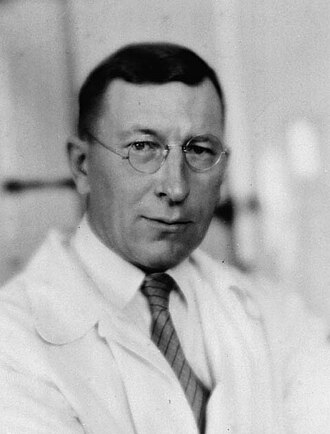
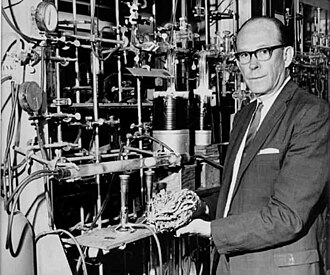
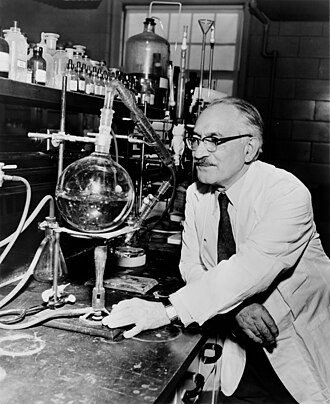
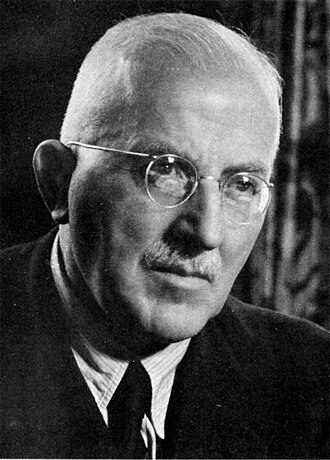
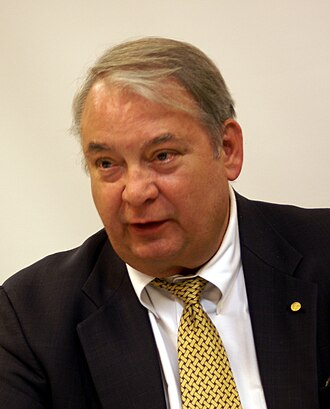
罗宾·希尔 是一位英国植物生物化学家,剑桥大学教授,知名于在1939年发现了光合作用中的希尔反应,此反应在光依赖反应中产生氧气。罗宾·希尔1946年当选英国皇家学会会士,1963年获皇家奖章,1987年获科普利奖章。
摘自维基百科「罗宾·希尔」,CC BY-SA 4.0
- 出生
- 1899 年 4 月 2 日,利明顿矿泉市
- 逝世
- 1991 年 3 月 15 日,剑桥
- 国籍
- 英国、大不列颠及爱尔兰联合王国
- 学科
- 化学、生物学
- 职业
- 生物化学家、大学教师
- 母语 / 工作语言
- 英语
- 母校
- 剑桥大学伊曼纽尔学院、彼得莱斯学校
- 工作单位
- 剑桥大学
研究领域
师承
博士导师1
学生1
来自 Wikidata 的「博士导师」「师从」「博士生」「学生」记录,可能不全。
所获奖项(5)
- 1962Charles F. Kettering Award
- 1972Finsen Medal
- 1987科普利奖章
- —英国皇家学会院士
- —皇家奖章
学会与院士
百科正文
英文维基百科补充中文条目比较短,下面是英文条目「Robin Hill (biochemist)」的原文
Robert Hill FRS (2 April 1899 – 15 March 1991), known as Robin Hill, was a British plant biochemist who, in 1939, demonstrated the 'Hill reaction' of photosynthesis, proving that oxygen is evolved during the light requiring steps of photosynthesis. He also made significant contributions to the development of the Z-scheme of oxygenic photosynthesis.
Education and early life
Hill was born in New Milverton, a suburb of Leamington Spa, Warwickshire. He was educated at Bedales School, where he became interested in biology and astronomy (he published a paper on sunspots in 1917), and Emmanuel College, Cambridge, where he read Natural Sciences. During the First World War he served in the Anti-gas Department of the Royal Engineers.
Career
In 1922, he joined the Department of Biochemistry at Cambridge, where he was directed to research haemoglobin. He published a number of papers on haemoglobin, and in 1926 he began to work with David Keilin on the haem containing protein cytochrome c. In 1932, he commenced work on plant biochemistry, focusing on photosynthesis and the oxygen evolution of chloroplasts, leading to the discovery of the 'Hill reaction'.
From 1943, Hill's work was funded by the Agricultural Research Council (ARC), although he continued to work in the Cambridge Biochemistry Department. Hill continued to receive most of his recognition for his earlier work on photosynthesis, and beginning in the late 1950s, his work concentrated on the energetics of photosynthesis. In collaboration with Fay Bendall, he made his second great contribution to photosynthesis research with the discovery of the 'Z scheme' of electron transport.
Hill retired from the ARC in 1966, although his research at Cambridge continued until his death in 1991. In his later years Hill worked on the issue of the application of the second law of thermodynamics to photosynthesis.
He was an expert on natural dyes and cultivated plants such as madder and woad. He painted watercolours using pigments he himself extracted. In the 1920s, he developed a fish-eye camera and used it to take stereoscopic whole-sky images, recording cloud patterns in three dimensions.
Awards and honours
The Robert Hill Institute at the University of Sheffield, from which he received an honorary degree in 1990, was named after him. Hill was elected a Fellow of the Royal Society (FRS) in 1946, his certificate of election reads: Distinguished for his research on Haemoglobin and Photosynthesis. He was the first to demonstrate the reconstruction of haemoglobin from its components: globin and haematin. This was the first case of the splitting and reconstruction of a conjugated protein. He determined the properties and dissociation curve of myoglobin which explain the physiological function of the pigment. He also determined the structure and properties of several haematin compounds thereby aiding the study of their catalytic activities. He discovered a new approach to the biochemical study of photosynthesis which enabled him to demonstrate and to measure the evolution of oxygen by isolated chloroplasts exposed to light in the complete absence of CO2. This remarkable photochemical reaction was found by him to have the same properties as "light reaction" obtained with intact green cells in presence of CO2, and it led him to formulate an interesting working hypothesis of the mechanism of photosynthesis.
He was awarded the Royal Medal in 1963, and the Copley Medal in 1987.
以上内容摘自英文维基百科「Robin Hill (biochemist)」,按 CC BY-SA 4.0 使用,去掉了参考文献、外部链接等尾部小节,公式改写成了纯文本。全文、配图和出处见原文。
同一学科、同时代的科学家