格物
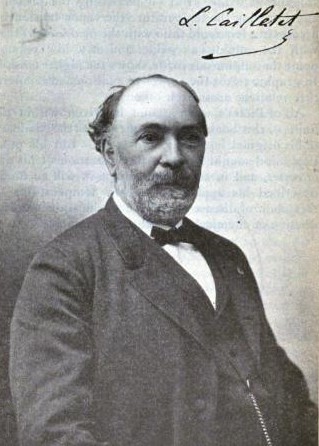
图:T. O'Connor Sloan · Public domain · Wikimedia Commons
- 出生
- 1832 年 9 月 21 日,塞纳河畔沙蒂永
- 逝世
- 1913 年 1 月 5 日,巴黎
- 国籍
- 法国
- 学科
- 物理学、化学、工程与发明、博物与综合
- 职业
- 物理学家、冶金厂厂主、化学家、工业家
- 母语 / 工作语言
- 法语
- 母校
- 国立巴黎高等矿业学校(1855 年)
- 工作单位
- 亨利·爱丁·圣克莱尔·德维尔
研究领域
主要贡献
代表成就
所获奖项(5)
- 1878戴维奖章
- 1884La Caze Prize of the Academy of Sciences
- 1889法国荣誉军团军官勋章
- —Officier de l'Instruction publique
- —查理三世勋章
学会与院士
百科正文
卡耶泰生于科多尔省塞纳河畔沙蒂永。他在巴黎接受了教育,后回到沙蒂永经营父亲的铁厂。一次他想找出温度不能够完全锻铁的原因时,他发现加热铁能使它处于高度不稳定状态,气体能溶解于其中。他分析了热风炉中的气体,这对他理解热在改变金属相态中的作用有很大帮助。他从此开始液化各种气体。
1877年,卡耶泰成功的制得了一滴液氧但用的方法与拉乌尔·皮克泰不同。他用到了焦耳-汤姆逊效应。氧气被压缩并被冷却。压缩空气被允许迅速膨胀,更进一步的冷却。于是就得到了一小滴液氧。
卡耶泰还曾在埃菲尔铁塔上装了一支300-m/985-ft高的压力表;测量落体时的空气阻力;研究了用于高海拔的液氧呼吸设备;发明了包括自动相机、高度计、用于上层大气研究的空气样本搜集器在内的多种装置。
以上内容摘自维基百科「路易·保罗·卡耶泰」,按 CC BY-SA 4.0 使用,去掉了参考文献、外部链接等尾部小节,公式改写成了纯文本。全文、配图和出处见原文。
英文维基百科补充中文条目比较短,下面是英文条目「Louis Paul Cailletet」的原文
Louis-Paul Cailletet (21 September 1832 – 5 January 1913) was a French physicist and inventor.
Life and work
Cailletet was born in Châtillon-sur-Seine, Côte-d'Or. Educated in Paris, Cailletet returned to Châtillon to manage his father's ironworks. In an effort to determine the cause of accidents that occurred while tempering incompletely forged iron, Cailletet found that heating the iron put it in a highly unstable state, with gases dissolved in it. He then analyzed the gases from blast furnaces, which helped him understand the role of heat in the changes of states (phases) of metals. This brought him to the work of liquefying the various gases.
Cailletet succeeded in producing droplets of liquid oxygen in 1877 by a different method than Raoul Pictet: He used the Joule-Thomson effect; oxygen was cooled while highly compressed, then allowed to rapidly expand, cooling it further, resulting in the production of small droplets of liquid oxygen.
Among his other achievements, Cailletet installed a 300-m/985-ft high manometer on the Eiffel Tower; conducted an investigation of air resistance on falling bodies; made a study of a liquid-oxygen breathing apparatus for high-altitude ascents; and developed numerous devices, including automatic cameras, an altimeter, and air-sample collectors for sounding-balloon studies of the upper atmosphere.
以上内容摘自英文维基百科「Louis Paul Cailletet」,按 CC BY-SA 4.0 使用,去掉了参考文献、外部链接等尾部小节,公式改写成了纯文本。全文、配图和出处见原文。
同年获同一奖项
同一学科、同时代的科学家



同一学科的科学家
更多 ›