格物
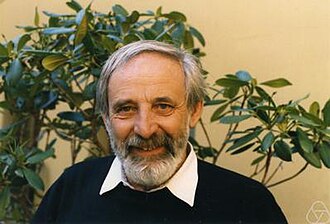
图:George Bergman · GFDL 1.2 · Wikimedia Commons
拉乌尔·博特1923—2005
Raoul Bott
Hungarian-born mathematician
拉乌尔·博特,匈牙利裔美国数学家。他出生于布达佩斯。1938年全家迁到加拿大,他就读于麦吉尔大学。他一生大部分时间在美国工作。1959年至1999年,他在哈佛大学任教授。2000年荣获沃尔夫奖,2005年当选英国皇家学会海外会员。惜同年于美国加州圣地亚哥因癌症逝世。
摘自维基百科「拉乌尔·博特」,CC BY-SA 4.0
- 出生
- 1923 年 9 月 24 日,布达佩斯
- 逝世
- 2005 年 12 月 20 日,卡尔斯巴德
- 国籍
- 美国
- 学科
- 物理学、数学、博物与综合
- 职业
- 数学家、物理学家、大学教师
- 母语 / 工作语言
- 英语
- 母校
- 麦吉尔大学(1945 年)、卡内基理工学院(博士,1947 年)、卡内基梅隆大学
- 工作单位
- 哈佛大学(1959—1999)、密歇根大学(1951—1959)、卡内基理工学院(1947—1949)、普林斯顿高等研究院(1949—1951)
研究领域
主要贡献
代表成就
师承
博士导师1
博士生32
来自 Wikidata 的「博士导师」「师从」「博士生」「学生」记录,可能不全。
所获奖项(7)
- 1956Sloan 基金奖励
- 1964奥斯瓦尔德·维布伦几何学奖
- 1976古根海姆学者奖
- 1987美国国家科学奖章
- 1990勒罗伊·P·斯蒂尔奖
- 2000沃尔夫数学奖
- 2005英国皇家学会外籍会员
学会与院士
百科正文
他最初研究电路,后来投身纯数学。
- 贡献:
- Bott-Duffin定理
- 他应用莫尔斯理论来研究李群的同伦论,成果有博特周期性定理(1956年)
- Borel–Weil–Bott定理
- 关于不动点定理及阿蒂亚-辛格指标定理的研究
- 叶状结构(Foliation)
他母亲会说匈牙利语,可是其捷克裔继父不会,他们一家以德语交谈。他自幼学英语,高中时,学校用的语言是斯洛伐克语,不过他自称不喜欢学习语言。
以上内容摘自维基百科「拉乌尔·博特」,按 CC BY-SA 4.0 使用,去掉了参考文献、外部链接等尾部小节,公式改写成了纯文本。全文、配图和出处见原文。
英文维基百科补充中文条目比较短,下面是英文条目「Raoul Bott」的原文
Raoul Bott (September 24, 1923 – December 20, 2005) was a Hungarian-American mathematician known for numerous foundational contributions to geometry in its broad sense. He is best known for his Bott periodicity theorem, the Morse–Bott functions which he used in this context, and the Borel–Bott–Weil theorem.
Early life
Bott was born in Budapest, Hungary, the son of Margit Kovács and Rudolph Bott. His father was of Austrian descent, and his mother was of Hungarian Jewish descent; Bott was raised a Catholic by his mother and stepfather in Bratislava, Czechoslovakia, now the capital of Slovakia. Bott grew up in Czechoslovakia and spent his working life in the United States. His family emigrated to Canada in 1938, and subsequently he served in the Canadian Army in Europe during World War II.
Career
Bott later went to college at McGill University in Montreal, where he studied electrical engineering. He then earned a PhD in mathematics from Carnegie Mellon University in Pittsburgh in 1949. His thesis, titled Electrical Network Theory, was written under the direction of Richard Duffin. Afterward, he began teaching at the University of Michigan in Ann Arbor. Bott continued his study at the Institute for Advanced Study in Princeton. He was a professor at Harvard University from 1959 to 1999. In 2005 Bott died of cancer in San Diego.
With Richard Duffin at Carnegie Mellon, Bott studied existence of electronic filters corresponding to given positive-real functions. In 1949 they proved a fundamental theorem of filter synthesis. Duffin and Bott extended earlier work by Otto Brune that requisite functions of complex frequency s could be realized by a passive network of inductors and capacitors. The proof relied on induction on the sum of the degrees of the polynomials in the numerator and denominator of the rational function.
In his 2000 interview with Allyn Jackson of the American Mathematical Society, he explained that he sees "networks as discrete versions of harmonic theory", so his experience with network synthesis and electronic filter topology introduced him to algebraic topology.
Bott met Arnold S. Shapiro at the IAS and they worked together.
He studied the homotopy theory of Lie groups, using methods from Morse theory, leading to the Bott periodicity theorem (1957). In the course of this work, he introduced Morse–Bott functions, an important generalization of Morse functions.
This led to his role as collaborator over many years with Michael Atiyah, initially via the part played by periodicity in K-theory. Bott made important contributions towards the index theorem, especially in formulating related fixed-point theorems, in particular the so-called 'Woods Hole fixed-point theorem', a combination of the Riemann–Roch theorem and Lefschetz fixed-point theorem (it is named after Woods Hole, Massachusetts, the site of a conference at which collective discussion formulated it). The major Atiyah–Bott papers on what is now the Atiyah–Bott fixed-point theorem were written in the years up to 1968; they collaborated further in recovering in contemporary language Ivan Petrovsky on Petrovsky lacunas of hyperbolic partial differential equations, prompted by Lars Gårding. In the 1980s, Atiyah and Bott investigated gauge theory, using the Yang–Mills equations on a Riemann surface to obtain topological information about the moduli spaces of stable bundles on Riemann surfaces. In 1983 he spoke to the Canadian Mathematical Society in a talk he called "A topologist marvels at Physics".
He is also well known in connection with the Borel–Bott–Weil theorem on representation theory of Lie groups via holomorphic sheaves and their cohomology groups; and for work on foliations. With Chern he worked on Nevanlinna theory, studied holomorphic vector bundles over complex analytic manifolds and introduced the Bott-Chern classes, useful in the theory of Arakelov geometry and also to algebraic number theory.
Awards
In 1964, he was awarded the Oswald Veblen Prize in Geometry by the American Mathematical Society. In 1983, he was awarded the Jeffery–Williams Prize by the Canadian Mathematical Society. In 1987, he was awarded the National Medal of Science.
In 2000, he received the Wolf Prize. In 2005, he was elected an Overseas Fellow of the Royal Society of London.
Students
Bott had 35 PhD students, including Stephen Smale, Daniel Quillen, Peter Landweber, Robert MacPherson, Robert W. Brooks, Susan Tolman, and Eric Weinstein. Smale and Quillen won Fields Medals in 1966 and 1978 respectively.
以上节选摘自英文维基百科「Raoul Bott」,按 CC BY-SA 4.0 使用,去掉了参考文献、外部链接等尾部小节,公式改写成了纯文本。篇幅所限,较长的小节只摘了开头一部分,有的小节没有收;全文、配图和出处见原文。
同年获同一奖项
同一学科、同时代的科学家




同一学科的科学家
更多 ›