格物
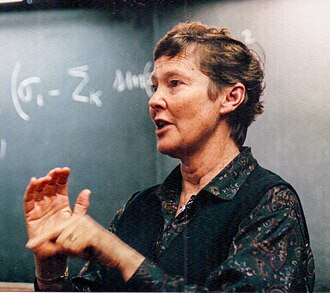
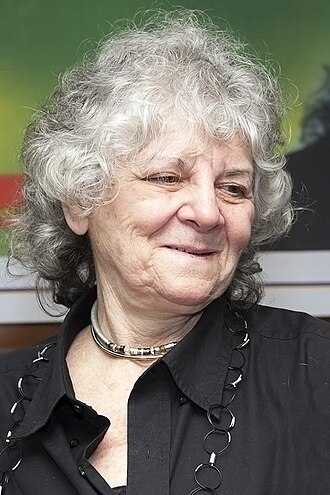
图:Dan Quinn · CC BY-SA 4.0 · Wikimedia Commons
海伦·奎恩1943—
Helen Quinn
Australian physicist (born 1943)
海伦·罗达·奎恩,澳大利亚出生的美国粒子物理学家,以寻找三种相互作用力统一理论闻名,并获得一些荣誉国际奖项。
摘自维基百科「海倫·奎恩」,CC BY-SA 4.0
- 出生
- 1943 年 5 月 19 日,墨尔本
- 国籍
- 美国、澳大利亚
- 学科
- 物理学、博物与综合
- 职业
- 物理学家、大学教师
- 母语 / 工作语言
- 英语
- 母校
- 斯坦福大学(哲学博士)、德国电子加速器、墨尔本大学、Tintern Grammar
- 工作单位
- 哈佛大学、斯坦福大学
研究领域
师承
博士导师1
来自 Wikidata 的「博士导师」「师从」「博士生」「学生」记录,可能不全。
所获奖项(8)
- 2000狄拉克奖章(ICTP)
- 2005Honorary Officer of the Order of Australia
- 2008奥斯卡·克莱因纪念讲座
- 2013樱井奖
- 2016Compton Medal for Leadership in Physics
- 2018富兰克林研究所奖项
- —美国物理学会会士
- —美国文理科学院院士
学会与院士
百科正文
贡献
海伦·奎恩曾与哈沃德·乔吉及史蒂文·温伯格研究统一理论。
1977年,海伦·奎恩与皮塞提出皮塞-奎恩理论(Peccei–Quinn theory),引入一种假想的亚原子粒子轴子,试图解决CP守恒问题。
以上内容摘自维基百科「海倫·奎恩」,按 CC BY-SA 4.0 使用,去掉了参考文献、外部链接等尾部小节,公式改写成了纯文本。全文、配图和出处见原文。
英文维基百科补充中文条目比较短,下面是英文条目「Helen Quinn」的原文
Helen Rhoda Arnold Quinn (born 19 May 1943) is an Australian-born particle physicist and educator who has made major contributions to both fields. Her contributions to theoretical physics include the Peccei–Quinn theory which implies a corresponding symmetry of nature(related to matter-antimatter symmetry and the possible source of the dark matter that pervades the universe) and contributions to the search for a unified theory for the three types of particle interactions (strong, electromagnetic, and weak). As Chair of the Board on Science Education of the National Academy of Sciences, Quinn led the effort that produced A Framework for K-12 Science Education: Practices, Crosscutting Concepts, and Core Ideas—the basis for the Next Generation Science Standards adopted by many states. Her honours include the Dirac Medal of the International Center for Theoretical Physics, the Oskar Klein Medal from the Royal Swedish Academy of Sciences, appointment as an Honorary Officer of the Order of Australia, the J. J. Sakurai Prize for Theoretical Particle Physics from the American Physical Society, the Karl Taylor Compton Medal for Leadership in Physics from the American Institute of Physics, the 2018 Benjamin Franklin Medal in Physics from the Franklin Institute, and the 2023 Harvey Prize from Technion -- Israel Institute of Technology.
Life
Quinn grew up in Australia. Of her childhood with her three brothers, she says, "I learned very young how to make myself heard." She graduated in 1959 from Tintern Grammar, Tintern Church of England Girls' Grammar School, in Ringwood East, Victoria, Australia. She began college at the University of Melbourne before moving to the United States and transferring to Stanford University. She received her PhD from Stanford in 1967, at a time when less than 2% of physicists were women. She did her postdoctoral work at the DESY (the German Synchrotron Laboratory) in Hamburg, Germany.
Professional contributions
Working with Howard Georgi and Steven Weinberg, Quinn showed how the three types of particle interactions (strong, electromagnetic, and weak), which look very different as we see their impact in the world around us, become very similar in extremely high-energy processes and so might be three aspects of a single unified force.
With Roberto Peccei, she originated Peccei–Quinn theory, which suggested a possible near-symmetry of the universe (now known as Peccei–Quinn symmetry) to explain how strong interactions can maintain CP-symmetry (the symmetry between matter and antimatter) when weak interactions do not. One consequence of this theory is a particle known as the axion which has yet to be observed but is one candidate for the dark matter that pervades the universe.
Career
- Her professional career is as follows:
- 1967–68 Research Associate in Physics, SLAC
- 1968–70 Guest Scientist, Deutsches Elektronen-Synchrotron (DESY), Hamburg, Germany
- 1971–72 Honorary Research Fellow, Harvard University
- 1972–75 Assistant Professor of Physics, Harvard University
- 1976–77 Associate Professor of Physics, Harvard University
- 1977–78 Visiting Associate Professor, Stanford University
- 1978–79 Research Associate, SLAC, Stanford University
- 1979–2003 Member, Scientific Staff, SLAC, Stanford University
- 1988–2004 Education and Public Outreach Manager, SLAC, Stanford University
1988–2004 Cofounder and first president of the Contemporary Physics Education Project (CPEP)
2003–10 Professor of Physics, Stanford Linear Accelerator Center (SLAC), Stanford University
Honours
2024 Matteucci Medal of Accademia Nazionale delle Scienze, Rome, Italy. She is the fourth woman to receive this award since it was established in 1868, following Marie Curie, Irène Joliot-Curie, and Jocelyn Bell Burnell.
2023 Harvey Prize of Technion -- Israel Institute of Technology.
2023 an honoree by the Carnegie Corporation of New York's Great Immigrant Award.
2021 David M. Lee Historical Lecture in Physics, Harvard University: "A window on particle physics at Harvard in the early 1970's".
2019 J. Robert Oppenheimer Lecture, University of California, Berkeley: "Teaching for Learning: What I have learned from learning research". A video of this lecture is available.
以上节选摘自英文维基百科「Helen Quinn」,按 CC BY-SA 4.0 使用,去掉了参考文献、外部链接等尾部小节,公式改写成了纯文本。篇幅所限,较长的小节只摘了开头一部分,有的小节没有收;全文、配图和出处见原文。