格物
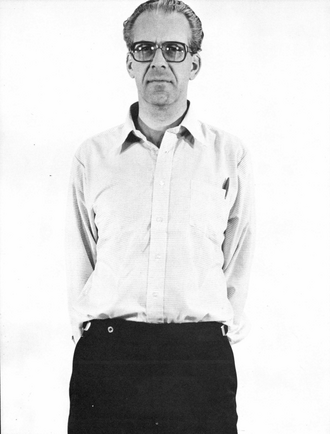
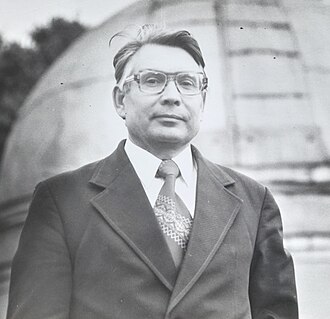
图:作者不详 · Public domain · Wikimedia Commons
马丁·施密特1929—2022
Maarten Schmidt
Dutch astronomer (1929–2022)
马尔滕·施密特,荷兰天文学家,第一个意识到射电源3C 273的光谱中无法证认的宽发射线,其实是高红移后的氢的巴尔末线和电离氧的谱线,从而成为“类星体”这一天体种类公认的发现者。
摘自维基百科「马尔滕·施密特」,CC BY-SA 4.0
- 出生
- 1929 年 12 月 28 日,格罗宁根
- 逝世
- 2022 年 9 月 17 日,弗雷斯诺
- 国籍
- 荷兰王国、美国
- 学科
- 天文学、博物与综合
- 职业
- 天文学家、大学教师
- 母校
- 莱顿天文台、莱顿大学
- 工作单位
- 加州理工学院
师承
博士导师1
博士生2
来自 Wikidata 的「博士导师」「师从」「博士生」「学生」记录,可能不全。
所获奖项(10)
- 1964海伦·B·华纳天文奖
- 1968卡尔·史瓦西奖章
- 1968伦福德奖金
- 1978亨利·诺利斯·罗素讲座
- 1979Karl G. Jansky Lectureship
- 1980英国皇家天文学会金质奖章
- 1991詹姆斯·克雷格·沃森奖
- 1992布鲁斯奖
- 1993Petrie Prize Lecture
- 2008Kavli Prize in Astrophysics
学会与院士
百科正文
经历
马尔滕·施密特生于荷兰格罗宁根。施密特师从扬·奥尔特,并于1956年在莱顿天文台获得博士学位。
1959年他迁往美国并进入加州理工学院任职。一开始他的研究是关于星系动力学和质量分布的理论。在这个时期要注意的是,他提出了涉及在星际云气中恒星形成率和星际物质密度相关的施密特定律。接着他开始研究无线电波源的光谱。1963年他使用帕洛马山天文台著名的200英寸的反射望远镜确定一个可见光下的天体就是电波源3C 273并研究其光谱。当这个外表像恒星的物体看起来距离地球相对较近,但 3C 273 的光谱却出现高达 0.158 的红移,代表这个物体距离银河系极远,而且光度极高。施密特因此将 3C 273 称为“类星体”("Quasi-Stellar Object" 或 "Quasar"),之后并发现了数千个类星体。
荣誉
- 获奖
- 1964年美国天文学会海伦·B·华纳天文学奖
- 1966年3月11日时代杂志封面
- 1978年亨利·诺利斯·罗素讲座
- 1980年英国皇家天文学会金质奖章
- 1980年荷兰皇家艺术与科学学院院士
- 1991年詹姆斯·克雷格·沃森奖
- 1992年布鲁斯奖
- 2008年科维理奖天文物理学奖
- 挪威科学与文学院院士
- 命名事物
- 小行星10430
以上内容摘自维基百科「马尔滕·施密特」,按 CC BY-SA 4.0 使用,去掉了参考文献、外部链接等尾部小节,公式改写成了纯文本。全文、配图和出处见原文。
英文维基百科补充中文条目比较短,下面是英文条目「Maarten Schmidt」的原文
Maarten Schmidt (28 December 1929 – 17 September 2022) was a Dutch-born American astronomer who first measured the distances of quasars. He was the first astronomer to identify a quasar, and so was pictured on the March cover of Time magazine in 1966.
Early life
Schmidt was born in Groningen, The Netherlands, on 28 December 1929. His father, Wilhelm, worked as an accountant for the Dutch government; his mother, Annie Wilhelmina (Haringhuizen), was a housewife. Schmidt studied math and physics at the University of Groningen, graduating with a bachelor's degree in 1949 before obtaining a master's degree the following year. He then commenced doctoral studies at Leiden University under Jan Oort. Schmidt was awarded a Doctor of Philosophy from Leiden Observatory in 1956.
Career
After completing his doctorate, Schmidt resided in the United States for two years on a Carnegie Fellowship. He returned briefly to the Netherlands, but ultimately emigrated to the US on a permanent basis in 1959 to work at the California Institute of Technology. In the beginning, he worked on theories about the mass distribution and dynamics of galaxies. Of particular note from this period was his formulation of what has become known as the Schmidt law, which relates the density of interstellar gas to the rate of star formation occurring in that gas. He later began a study of the light spectra of radio sources. In 1963, using the 200-inch reflector telescope at the Palomar Observatory, Schmidt identified the visible object corresponding to one of these radio sources, known as 3C 273 and also studied its spectrum. While its star-like appearance suggested it was relatively nearby, the spectrum of 3C 273 proved to have what was at the time a high redshift of 0.158, showing that it lay far beyond the Milky Way, and thus possessed an extraordinarily high luminosity. Schmidt termed 3C 273 a "quasi-stellar" object or quasar; thousands have since been identified.
Schmidt was featured on the cover of Time magazine in March 1966. He was later a co-recipient, with Donald Lynden-Bell, of the inaugural Kavli Prize for Astrophysics in 2008.
He lectured a total of 33 times at the Summer Science Program.
Personal life
Schmidt married Cornelia Tom in 1955. They met at a party hosted by Oort, and remained married until her death in 2020. Together, they had three daughters: Anne, Elizabeth, and Marijke.
Schmidt died on 17 September 2022 at his home in Fresno, California. He was 92 years old.
Honors
- Awards
- Helen B. Warner Prize (1964)
- Front cover of Time 11 March 1966
- Member of the American Academy of Arts and Sciences (1969)
- Henry Norris Russell Lectureship (1978)
- Member of the National Academy of Sciences (1978)
- Gold Medal of the Royal Astronomical Society (1980)
- Golden Plate Award of the American Academy of Achievement (1980)
- Correspondent of the Royal Netherlands Academy of Arts and Sciences (1980)
- James Craig Watson Medal (1991)
- Bruce Medal (1992)
- Member of the German Academy of Sciences Leopoldina (1995)
- Member of the American Philosophical Society (2000)
- Kavli Prize for Astrophysics (2008)
Member of the Norwegian Academy of Science and Letters.
Named after him
Asteroid 10430 Martschmidt
以上内容摘自英文维基百科「Maarten Schmidt」,按 CC BY-SA 4.0 使用,去掉了参考文献、外部链接等尾部小节,公式改写成了纯文本。全文、配图和出处见原文。
同年获同一奖项
同一学科、同时代的科学家



同一学科的科学家
更多 ›