格物
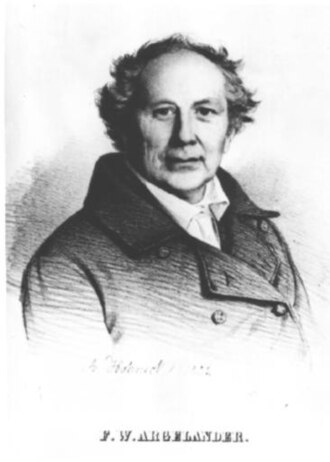
图:Public domain · Wikimedia Commons
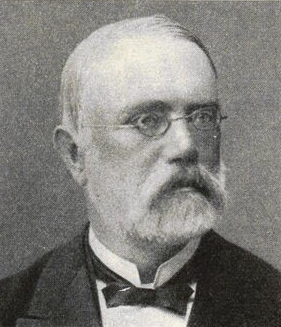
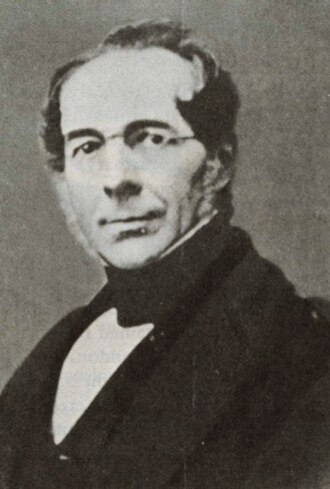
弗里德里希·阿格兰德1799—1875
Friedrich Wilhelm Argelander
German astronomer (1799–1875)
弗里德里希·威廉·奥古斯特·阿格兰德,普鲁士天文学家,编辑出版了波恩星表。
摘自维基百科「弗里德里希·阿格兰德」,CC BY-SA 4.0
- 出生
- 1799 年 3 月 22 日,克莱佩达
- 逝世
- 1875 年 2 月 17 日,波恩
- 国籍
- 普鲁士王国
- 学科
- 天文学、博物与综合
- 职业
- 天文学家、大学教师
- 母语 / 工作语言
- 德语
- 母校
- 柯尼斯堡大学
- 工作单位
- 波恩大学、柯尼斯堡天文台
研究领域
师承
博士生4
来自 Wikidata 的「博士导师」「师从」「博士生」「学生」记录,可能不全。
所获奖项(8)
- 1837杰米多夫奖
- 1846英国皇家学会外籍会员
- 1858honorary member of the Physics Association (Frankfurt am Main, Germany)
- 1863英国皇家天文学会金质奖章
- —Pour le Mérite for Sciences and Arts order
- —美国文理科学院院士
- —Order of Saint Stanislaus, 3rd class
- —Order of St. Vladimir, 4th class
学会与院士
百科正文
生平
阿格兰德1799年出生于东普鲁士的梅梅尔(今立陶宛的克莱佩达),父亲是德国人,母亲是芬兰人。阿格兰德曾师从德国著名天文学家贝塞尔,1822年在柯尼斯堡取得物理学博士学位。
1823年到1837年,阿格兰德在芬兰数个天文台担任领导人,后前往波恩。在那里他与普鲁士国王腓特烈·威廉四世建立了良好的私人友谊,成为波恩天文台的台长,进行了天体测量的工作。在他和同事们的努力下,1852年到1859年间,波恩天文台发表了波恩星表,记载了324,189颗恒星的位置,是照相术发明以前最完整的一份星表。阿格兰德还是早期研究变星的天文学家之一。
1863年他发起了德国天文学会。1875年阿格兰德在波恩去世。为纪念他,第1551号小行星以及月球上的一座环形山都以他的名字命名。
2006年,波恩大学成立了阿格兰德天文研究所。
以上内容摘自维基百科「弗里德里希·阿格兰德」,按 CC BY-SA 4.0 使用,去掉了参考文献、外部链接等尾部小节,公式改写成了纯文本。全文、配图和出处见原文。
英文维基百科补充中文条目比较短,下面是英文条目「Friedrich Wilhelm Argelander」的原文
Friedrich Wilhelm August Argelander (22 March 1799 – 17 February 1875) was a German astronomer. He is known for his determinations of stellar brightnesses, positions, and distances.
Life and work
Argelander was born in Memel in the Kingdom of Prussia (now Klaipėda in Lithuania), the son of a father of Finnish descent, Johann Gottlieb Argelander, and German (Prussian) mother, Dorothea Wilhelmina Grünhagen. He studied with Friedrich Bessel, whose assistant he became in 1820, and obtained his Ph.D. in 1822 at University of Königsberg. From 1823 until 1837, Argelander was the head of the Finnish observatory, first in Turku and then in Helsinki. He then moved to Bonn, Germany. There he designed and built a new observatory at the University of Bonn with funding approved directly by King Frederick William IV whom Argelander had become friends with in his childhood. This lifelong friendship had started when the then crown prince temporarily lived in Argelander's parents house after the Prussian royal family fled to Memel after the Battle of Jena–Auerstedt during the Napoleonic Wars.
Argelander developed practical methods for measuring stellar positions and magnitudes, contributing to the advancement of modern observational astronomy. He also measured stellar distances using heliometers. His work, together with that of his collaborators, included extensive star cataloguing and research on variable stars, made possible through the systematic use of newly developed observational techniques.
Argelander was the first astronomer to begin a careful study of variable stars. Only a handful were known when he began, and he was responsible for introducing the modern system of identifying them. He also made a rough determination of the direction in which the Sun was moving.
In 1842, he discovered that Groombridge 1830 had a very high proper motion. For many decades its proper motion was the highest known; today it still occupies third place. For a time, it was known as Argelander's Star.
Together with Adalbert Krüger and Eduard Schönfeld, Argelander was responsible for the star catalogue known as the Bonner Durchmusterung, published between 1859 and 1862, which gave the positions and brightness of more than 324,000 stars, although it did not cover much of the southern half of the sky. This was the last star map to be published without the use of photography.
In 1863, Argelander helped lead in the founding of an international organization of astronomers named the Astronomische Gesellschaft.
Honors and legacy
Elected a foreign member of the Royal Swedish Academy of Sciences in 1846.
Elected a Foreign Honorary Member of the American Academy of Arts and Sciences in 1855.
Elected Member of the Royal Academy of Science, Letters and Fine Arts of Belgium.
Was awarded the Gold Medal of the Royal Astronomical Society in 1863.
Orden Pour le Mérite für Wissenschaften und Künste (Order Pour le Mérite for Arts and Sciences - Civil class) in 1874.
The three astronomical institutes of the Bonn University were merged and renamed as the Argelander-Institut für Astronomie in 2006.
The crater Argelander on the Moon and the asteroid 1551 Argelander are named for him.
以上内容摘自英文维基百科「Friedrich Wilhelm Argelander」,按 CC BY-SA 4.0 使用,去掉了参考文献、外部链接等尾部小节,公式改写成了纯文本。全文、配图和出处见原文。
同一学科、同时代的科学家




同一学科的科学家
更多 ›