格物
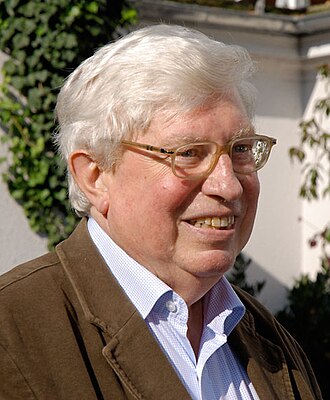
图:Wolfram Däumel · CC BY-SA 2.0 de · Wikimedia Commons
格哈德·埃特尔1936—
Gerhard Ertl
物理学家, 德国
日本国际奖 1992沃尔夫化学奖 1998诺贝尔化学奖 2007
格哈德·埃特尔,德国物理学家与物理化学家,在柏林的马克斯·普朗克学会弗里茨·哈伯研究所从事研究工作,2007年因为对表面化学研究的贡献而获得诺贝尔化学奖。
摘自维基百科「格哈德·埃特尔」,CC BY-SA 4.0
- 出生
- 1936 年 10 月 10 日,斯图加特
- 国籍
- 德国
- 学科
- 物理学、化学、博物与综合
- 职业
- 物理学家、化学家、大学教师
- 母语 / 工作语言
- 德语
- 母校
- 斯图加特大学(1957 年)、巴黎大学(1958 年)、慕尼黑大学(1959 年)、斯图加特大学(Diplom,1961 年)、慕尼黑工业大学(博士,1965 年)、Max Planck Institute for Intelligent Systems、约翰尼斯 - 开普勒体育馆、汉诺威莱布尼兹大学
- 工作单位
- 慕尼黑大学、汉诺威莱布尼兹大学、柏林洪堡大学、柏林自由大学
研究领域
师承
博士生3
来自 Wikidata 的「博士导师」「师从」「博士生」「学生」记录,可能不全。
所获奖项(28)
- 1985Carl Friedrich Gauss Medal
- 1985Centenary Prize
- 1987李比希奖章
- 1990Alwin Mittasch Prize
- 1991戈特弗里德·威廉·莱布尼茨奖
- 1991Bourke Award
- 1992Bunsen Medal
- 1992日本国际奖
- 1992欧洲物理学会欧洲物理奖
- 1995梅达尔·W·韦尔奇奖
- 1996Carl Engler Medal
- 1998沃尔夫化学奖
- 1998Karl Ziegler Prize
- 2007法拉第讲座奖
- 2007诺贝尔化学奖
- 2007奥托·哈恩奖
- 2008巴登-符腾堡州功绩勋章
- 2008Knight Commander's Cross of the Order of Merit of the Federal Republic of Germany
- 2008Rudolf-Diesel-Medaille
- 2008honorary member of the Physics Association (Frankfurt am Main, Germany)
- 2009Honorary doctor of the Humboldt University of Berlin
- 2009honorary doctor of Comenius University
- 2011honorary doctor of the Maria Curie-Skłodowska University
- 2014巴伐利亚马克西米兰科学与艺术勋章
- 2015Hall of Fame of German Research
- —honorary doctor of the Ruhr University Bochum
- —honorary doctor of the University of Münster
- —honorary doctor of the Katholieke Universiteit Leuven
学会与院士
百科正文
早年生活
埃特尔1936年10月10日生于德国斯图加特,1955年至1957年间在斯图加特大学就读,他亦曾在巴黎大学(1957年-1958年)和慕尼黑大学(1958年-1959年)就读。1961年他在斯图加特大学获得硕士学位,1965年在慕尼黑工业大学获得博士学位。
教学工作
完成博士课程后,埃特尔在慕尼黑工业大学担任讲师(1965年-1968年),1968年至1973年间在汉诺威大学出任教授,1973年至1986年转往慕尼克大学物理化学学院任教。1970至1980年代,他亦曾在加州理工学院、威斯康星大学密尔沃基分校和柏克莱加州大学任客座教授。1986年,他成为柏林自由大学和柏林工业大学的名誉教授,同年出任马克斯·普朗克学会弗里茨·哈伯研究所物理化学系主任,直至2004年退休。1996年起,他成为柏林洪堡大学的名誉教授。
研究工作
埃德尔因对分子层面机制的研究而闻名,他发展出一套固体表面化学,尤其是气固表面化学反应过程,的研究方法。他在高真空条件下,用LEED(低能电子散射)研究氢原子在金属表面吸附。他的研究直接启发了人们对于催化反应的了解。他最著名的研究或者可以包括氨合成,和一氧化碳在铂表面的氧化。但是他发展出来的方法学,广泛的影响了表面化学的进展,而实际影响,可以包括农业,半导体,以及异相催化。
他在1998年与柏克莱加州大学的加博尔·A·绍莫尔尧伊因为对表面化学的贡献而共同获得沃尔夫化学奖。2007年,他因为在该领域的研究成果获得诺贝尔化学奖,瑞典皇家科学院评价“他的研究有助了解‘铁为什么会生锈’、‘燃料电池和汽车中的催化剂如何工作’、‘南极上空的臭氧层如何被破坏’”。
以上内容摘自维基百科「格哈德·埃特尔」,按 CC BY-SA 4.0 使用,去掉了参考文献、外部链接等尾部小节,公式改写成了纯文本。全文、配图和出处见原文。
英文维基百科补充中文条目比较短,下面是英文条目「Gerhard Ertl」的原文
Gerhard Ertl (German pronunciation: [ˈɡeːɐ̯haʁt ˈʔɛʁtl̩]; born 10 October 1936) is a German physicist and a Professor emeritus at the Department of Physical Chemistry, Fritz-Haber-Institut der Max-Planck-Gesellschaft in Berlin, Germany. Ertl's research laid the foundation of modern surface chemistry, which has helped explain how fuel cells produce energy without pollution, how catalytic converters clean up car exhausts and even why iron rusts, the Royal Swedish Academy of Sciences said.
His work has paved the way for development of cleaner energy sources and will guide the development of fuel cells, said Astrid Graslund, secretary of the Nobel Committee for Chemistry.
He was awarded the 2007 Nobel Prize in Chemistry for his studies of chemical processes on solid surfaces. The Nobel academy said Ertl provided a detailed description of how chemical reactions take place on surfaces. His findings applied in both academic studies and industrial development, the academy said. “Surface chemistry can even explain the destruction of the ozone layer, as vital steps in the reaction actually take place on the surfaces of small crystals of ice in the stratosphere,” the award citation reads.
In 2015, Ertl signed the Mainau Declaration 2015 on Climate Change on the final day of the 65th Lindau Nobel Laureate Meeting. The declaration was signed by a total of 76 Nobel Laureates and handed to then-President of the French Republic, François Hollande, as part of the COP21 climate summit in Paris.
Biography
Ertl was born in Stuttgart, Germany, where he studied physics from 1955 to 1957 at the Technische Hochschule Stuttgart and then at the University of Paris (1957–1958) and LMU Munich (1958–1959). He completed his Diplom in Physics at the Technische Hochschule Stuttgart in 1961, followed his thesis advisor Heinz Gerischer from the Max Planck Institute for Metals Research in Stuttgart to Munich and received his PhD degree from the Technische Hochschule München in 1965.
Academic career
After completing his PhD, he became an assistant and lecturer at Technische Hochschule München (1965–1968). From 1968 to 1973, he was professor and director at Technische Hochschule Hannover; then, he became a professor at Institute for Physical Chemistry, LMU Munich (1973–1986). During the 1970s and 80s, he was also a visiting professor at the California Institute of Technology (1976–1977), the University of Wisconsin–Milwaukee (1979) and the University of California, Berkeley (1981–82).
He became the director at the Fritz Haber Institute of the MPG from 1986 till his retirement in 2004. In 1986, as honors, he was named "Honorary Professor" at the Free University of Berlin and at the Technische Universität Berlin, and in 1996 at the Humboldt University of Berlin.
From 2008 to 2016, Ertl served as a member of the university council of Technische Universität Darmstadt.
Research
Gerhard Ertl is known for determining the detailed molecular mechanisms of the catalytic synthesis of ammonia over iron (Haber Bosch process) and the catalytic oxidation of carbon monoxide over platinum (catalytic converter). During his research he discovered the important phenomenon of oscillatory reactions on platinum surfaces and, using photoelectron microscopy, was able to image for the first time, the oscillating changes in surface structure and coverage that occur during reaction.
He always used new observation techniques like low-energy electron diffraction (LEED) at the beginning of his career, later ultraviolet photoelectron spectroscopy (UPS) and scanning tunneling microscope (STM) yielding ground breaking results.
He won the Wolf Prize in Chemistry in 1998 along with Gabor A. Somorjai of the University of California, Berkeley for "their outstanding contributions to the field of the surface science in general and for their elucidation of fundamental mechanisms of heterogeneous catalytic reactions at single crystal surface in particular."
Gerhard Ertl was awarded the 2007 Nobel Prize in Chemistry for his studies of chemical processes on solid surfaces. The award, worth SEK 10 million (US$1.7 million, £1.15 million), was announced on Ertl's 71st birthday. "I am speechless", Ertl told Associated Press from his office in Berlin. "I was not counting on this."
As of November 2022, Ertl has an h-index of 124 according to Scopus.
Personal life
Ertl and his wife Barbara have two children and several grandchildren. His hobbies include playing the piano and also playing with his cats when he is not doing experiments. He identifies as Christian.
以上内容摘自英文维基百科「Gerhard Ertl」,按 CC BY-SA 4.0 使用,去掉了参考文献、外部链接等尾部小节,公式改写成了纯文本。全文、配图和出处见原文。
同年获同一奖项
同一学科、同时代的科学家




同一学科的科学家
更多 ›